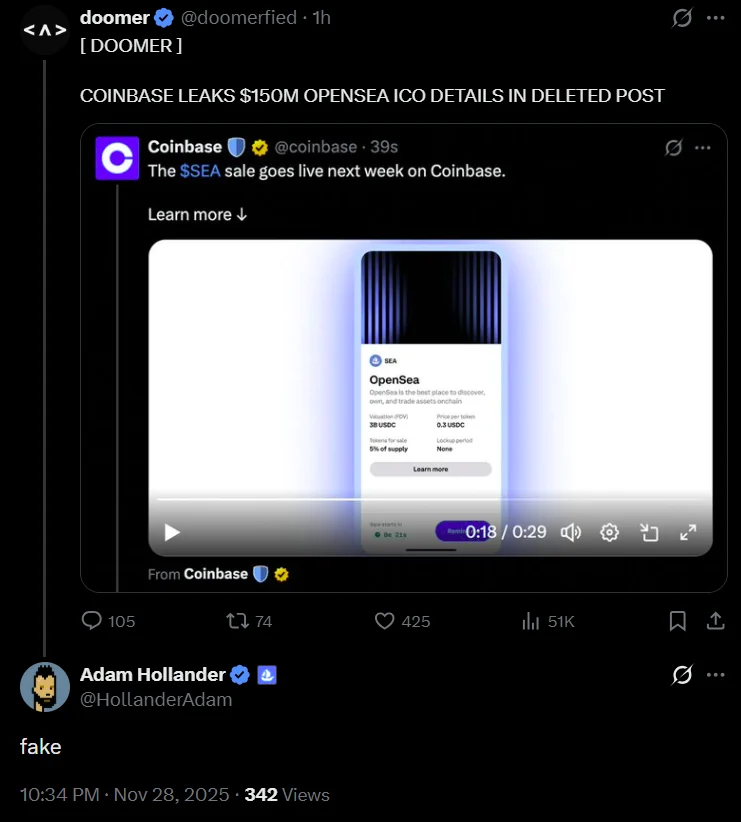
The digital asset ecosystem was recently gripped by a surge of speculative fervor regarding the long-anticipated launch of the OpenSea native token, known as SEA. On November 28, 2025, social media platforms, particularly X (formerly Twitter) and various Telegram channels, were inundated with claims suggesting that the premier NFT marketplace was preparing a $150 million token sale hosted exclusively on the Coinbase exchange. The rumors, which suggested an imminent launch scheduled for the following week, gained significant traction before being formally debunked by company leadership.
Adam Hollander, Chief Marketing Officer at OpenSea, moved quickly to quell the misinformation, explicitly labeling the viral posts as "fake." The rumors originated from a parody account that claimed Coinbase had abruptly deleted a promotional post teasing the multi-million dollar liquidity event. Despite the lack of official confirmation from either OpenSea or Coinbase, the speed at which the narrative spread highlights the heightened sensitivity of the NFT community toward potential tokenomics updates and the persistent hunger for retroactive rewards among historical users.
The Anatomy of the Rumor and Market Reaction
The misinformation campaign utilized a sophisticated blend of platform-mimicry and urgency to bypass the critical thinking of market participants. By attributing the "leak" to a major exchange like Coinbase, the actors behind the hoax tapped into existing investor biases regarding institutional partnerships and token launch strategies.
In the fast-paced world of cryptocurrency, where "leaked" information often precedes legitimate market-moving announcements, the distinction between parody and reality has become increasingly blurred. The incident serves as a case study in how social media sentiment can be manipulated to trigger short-term market volatility. While the specific impact on the broader NFT market remained relatively muted, the incident underscores the susceptibility of the ecosystem to coordinated disinformation campaigns that exploit anticipation surrounding the OpenSea roadmap.
The Official Roadmap: What We Know About SEA
Despite the debunked rumors regarding an immediate sale, OpenSea has confirmed a concrete trajectory for the introduction of its native token. According to official disclosures, the SEA token is slated for an official launch in the first quarter of 2026. This launch is not a spontaneous event but rather the culmination of a strategic platform evolution aimed at decentralizing governance and incentivizing long-term platform participation.
Devin Finzer, the CEO of OpenSea, has been transparent about the token’s intended utility and distribution model. Central to the strategy is a commitment to the platform’s foundational user base. Finzer confirmed that 50% of the total supply of SEA will be allocated directly to the community. This distribution is designed to be inclusive, prioritizing "historical users"—those who transacted on the platform during its formative years—as well as active participants in various rewards programs.
The architectural design of the SEA token reflects a shift toward a sustainable economic model for NFT marketplaces. OpenSea has explicitly stated its intention to implement a robust buyback program. At the time of the token’s launch, the platform plans to commit 50% of its generated revenue to periodically repurchase SEA tokens from the open market. This mechanism is intended to create consistent demand for the asset, potentially curbing the sell-pressure often associated with initial token distributions while simultaneously rewarding stakeholders.
Chronology of OpenSea’s Evolution
The path to the 2026 token launch is marked by several pivotal milestones that have defined OpenSea’s tenure as the dominant NFT marketplace.
- 2017–2020: The Growth Phase: OpenSea established itself as the first decentralized marketplace for non-fungible tokens, pioneering the open-protocol standard for digital assets on the Ethereum blockchain.
- 2021: The NFT Supercycle: The platform experienced unprecedented growth, facilitating billions in trading volume as NFTs entered the mainstream consciousness. This period saw OpenSea solidify its position as a "unicorn" in the tech space.
- 2022–2023: Strategic Consolidation: Faced with increased competition from Blur and other specialized marketplaces, OpenSea began focusing on developer tools, including the Seaport protocol, to improve transaction efficiency and lower gas costs.
- 2024: Preparing for Governance: Internal shifts indicated a pivot toward more decentralized decision-making processes, laying the groundwork for the eventual introduction of a governance token.
- Q1 2026 (Targeted): The SEA Token Launch: The anticipated debut of the SEA token, intended to formalize community rewards, staking mechanisms, and decentralized governance.
Economic Implications and Market Dynamics
The decision to implement a buyback mechanism using platform revenue is a significant development in tokenomics. Historically, many Web3 projects have struggled to align the interests of investors with the actual utility of their platforms. By tethering the token’s value to the platform’s revenue, OpenSea is attempting to bridge the gap between speculative investment and intrinsic value.
For market participants, the significance of the SEA token lies in its dual role: a reward mechanism for loyal users and a governance instrument for the platform’s future. In the current regulatory environment, where the status of digital assets as securities remains a focal point for global regulators, the transparency with which OpenSea is managing this launch is critical. By providing a clear timeline and articulating the utility of the token well in advance, the company aims to mitigate regulatory uncertainty and maintain the trust of its global user base.
The Risk of Disinformation in Web3
The hoax involving the $150 million Coinbase sale highlights a broader trend: the "professionalization" of crypto-related misinformation. Parody accounts, often designed to mimic legitimate news outlets or corporate entities, are now capable of moving markets. The use of social media platforms like X and messaging services like Telegram creates an environment where verification is secondary to speed.
Industry experts suggest that the only defense against such disinformation is a strict reliance on primary sources. In this instance, the quick intervention by Adam Hollander provided a necessary corrective, yet the initial "fake" post managed to proliferate across multiple social layers. This incident serves as a reminder to investors that in the absence of an official filing or a statement hosted on the company’s verified domain, any information concerning large-scale financial offerings should be treated with extreme skepticism.
Future Outlook and Strategic Implications
Looking toward 2026, the success of the SEA token will likely depend on three key factors: the efficacy of the initial distribution, the scalability of the buyback program, and the platform’s ability to maintain its market share in an increasingly competitive landscape.
The integration of the token into the core marketplace experience is perhaps the most critical component. If the token provides tangible benefits—such as reduced trading fees, exclusive access to drops, or meaningful voting power in platform governance—it could reinvigorate the user base and differentiate OpenSea from competitors that have moved toward more aggressive, short-term incentive models.
Furthermore, the focus on "historical users" is a strategic move to re-engage a demographic that may have migrated to other platforms during the recent market consolidation. By acknowledging the contributions of early adopters, OpenSea is essentially attempting to build a "social contract" with its most valuable stakeholders.
Conclusion
The recent rumor regarding the $150 million SEA token sale, while definitively debunked by the company’s leadership, underscored the intense anticipation surrounding OpenSea’s long-term roadmap. The market’s reaction to the hoax is reflective of the high stakes involved in the upcoming Q1 2026 token launch.
As OpenSea moves closer to this transition, the focus will likely shift from speculation to execution. The company’s commitment to a community-centric model, coupled with a revenue-backed tokenomic structure, positions the SEA token as a significant experiment in decentralized marketplace governance. For the broader digital asset industry, the unfolding story of the SEA token will provide valuable insights into how legacy platforms can successfully integrate tokenized incentives without sacrificing the operational integrity that made them industry leaders in the first place.
For now, the message from the leadership team remains clear: stay vigilant, rely on verified communications, and look toward the official 2026 roadmap for the actual details regarding the future of the OpenSea ecosystem. The era of the SEA token is approaching, but as demonstrated by recent events, it will be defined by official channels and verified strategic developments rather than the volatile rumors of the social media landscape.