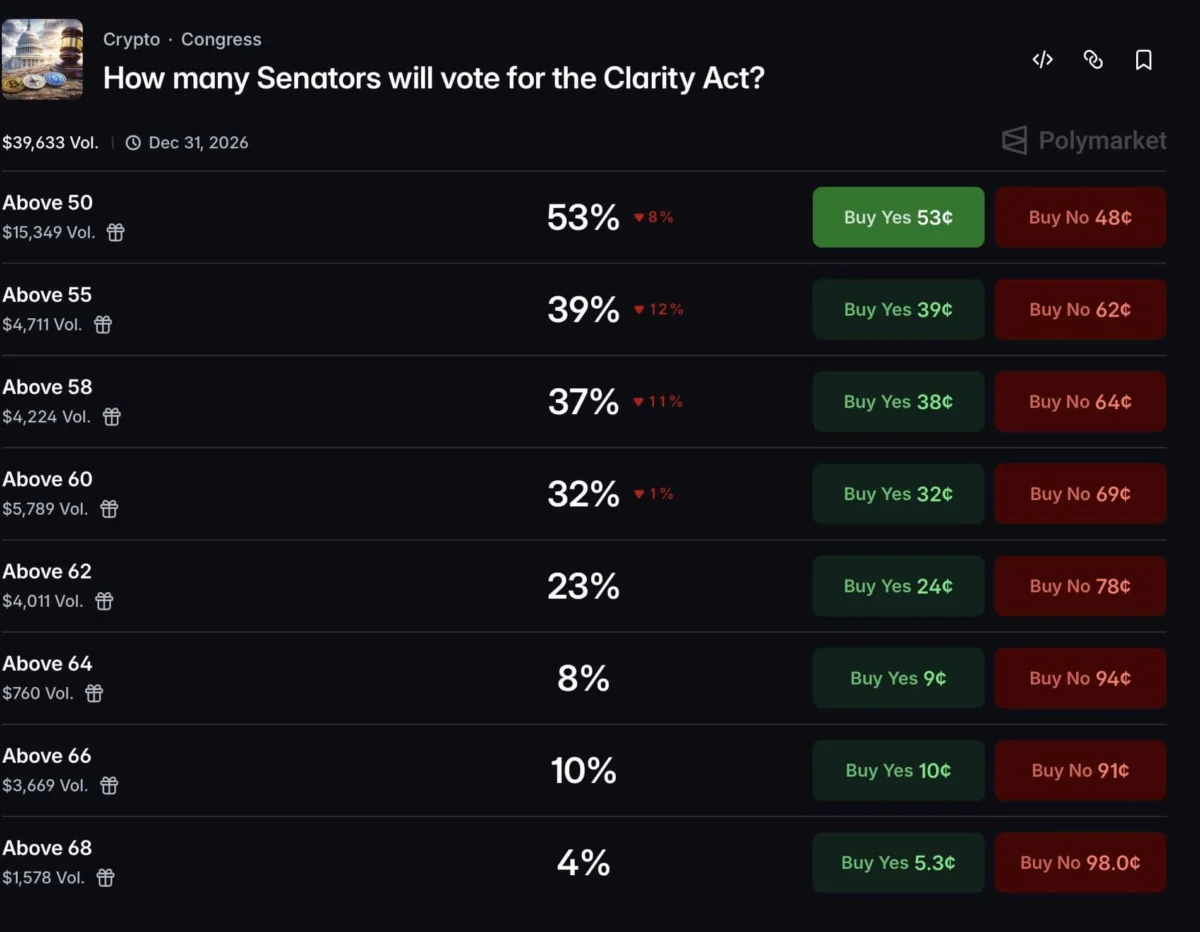
The legislative future of the digital asset industry faced a reality check this week as prediction markets adjusted their outlook for the United States Senate’s upcoming deliberations on the CLARITY Act. According to live data from Polymarket’s predictive contracts, participants have reduced their confidence regarding the size of the legislative coalition that will support the pioneering crypto market-structure bill. Specifically, traders now price a 53% probability that more than 50 senators will cast a "Yes" vote on the first final-passage vote in the Senate. This figure represents an 8-point drop within a single week, underscoring the growing headwinds confronting the legislation as it navigates a deeply divided upper chamber.
The recalibration extends far beyond a simple binary outcome of whether the bill will clear the chamber. While a bare majority remains narrowly favored, expectations for a commanding, filibuster-proof majority have withered considerably. The market tracking whether the bill will secure more than 60 votes currently languishes at a mere 32%. This stark 21-percentage-point gap between simple majority expectations and supermajority support illuminates the core legislative struggle: while lawmakers may broadly agree that regulatory oversight for digital assets requires updating, forging a consensus wide enough to withstand procedural roadblocks remains a formidable challenge.
Understanding the Mechanics of the Polymarket Contract
To accurately interpret these shifting figures, one must examine the precise mechanics governing the Polymarket contract titled “How many Senators will vote for the Clarity Act?” Running through December 31, 2026, the contract establishes strict parameters for resolution. The contract measures exclusively the first official Senate vote on the final passage of qualifying crypto market-structure legislation. Under the platform’s explicit resolution rules, preliminary milestones—such as committee votes, motions to proceed, procedural cloture votes, and individual floor amendments—do not trigger the market’s final settlement.
Furthermore, the contract’s numerical thresholds operate on strict mathematical definitions. In prediction market terminology, crossing a threshold like "Above 50" requires strictly greater participation, meaning at least 51 senators must vote in the affirmative. The ladder of expectations illustrates a rapid drop-off as the required threshold climbs. Contracts predicting support above 55 senators currently sit at 39%, while those anticipating support above 58 senators hover at 37%. Both metrics have suffered double-digit percentage declines, registering some of the steepest drops across the platform’s political interest categories.

This tiered decline reveals that market participants are not writing off the bill entirely. Instead, they are systematically trimming their expectations regarding broad bipartisan buy-in. Securing a simple majority is structurally and politically distinct from mustering the 60 votes required to overcome a legislative filibuster or the 67 votes necessary to override a potential presidential veto. Consequently, the market pricing serves as an acute barometer of political friction rather than a definitive prediction of ultimate enactment into law.
Legislative Background and Chronological Trajectory
The journey of the CLARITY Act through the halls of Congress has been marked by protracted negotiations, intense lobbying, and significant milestone achievements over the past two years. The legislative vehicle underlying these market dynamics, designated as H.R. 3633, first demonstrated robust momentum in the House of Representatives. On July 17, 2025, the lower chamber greenlit the bill by a decisive 294-134 bipartisan vote, signaling that representatives from both major political parties recognized the urgent necessity of establishing a comprehensive regulatory framework for cryptocurrencies and digital commodities.
Following its transmission to the Senate, the legislative process slowed as committees engaged in rigorous scrutiny. On June 1, 2026, the Senate Banking Committee officially reported an amended substitute version of the bill, advancing it closer to a potential full chamber floor debate. However, the path forward has since encountered institutional resistance. Recent legislative updates indicate that Democratic lawmakers have expressed reservations regarding specific provisions in the committee’s final version, prompting them to formulate formal counteroffers rather than accepting the House-passed text outright.
Simultaneously, external regulatory stakeholders have entered the fray. Notably, the Office of the New York Attorney General publicly urged members of Congress to block the current iteration of the Crypto Clarity Act, arguing that the legislation could inadvertently weaken investor protections and strip state-level regulators of essential enforcement tools. These developments have weighed heavily on secondary market sentiment, with separate forecasting metrics indicating that the overall probability of the bill successfully clearing all legislative hurdles to become law before the conclusion of the calendar year has dipped to approximately 20%.
Executive Branch Intervention and Official Responses
Recognizing the stalled momentum in the upper chamber, the executive branch has ramped up pressure on Capitol Hill. Recent reports indicate that the Trump administration has launched a concerted lobbying push, deploying high-level officials to convince undecided senators of the strategic and economic necessity of advancing the Crypto Clarity Act. The administration’s intervention highlights the high stakes attached to the legislation, which aims to definitively delineate regulatory jurisdiction between the Securities and Exchange Commission (SEC) and the Commodity Futures Trading Commission (CFTC).
Despite these administrative efforts, partisan divisions persist. Senate leadership faces the unenviable task of bridging ideological chasms concerning how digital assets should be classified—specifically, distinguishing between assets that function as decentralized commodities and those that operate as unregistered securities. While industry advocacy groups contend that legislative clarity is paramount for maintaining U.S. competitiveness in the global fintech arena, consumer protection advocates and certain state-level officials continue to counsel caution, warning against hasty deregulation.
Broader Implications for Market Structure and Regulatory Jurisdictions
The implications of the Senate’s deliberations extend far beyond the immediate outcomes of prediction market contracts or legislative vote counts. At its core, the CLARITY Act represents the most significant structural overhaul of American financial market oversight in decades. By attempting to resolve the jurisdictional turf war between the SEC and the CFTC, the legislation will determine how digital asset exchanges, token issuers, and decentralized finance (DeFi) protocols operate within the United States.
If the Senate manages to assemble a sufficient bipartisan coalition to pass the bill—even if it falls short of an overwhelming supermajority—it would fundamentally alter the regulatory enforcement landscape. Conversely, a failure to advance the legislation before the expiration of the current congressional session would leave the crypto industry subject to regulation-by-enforcement, perpetuating legal ambiguity and potentially driving capital and talent toward more hospitable international jurisdictions.
As the Polymarket data demonstrates, sophisticated observers are pricing in the immense difficulty of achieving legislative consensus in an increasingly polarized political environment. While the probability of securing a foundational majority on the floor remains above even odds, the steep decline in supermajority expectations serves as a clear warning. For digital asset participants, institutional investors, and legal scholars alike, the months leading up to the end of 2026 will prove decisive in determining whether the promise of regulatory clarity can successfully transition from political rhetoric into statutory law.