Decentralized finance (DeFi) giant Aave is encountering a classic economic paradox within its newly launched Arc network market. While liquidity providers have flooded the protocol’s newest iteration with staggering amounts of capital, actual utilization remains near zero, highlighting the delicate chicken-and-egg dynamic that governs liquidity mining and protocol expansion in the Web3 ecosystem.
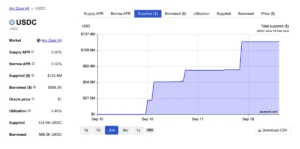
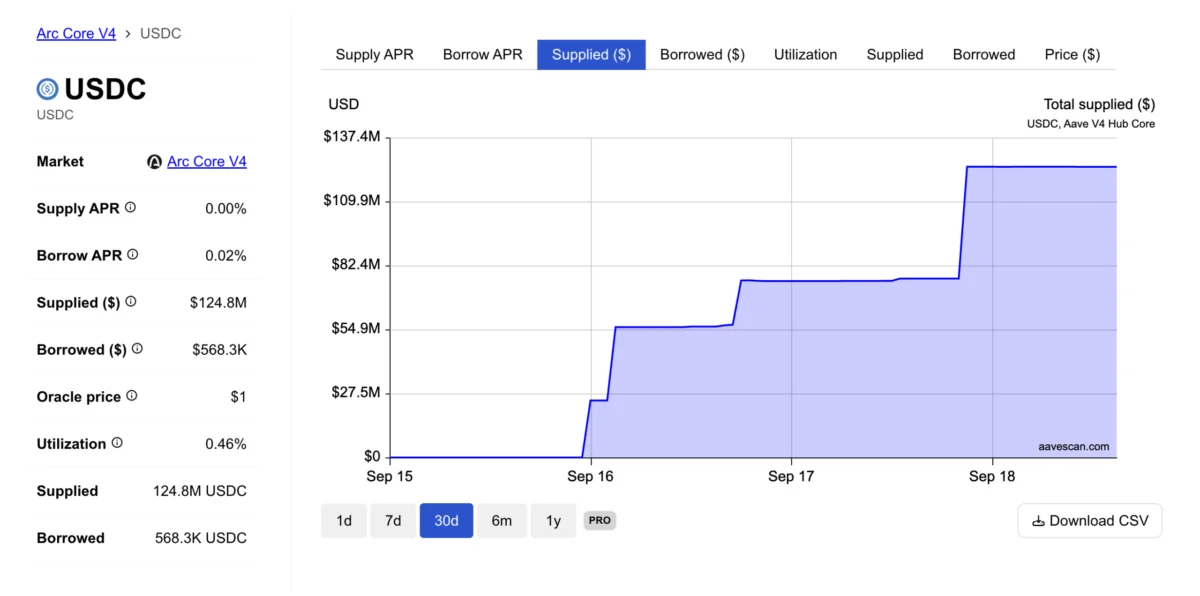
According to on-chain data retrieved from Aavescan, the newly established Aave V4 Arc market has successfully attracted approximately $124.8 million in USD Coin (USDC) as of mid-September. However, this massive influx of stablecoin liquidity has been met with an anemic response from the borrowing side. Total active borrows on the platform have hovered below the $600,000 threshold, leaving more than 99.5% of the deposited capital sitting completely idle.
This extreme imbalance underscores a fundamental truth about modern decentralized credit markets: capital accumulation alone does not equate to a functioning lending economy. While the headline figure of $125 million signals strong initial brand confidence and institutional or whale-level interest in Aave’s latest infrastructure, the lack of active borrowing threatens to undermine the core utility and economic model of the lending pool.
A Chronological View of the Liquidity Surge
The rapid accumulation of capital within the Aave V4 Arc market has materialized at an astonishing velocity over a remarkably short window, signaling aggressive positioning by early liquidity providers.
Tracking data from mid-September illustrates the exponential trajectory of the deposits. On September 16, excess reserves within the Arc market stood at a modest $24.5 million. Just twenty-four hours later, on September 17, reported deposits more than tripled to approximately $75.8 million. By September 18, the figure exploded past the $124 million mark, representing roughly a 65% jump in a single day and more than a fivefold expansion since the market first began drawing significant excess liquidity.
Conversely, borrower demand has crawled upward at a microscopic pace. Midnight readings on September 18 captured borrowing activity scraping a mere $73,400. Although subsequent hours saw a modest uptick, pushing total borrows to roughly $568,300, the growth rate of borrowing pales in comparison to the tidal wave of incoming deposits.
Consequently, borrowers are utilizing a meager 0.46% of the available USDC liquidity pool. In practical terms, roughly $124.2 million sits dormant, yielding no functional credit utility for borrowers while failing to generate sustainable returns for the depositors who parked their capital there.
The Mechanics of Idle Capital: Understanding the Yield Dilemma
To understand why this massive liquidity imbalance matters, one must examine the foundational economic engine of Aave and similar decentralized lending protocols. Aave functions as a decentralized intermediary, bridging the gap between capital suppliers—users seeking a yield on their idle crypto assets—and capital seekers, who lock up collateral to borrow liquidity for trading, leverage, or operational needs.

In a healthy, balanced market, borrowers pay interest to the protocol, a portion of which is distributed to depositors as a yield reward. However, when borrowing demand collapses or fails to materialize alongside supply, the economic feedback loop breaks down.
In the case of the Aave V4 Arc market, the overabundance of supply paired with virtually non-existent demand has driven yields down to nominal levels. Current metrics indicate that the supply return sits at a flat 0.00%, while the borrowing rate hovers near 0.02%. For liquidity providers, parking capital in this specific market currently yields zero financial return, raising questions about the motivations behind the sudden capital influx. Analysts suggest that early depositors may be positioning themselves preemptively, anticipating future incentive programs, governance rewards, or the anticipated rollout of broader institutional connectivity tied to the Arc network initiative.
The Chicken-and-Egg Dilemma of DeFi Liquidity
The predicament facing Aave is a textbook example of the liquidity bootstrap problem that has plagued decentralized finance protocols since their inception.
New lending markets cannot attract borrowers without deep, reliable liquidity pools; after all, a borrower cannot take out a multi-million-dollar loan if the underlying liquidity does not exist. Conversely, liquidity providers are reluctant to supply capital unless there is immediate demand generating healthy yields.
To break this stalemate, protocols frequently rely on a "build it and they will come" strategy, accepting that early-stage markets will experience prolonged periods of capital inefficiency. Industry observers generally view the initial $125 million deposit surge not as a sign of systemic failure, but rather as a necessary foundational phase. By establishing a deep liquidity buffer first, Aave provides the structural confidence required for risk-averse borrowers—particularly institutional entities or algorithmic funds operating within permissioned or specialized frameworks like Arc—to deploy strategies without running into slippage or liquidity constraints.
Broader Implications for Aave V4 and the DeFi Landscape
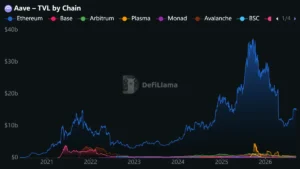
Aave continues to maintain a dominant foothold in the decentralized finance sector, commanding nearly half of the total market share for DeFi loans across its various iterations and deployments. However, as the protocol transitions toward V4 and explores specialized architectures like the Arc network, the metrics for success are shifting.
Historically, the success of a new pool was measured purely by Total Value Locked (TVL). In the current macroeconomic and on-chain climate, however, TVL is increasingly recognized as a vanity metric if it fails to translate into active loan volume and protocol revenue.
The primary test for Aave over the coming weeks will not be whether it can attract more depositors—the recent surge proves the protocol’s magnetic pull remains intact—but whether organic demand from borrowers can catch up to the mountain of idle capital. If borrowing rates and utilization metrics remain stagnant, liquidity providers may eventually rotate their capital toward higher-yielding opportunities elsewhere in the DeFi ecosystem, leading to sudden liquidity contractions.
Market observers and protocol contributors alike are keeping a close watch on borrowing velocity as the definitive KPI (Key Performance Indicator) for the Arc network’s real-world adoption. Until loan issuance scales proportionately with supply, Aave’s impressive headline figures will remain a monument to untapped potential rather than an active, thriving lending economy.