Foundry, the industry leader in North American digital asset mining and the operator of the world’s largest Bitcoin mining pool, has officially declared its intention to enter the Zcash (ZEC) ecosystem. The company plans to launch a specialized mining pool tailored specifically for institutional participants and publicly traded companies in April 2026. This move marks a significant diversification for Foundry, which currently dominates the Bitcoin mining landscape through its Foundry USA pool. By targeting Zcash, a veteran privacy-focused cryptocurrency, Foundry aims to bridge a long-standing infrastructure gap that has historically prevented large-scale financial entities from participating in the privacy-preserving Proof-of-Work (PoW) sector.
The announcement comes at a pivotal moment for the Zcash network, which has recently experienced a notable surge in computational security and network participation. As institutional interest in digital assets shifts from purely speculative trading toward infrastructure and yield-generating activities like mining, the demand for compliant, transparent, and robust mining pools has reached a critical threshold. Foundry’s entry is expected to provide the necessary framework for enterprise-grade operations to secure the Zcash network while adhering to the rigorous auditing and operational standards required by institutional investors.
The Evolution of Foundry and the Bitcoin Mining Precedent
To understand the significance of Foundry’s expansion, one must look at its trajectory within the Bitcoin mining industry. As a subsidiary of Digital Currency Group (DCG), Foundry was established to provide North American miners with the tools and capital necessary to compete with global operations, particularly those formerly concentrated in East Asia. Since its inception, Foundry USA has grown to become the dominant force in Bitcoin mining, often accounting for 25% to 30% of the total global hashrate.
The success of Foundry USA was built on a foundation of "institutional-grade" service. Unlike many early mining pools that operated with opaque fee structures or lacked robust legal frameworks, Foundry offered a transparent, US-based alternative. This allowed public companies like Marathon Digital Holdings, Riot Platforms, and CleanSpark to participate in the network with the confidence that their mining activities were compliant with US regulations. Foundry now intends to replicate this successful blueprint for Zcash, a protocol that shares many architectural similarities with Bitcoin but introduces complex privacy features that require specialized handling.
Understanding Zcash: Privacy, Compliance, and Technical Foundations
Zcash was launched in 2016 by the Electric Coin Company (ECC), led by cryptographer Zooko Wilcox. It was the first widespread application of zk-SNARKs (Zero-Knowledge Succinct Non-Interactive Arguments of Knowledge), a form of zero-knowledge cryptography that allows parties to verify transactions without revealing the sender, receiver, or transaction amount. While Bitcoin and Ethereum utilize a public ledger where every transaction is visible to anyone with an internet connection, Zcash offers "shielded" addresses that provide true financial privacy.

The protocol was built on Bitcoin’s original codebase, which means it inherits several key economic properties:
- Fixed Supply: A hard cap of 21 million tokens.
- Halving Cycles: Block rewards are reduced by 50% approximately every four years to manage inflation.
- Proof-of-Work: The network is secured by miners who solve complex mathematical problems using specialized hardware.
Despite its privacy-centric nature, Zcash has worked to maintain a "compliance-friendly" posture. The protocol includes features that allow users to share transaction details with third parties (such as auditors or tax authorities) via "view keys." This distinction is vital for Foundry’s mission, as it allows the mining pool to demonstrate how financial privacy and regulatory compliance can coexist within a single digital infrastructure.
Bridging the Institutional Gap in ZEC Mining
According to Mike Colyer, CEO of Foundry, the motivation for the new pool stems from the disconnect between Zcash’s maturity as an asset and the state of its supporting infrastructure. "Zcash has matured into an institutional-grade asset, but the mining infrastructure supporting it hasn’t kept pace," Colyer stated in the press release.
Currently, much of the Zcash hashrate is distributed across pools that may not meet the stringent KYC (Know Your Customer) and AML (Anti-Money Laundering) requirements of Western financial institutions. For a publicly traded company to mine ZEC, it must be able to prove the origin of its rewards and ensure that its mining partners are operating within legal boundaries. By launching a US-based, institutional-grade pool, Foundry provides a "safe harbor" for these entities.
The timing of the launch in April 2026 suggests a long-term commitment to the protocol. It allows Foundry to build out the necessary software stack to handle Zcash’s specific Equihash mining algorithm and integrate it with their existing suite of enterprise tools, including site management, equipment financing, and advisory services.
Analyzing the Recent Zcash Hashrate Boom
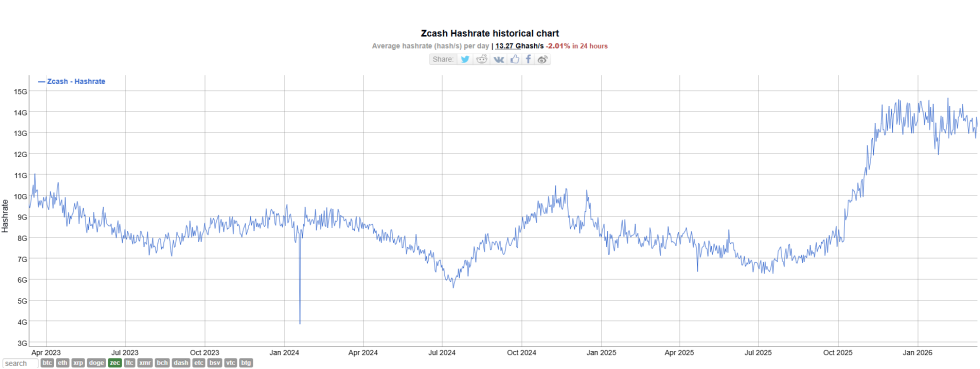
Foundry’s decision is backed by compelling data regarding the health of the Zcash network. Over the past several months, the Zcash hashrate—a measure of the total computational power dedicated to mining the coin—has seen an unprecedented increase. In October 2024, the hashrate was recorded at approximately 8 Gigahashes per second (Ghash/s). By early 2025, that figure had climbed to over 13 Ghash/s, representing a nearly 60% increase in network security in a relatively short window.

This surge in hashrate is often a leading indicator of institutional interest or the deployment of more efficient ASIC (Application-Specific Integrated Circuit) mining hardware. For a mining pool operator like Foundry, a rising hashrate signals a growing market of miners who need professional pool services. It also suggests that despite price volatility, the underlying security and perceived value of the Zcash network remain strong among those who provide the physical infrastructure for the blockchain.
Official Responses and Industry Sentiment
The announcement has been met with enthusiasm from the Zcash community and its supporting organizations. Zooko Wilcox, the founder of Zcash and currently the Chief Product Officer at Shielded Labs, expressed his support for the move. Shielded Labs is a Switzerland-based independent organization dedicated to supporting the Zcash ecosystem.
"We at Shielded Labs are delighted that Foundry—the largest Bitcoin mining pool, and one based in North America—is launching an enterprise-grade Zcash mining pool," Wilcox said. His endorsement highlights the importance of geographic diversity in mining. With a large portion of Zcash mining hardware historically concentrated in various global regions, a major North American player adds a layer of decentralization and stability to the network’s power structure.
Industry analysts suggest that Foundry’s entry could act as a catalyst for other institutional service providers—such as custodians and prime brokers—to enhance their Zcash offerings. When a market leader like Foundry commits to a specific asset, it often reduces the perceived "career risk" for other institutional players to follow suit.
Broader Implications for the Privacy Coin Landscape
The move by Foundry comes at a time when privacy coins face a complex regulatory environment. Some jurisdictions have moved to delist privacy-centric assets from retail exchanges due to concerns over illicit use. However, Foundry’s initiative suggests a different perspective: that privacy is an essential component of institutional finance.
In traditional banking, transaction details are not public; they are private between the bank, the client, and the regulator. Zcash’s technology aims to replicate this "private-but-compliant" model on the blockchain. Foundry’s institutional pool could serve as a testing ground for how large-scale miners can participate in privacy-preserving networks while maintaining the transparency required by their shareholders and regulators.
Furthermore, this expansion signals that the Proof-of-Work model remains relevant for assets beyond Bitcoin. While many networks have transitioned to Proof-of-Stake (PoS), Zcash continues to utilize PoW to distribute its tokens and secure its ledger. Foundry’s expertise in managing massive PoW operations is a natural fit for this ecosystem.
Market Context and Future Outlook
As of the current reporting period, Zcash (ZEC) is trading at approximately $209. While the asset has experienced a 11% retracement over the past week, its long-term trajectory remains a point of focus for investors watching the intersection of privacy and blockchain technology. The ZEC price has historically been sensitive to developments in network upgrades and major infrastructure announcements.
Looking toward 2026, the Zcash roadmap includes potential upgrades to its consensus mechanism and further refinements to its "shielding" technology to make it more accessible on mobile devices. Foundry’s April 2026 launch date aligns with a period where these technical milestones are expected to have reached maturity, potentially coinciding with a new cycle of institutional digital asset adoption.
The introduction of an institutional-grade mining pool by a firm with Foundry’s pedigree is more than just a business expansion; it is a vote of confidence in the longevity and necessity of privacy in the digital age. By providing a bridge for public companies to secure the Zcash network, Foundry is not only diversifying its own revenue streams but is also fortifying the infrastructure of one of the most technologically significant protocols in the cryptocurrency space. As the countdown to April 2026 begins, the mining community will be watching closely to see how this North American giant reshapes the landscape of Zcash and the broader privacy coin market.