The long-anticipated transition of the Ethereum network from a Proof-of-Work (PoW) consensus mechanism to Proof-of-Stake (PoS), commonly referred to as "the Merge," has fundamentally reshaped the landscape of cryptocurrency mining. While the upgrade was hailed as a monumental achievement for environmental sustainability—reducing the network’s energy consumption by more than 99.9%—it has simultaneously triggered a financial crisis for the global community of GPU (Graphics Processing Unit) miners. Within days of the transition, mining profitability for nearly all alternative PoW cryptocurrencies plummeted into negative territory, leaving millions of dollars’ worth of hardware idling or operating at a loss.
The Mechanics of the Mining Displacement
Before the Merge, Ethereum was the most profitable and widely mined cryptocurrency for those utilizing consumer-grade graphics cards. Unlike Bitcoin, which transitioned to specialized ASIC (Application-Specific Integrated Circuit) hardware years ago, Ethereum’s Ethash algorithm remained accessible to high-end GPUs. This created a multi-billion dollar industry comprising hobbyists and industrial-scale mining farms.
When the Merge officially took place, the Ethereum network ceased to issue rewards to miners, switching instead to validators who "stake" their ETH to secure the blockchain. This left a massive vacuum. The "hashrate"—a measure of the total computational power dedicated to a network—that once secured Ethereum had to go somewhere. This hashrate, estimated to be around 850 to 900 Terahashes per second (TH/s) prior to the switch, began flooding into smaller PoW chains such as Ethereum Classic (ETC), Ravencoin (RVN), Ergo (ERG), and Flux.
However, the economic infrastructure of these alternative coins was never designed to absorb such a massive influx of computational power. In the world of PoW mining, networks utilize a "difficulty adjustment" algorithm. This mechanism ensures that blocks are produced at a consistent interval regardless of how many miners are active. When the hashrate on a network like Ethereum Classic suddenly spiked by nearly 500% in the wake of the Merge, the difficulty followed suit, making it significantly harder for individual miners to earn rewards.
A Statistical Overview of Negative Profitability
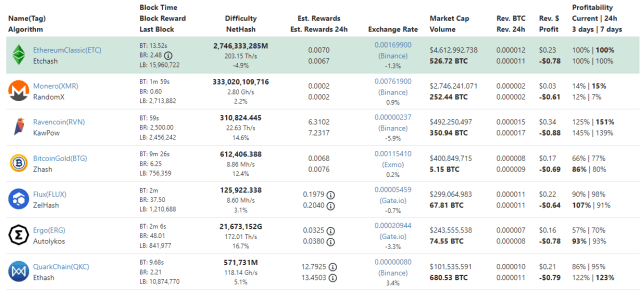
Data from industry-standard mining calculators, such as WhatToMine, paints a grim picture for the post-Merge mining economy. As of the latest market assessments, Ethereum Classic, which emerged as the primary destination for displaced miners, is yielding a net profit of approximately -$0.78 per hour for a standard setup utilizing three AMD RX 480 graphics cards. This calculation is based on a global average electricity cost of $0.10 per kilowatt-hour (kWh).

Even for those equipped with the most powerful consumer hardware available, the situation remains unsustainable. A single Nvidia GeForce RTX 3090 Ti, the flagship of the previous generation of GPUs, currently nets an hourly profit of approximately -$0.50 when mining ETC. These figures indicate that for the vast majority of participants, the cost of the electricity required to run the machines now exceeds the market value of the coins being produced.
The following table illustrates the current state of hourly profitability for popular PoW alternatives (estimated at $0.10/kWh):
- Ethereum Classic (ETC): -$0.78
- Ravencoin (RVN): -$1.02
- Ergo (ERG): -$0.65
- Beam (BEAM): -$1.15
- Bitcoin Gold (BTG): -$0.55
These numbers represent a "capitulation phase" for the mining industry. While some miners are continuing to operate at a loss—a strategy known as "speculative mining" in hopes that the coin prices will surge in the future—many have been forced to disconnect their rigs permanently.
Chronology of the Transition
The road to this profitability crisis was paved over several years of development and delays. The timeline of the Merge and its immediate aftermath provides context for the current market saturation:
- December 2020: The Beacon Chain is launched, introducing the PoS layer to Ethereum and marking the beginning of the multi-year transition.
- Early 2022: As the Merge date becomes more certain, hashrate on the Ethereum network reaches an all-time high, as miners attempt to extract as much value as possible before the "Difficulty Bomb" or the software switch occurs.
- September 15, 2022: The Merge is successfully executed. The Total Terminal Difficulty (TTD) is reached, and the network officially stops supporting PoW.
- September 15–17, 2022: A massive migration occurs. The hashrate of Ethereum Classic jumps from roughly 60 TH/s to over 300 TH/s within 48 hours. Ravencoin and Ergo see similar proportional spikes.
- September 20, 2022: Difficulty adjustments across all major GPU-minable chains catch up to the new hashrate levels. Mining profitability across the board drops below the break-even point for the average user.
Market Reactions and Industry Sentiment
The immediate reaction from the hardware market has been a sharp decline in the secondary price of graphics cards. During the height of the mining boom in 2021, GPUs often sold for two to three times their Manufacturer’s Suggested Retail Price (MSRP). Following the Merge, the market has been flooded with "ex-mining" cards, leading to a price crash that has benefited gamers but decimated the resale value for mining enterprises.
Industry leaders have expressed a mix of resignation and cautious optimism for the long term. Chandler Guo, a prominent figure in the Chinese mining community, attempted to lead a "hard fork" of the Ethereum chain called EthereumPoW (ETHW) to maintain a version of the network that still required miners. However, ETHW has struggled with low adoption, technical glitches, and a lack of support from major decentralized finance (DeFi) protocols and stablecoin issuers like Tether and Circle.

Meanwhile, representatives from Ethereum Classic have welcomed the hashrate, noting that the increased computational power makes the network significantly more secure against 51% attacks. However, they acknowledge that security does not automatically translate to immediate profitability for the participants providing that security.
Broader Implications and the Future of GPU Mining
The current crisis raises a fundamental question: Is GPU mining dead? For the foreseeable future, the answer appears to be "yes" for those seeking a steady, profitable income stream. The fundamental problem is a lack of "utility demand" for the alternative PoW chains.
Ethereum’s value was driven by its massive ecosystem of applications, NFTs, and financial tools. Coins like Ravencoin or Ethereum Classic currently lack the same level of network activity. Without a significant increase in the market price of these tokens—or a massive exit of miners to lower the difficulty—the "mining math" simply does not add up.
There are several potential paths forward for the industry:
1. The "Shakeout" Phase: As unprofitable miners turn off their machines, the network difficulty on chains like ETC will eventually decrease. This will eventually lead to a new equilibrium where the most efficient miners (those with the cheapest electricity and most efficient hardware) can become profitable again.
2. High-Performance Computing (HPC) Pivot: Some industrial mining farms are exploring the possibility of repurposing their GPU clusters for other tasks, such as artificial intelligence (AI) training, 3D rendering, or cloud computing. Unlike mining, these tasks require significant bandwidth and different software configurations, making the transition difficult for smaller hobbyists.
3. The Rise of a New PoW King: Historically, the crypto market has seen "cycles" where a new coin emerges to become the dominant mining target. However, given the current global shift toward Environmental, Social, and Governance (ESG) standards, the launch of a new, large-scale PoW network seems increasingly unlikely.
Impact on Ethereum’s Market Performance
Amidst the mining turmoil, the price of Ether (ETH) itself has experienced significant volatility. At the time of writing, ETH is trading around $1,400, representing a 6% decline over the past week. This "sell the news" reaction is common in cryptocurrency markets following major upgrades. Despite the price dip, proponents argue that the fundamental value proposition of Ethereum has improved due to the massive reduction in token issuance (the "Triple Halving" effect) and the elimination of the environmental concerns that previously deterred institutional investors.
The Merge has successfully transformed Ethereum into a "yield-bearing asset" through staking, but it has done so by dismantling the very industry that helped build it. As the dust settles, the thousands of miners who once powered the world’s second-largest blockchain find themselves at a crossroads, holding hardware that costs more to run than it produces in value. The era of easy GPU mining profits has, for now, come to an end.