Foundry, a premier digital asset infrastructure provider and the operator of the world’s largest Bitcoin mining pool by aggregate hashrate, has officially announced its strategic expansion into the privacy-centric cryptocurrency sector. The company plans to launch a dedicated, institutional-grade Zcash (ZEC) mining pool slated for deployment in April 2026. This development marks a pivotal milestone for the Zcash ecosystem, addressing a long-standing deficit in institutional-grade operational infrastructure for privacy coins and welcoming larger corporate entities into a market traditionally dominated by independent, decentralized operators.
Main Facts of the Expansion
The newly announced mining pool will be managed and operated out of the United States, mirroring the operational framework of Foundry’s flagship Foundry USA Pool. By designing a system tailored specifically to the rigorous compliance, security, and reporting requirements of public companies and institutional investors, Foundry aims to bridge the gap between traditional corporate finance and decentralized privacy technologies.
A mining pool operates by allowing geographically dispersed miners to aggregate their computational power—known as hashrate—over a shared network. By pooling resources, participants can dramatically stabilize their revenue streams, smoothing out the variance inherent in solo mining and competing more effectively for block rewards distributed by the blockchain. Foundry’s entry into this space introduces enterprise-level reliability to Zcash, a digital asset that has steadily matured over its decade-long history but has historically lacked the robust, institutional-grade mining support seen in larger networks like Bitcoin and Ethereum.
Background and Technical Context of Zcash
Launched in October 2016, Zcash was developed as a decentralized, permissionless cryptocurrency with a primary focus on user privacy and financial confidentiality. Mechanically, Zcash shares deep roots with Bitcoin. The network was originally constructed using a modified version of Bitcoin’s foundational codebase, resulting in identical tokenomics: a hard supply cap fixed at 21 million ZEC, and a predictable issuance schedule where block rewards are systematically halved approximately every four years.
However, the fundamental divergence between Bitcoin and Zcash lies in transaction privacy. While cryptocurrencies like Bitcoin and Ethereum are technically pseudonymous—meaning transactions are recorded on a transparent, publicly viewable ledger tied to public addresses rather than legal identities—Zcash offers advanced zero-knowledge cryptography (specifically zk-SNARKs). This technology allows users to execute fully shielded transactions that conceal the sender, recipient, and transaction amount while still mathematically proving the validity of the transfer on a public blockchain.

Advocates argue that this dual capability—combining robust financial privacy with transparent, verifiable blockchain mechanics—proves that regulatory compliance and absolute digital privacy can successfully coexist within modern financial architecture.
Chronology of Events Leading to the 2026 Launch
The announcement of Foundry’s institutional Zcash pool does not occur in a vacuum; it is the culmination of several concurrent trends across the digital asset landscape, characterized by surging network activity and renewed institutional interest in alternative Layer-1 assets.
Over the past several years, Zcash has undergone significant infrastructural and developmental shifts. While the broader cryptocurrency market experienced shifting regulatory sentiments regarding privacy coins—with some jurisdictions implementing strict delisting policies across centralized exchanges—Zcash maintained a resilient, globally distributed developer and miner base.
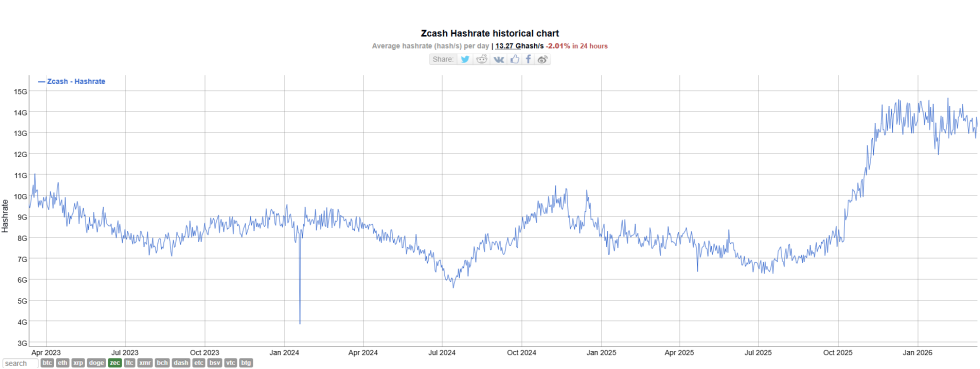
The momentum accelerated dramatically in late 2024 and throughout 2025, culminating in a striking surge in network hashrate. According to comprehensive historical data from BitInfoCharts, the total computational power securing the Zcash blockchain hovered below 8 gigahashes per second (Ghash/s) as recently as October. Over the ensuing months, that figure experienced a rapid upward trajectory, climbing past 13 Ghash/s as new mining hardware came online and interest in the network’s security model intensified.
Recognizing this organic expansion in network security, Foundry formalized its expansion plans in early 2026, setting a concrete deployment target for April 2026. This timeline provides prospective institutional participants several weeks to integrate their hardware setups, review compliance frameworks, and prepare for seamless onboarding onto the upcoming US-based pool infrastructure.
Official Responses and Industry Reactions
The announcement has garnered enthusiastic endorsement from key stakeholders within the Zcash and broader privacy-coin ecosystems. Industry leaders have highlighted the strategic importance of having North America’s largest and most established mining operator throw its weight behind a privacy-focused asset.

Zooko Wilcox, founder of Zcash and chief product officer at Shielded Labs—an independent, Switzerland-based support and research organization dedicated to the Zcash ecosystem—welcomed the news with strong affirmation.
"We at Shielded Labs are delighted that Foundry—the largest Bitcoin mining pool, and one based in North America—is launching an enterprise-grade Zcash mining pool," Wilcox stated in the official press release. His sentiments were echoed by corporate leadership at Foundry, who emphasized that the maturation of the asset class necessitated a parallel evolution in support systems.
Mike Colyer, Chief Executive Officer of Foundry, articulated the core motivation behind the initiative, noting that the existing operational infrastructure had simply failed to keep pace with the asset’s broader financial maturation. "Zcash has matured into an institutional-grade asset, but the mining infrastructure supporting it hasn’t kept pace," Colyer remarked, underscoring Foundry’s commitment to building compliant, scalable bridges for traditional market participants.
Market Dynamics and Current Price Action
While the infrastructural outlook for Zcash appears robust, the token’s immediate market valuation reflects the broader volatility characteristic of digital asset commodities. At the time of reporting, Zcash (ZEC) is changing hands at approximately $209 per token, reflecting a retracement of more than 11% over the preceding seven-day trading window.
Market analysts point out that while short-term price fluctuations are driven by macroeconomic conditions and general market liquidity cycles, fundamental network developments—such as the integration of enterprise-grade mining pools—tend to exert a stabilizing influence over long-term network security and investor sentiment. The introduction of institutional capital and sophisticated mining operations often correlates with improved hash rate distribution, reduced susceptibility to centralization attacks, and enhanced baseline network health.
Broader Impact and Industry Implications
Foundry’s upcoming Zcash mining pool carries several profound implications for the digital asset industry, particularly regarding the intersection of institutional finance and privacy technology.
First, the move signals a growing institutional appetite for alternative cryptocurrencies that offer specialized utility, such as zero-knowledge privacy. For years, institutional capital in the mining sector was strictly siloed within Bitcoin and, to a lesser extent, Ethereum. By providing a trusted, US-based conduit for Zcash mining, Foundry lowers the operational and regulatory friction that typically deters publicly traded companies and risk-averse institutional funds from entering privacy-adjacent markets.
Second, the geographic concentration and regulatory compliance focus of the pool address a vital concern for corporate miners. Operating out of the United States under established corporate governance models ensures that participants can engage in Zcash mining without running afoul of evolving international AML (Anti-Money Laundering) and KYC (Know Your Customer) standards. This compliance-first approach demonstrates that privacy-enhancing networks can successfully integrate into regulated corporate portfolios.
Finally, the influx of enterprise hashrate anticipated by April 2026 is expected to further fortify the Zcash blockchain against 51% attacks and other network vulnerabilities, cementing its long-term viability as a secure, censorship-resistant medium of exchange. As the digital asset landscape continues to mature, Foundry’s initiative may well serve as a blueprint for how privacy technologies can achieve mainstream commercial adoption without sacrificing the cryptographic foundations upon which they were built.