Foundry, the digital asset infrastructure heavyweight and operator of the world’s most prolific Bitcoin mining pool, has officially announced its strategic expansion into the privacy-preserving cryptocurrency sector with the planned launch of a dedicated Zcash (ZEC) mining pool. Scheduled for a commercial debut in April 2026, the new initiative is specifically designed to cater to the stringent requirements of institutional investors, public corporations, and large-scale enterprise miners who have historically faced a dearth of regulated, high-tier infrastructure within the Zcash ecosystem. By leveraging the operational blueprint of its industry-leading Foundry USA Bitcoin pool, the company aims to bridge the gap between advanced cryptographic privacy and the compliance needs of the modern financial world.
The Strategic Evolution of Foundry and the Zcash Ecosystem
Foundry’s dominance in the Bitcoin mining sector is well-documented. As a subsidiary of Digital Currency Group (DCG), the company operates Foundry USA, which consistently commands the largest share of the global Bitcoin hashrate, often fluctuating between 25% and 30% of the total network power. This position of leadership has provided Foundry with a unique vantage point regarding the needs of institutional miners—entities that require more than just raw hashpower. They require transparency in reporting, robust security protocols, and geographical proximity to regulatory oversight, particularly within the North American market.
The decision to expand into Zcash represents a significant pivot toward diversifying the company’s portfolio. While Bitcoin remains the "digital gold" of the ecosystem, Zcash has carved out a niche as a sophisticated, privacy-centric alternative. Launched in 2016, Zcash was built on the foundation of Bitcoin’s original codebase but introduced groundbreaking zero-knowledge proof technology, specifically zk-SNARKs (Zero-Knowledge Succinct Non-Interactive Arguments of Knowledge). This technology allows users to transact without revealing the sender, receiver, or transaction amount on the public ledger, while still maintaining the integrity of the blockchain’s total supply.
According to Mike Colyer, CEO of Foundry, the maturation of Zcash as an asset class has outpaced the development of the industrial infrastructure required to support it. "Zcash has matured into an institutional-grade asset, but the mining infrastructure supporting it hasn’t kept pace," Colyer stated in the official announcement. By launching an "institutional-grade" pool, Foundry intends to provide a "safe harbor" for miners who demand US-based operations and enterprise-level reliability.

Addressing the Institutional Infrastructure Gap
For public companies and large financial institutions, participating in cryptocurrency mining involves navigating a complex web of auditing, tax compliance, and "Know Your Customer" (KYC) requirements. Most existing Zcash mining pools have historically been decentralized or operated in jurisdictions with less stringent regulatory frameworks, which can pose a reputational or legal risk for large-scale corporate entities.
The upcoming Foundry Zcash pool is designed to resolve these friction points. By offering a US-based operation, Foundry provides a layer of jurisdictional comfort. Furthermore, the pool is expected to integrate the same suite of reporting tools and payout transparency that made Foundry USA the preferred choice for North American Bitcoin miners. This includes detailed earnings breakdowns, sub-account management for different mining sites, and API integrations for automated accounting—features that are essential for companies listed on major stock exchanges.
Zooko Wilcox, the founder of Zcash and currently the Chief Product Officer at Shielded Labs, emphasized the importance of this development. Shielded Labs, a Switzerland-based independent organization dedicated to supporting the Zcash ecosystem, has been instrumental in fostering the coin’s transition toward more sustainable and institutional-friendly models. Wilcox noted that having the largest Bitcoin mining pool operator enter the Zcash space is a monumental validation of the coin’s long-term viability and its role in a compliant digital financial system.
Technical Synergy: Bitcoin Lineage and Tokenomics
The transition from Bitcoin to Zcash mining is technically logical for an operator like Foundry. Because Zcash is a fork of the Bitcoin codebase, it shares several core economic principles that are familiar to institutional miners:
- Fixed Supply Cap: Like Bitcoin, Zcash has a hard cap of 21 million tokens. This scarcity is a primary driver for institutional "store of value" arguments.
- Halving Cycles: Zcash employs a halving mechanism approximately every four years, where the block reward issued to miners is reduced by 50%. This predictable inflationary schedule allows for long-term financial modeling.
- Proof-of-Work Consensus: While Zcash has explored the possibility of transitioning to Proof-of-Stake in the future, it currently remains a Proof-of-Work (PoW) network. This allows miners to utilize specialized ASIC (Application-Specific Integrated Circuit) hardware, specifically those designed for the Equihash algorithm, to secure the network.
Foundry’s entry into the space suggests a belief that PoW-based Zcash mining will remain a profitable and essential component of the network for the foreseeable future. By the time the pool launches in 2026, the Zcash network will have matured through several more development cycles, potentially including further enhancements to its privacy protocols and user accessibility.

Analyzing the Surge in Network Hashrate
The announcement of Foundry’s expansion comes amid a period of significant growth for the Zcash network. Data from BitInfoCharts and other on-chain analytics platforms indicate a robust upward trend in the computing power dedicated to ZEC mining. In October 2025, the network hashrate was hovering below 8 Ghash/s. By early 2026, that figure has surged to over 13 Ghash/s, representing a nearly 60% increase in network security and miner participation in just a few months.
This surge can be attributed to several factors. First, the release of more efficient Equihash ASIC miners from manufacturers like Bitmain has allowed miners to generate more hashpower with lower electricity consumption. Second, as Bitcoin mining difficulty continues to reach all-time highs, some diversified mining operations are looking for alternative PoW coins with favorable "yield-to-power" ratios. The entry of a player like Foundry is likely to accelerate this trend, as their institutional clients may shift a portion of their energy capacity toward Zcash to diversify their digital asset holdings.
The Compliance and Privacy Paradox
One of the primary hurdles for Zcash has been the perceived conflict between "privacy" and "regulation." Global regulators have frequently expressed concerns that privacy coins could be used to circumvent Anti-Money Laundering (AML) and Counter-Terrorist Financing (CTF) laws. However, the Zcash community and organizations like Shielded Labs have worked diligently to demonstrate that privacy is a fundamental human right that can coexist with compliance.
Zcash features "view keys," which allow a user to share transaction details with a third party—such as an auditor or a tax authority—without making those details public to the entire world. This "selective disclosure" is a key selling point for institutions. Foundry’s press release highlighted this balance, noting that Zcash demonstrates how financial privacy and compliant digital infrastructure can coexist. By providing a transparent, US-based mining pool, Foundry is essentially "professionalizing" the privacy sector, making it palatable for entities that must answer to shareholders and government regulators.
Market Performance and Economic Outlook
At the time of the announcement, the price of Zcash (ZEC) was trading at approximately $209. While the asset has experienced a weekly retracement of roughly 11%, the long-term price action reflects a recovery from previous bear market lows. Historically, Zcash has been more volatile than Bitcoin, but it often attracts significant speculative interest during periods of increased focus on digital sovereignty and data privacy.
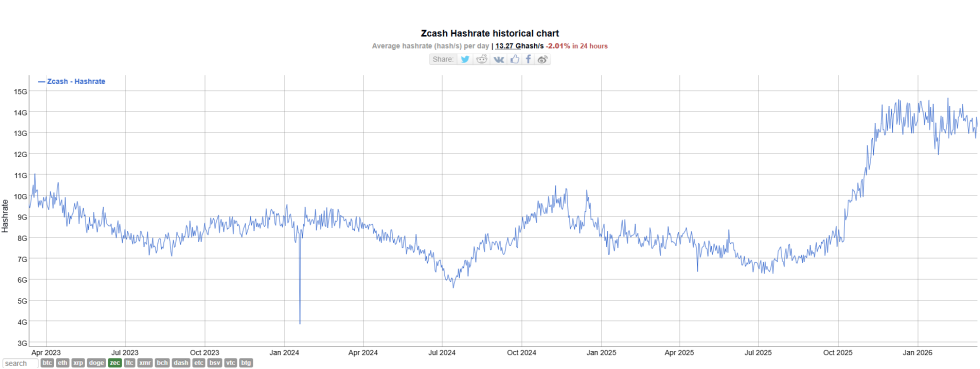
For miners, the profitability of Zcash depends on three main variables: the price of ZEC, the network difficulty (hashrate), and the cost of electricity. Foundry’s move to establish a pool in April 2026 suggests a long-term bullish outlook on ZEC’s price. For an institutional pool to be viable, there must be enough mining reward value to justify the operational overhead. If the hashrate continues its current trajectory, the network will become one of the most secure PoW chains outside of the Bitcoin and Litecoin ecosystems.
Chronology of Recent Zcash Developments
The timeline leading up to Foundry’s 2026 launch is marked by several pivotal moments for the Zcash protocol:
- Late 2023 – 2024: Intensive discussions regarding the "Sustainability Fund" and the transition of Zcash development funding. The emergence of Shielded Labs as a key support organization in Switzerland.
- 2025: A notable increase in ASIC efficiency leads to a steady climb in hashrate, crossing the 10 Ghash/s threshold for the first time in years.
- March 2026: Foundry officially announces its institutional Zcash pool, citing a need for better infrastructure.
- April 2026 (Projected): The scheduled launch of the pool, coinciding with expected network upgrades aimed at improving shielded transaction performance.
Broader Implications for the Crypto Mining Industry
Foundry’s expansion is a signal to the broader market that the era of "Bitcoin-only" institutional mining may be evolving. As the digital asset landscape matures, institutions are looking for ways to capture value across different cryptographic verticals. Privacy is increasingly viewed as a premium feature in a world of total digital transparency.
Furthermore, this move reinforces North America’s position as a global hub for mining innovation. By hosting the operations in the US, Foundry is helping to de-risk the privacy coin sector, potentially encouraging other service providers—such as custodians and exchanges—to deepen their support for Zcash.
In conclusion, the launch of the Foundry Zcash mining pool in April 2026 is more than just a new service offering; it is a strategic bridge between the world of high-privacy cryptography and the world of high-compliance finance. As the network hashrate continues to climb and the demand for institutional-grade tools grows, Foundry’s entry could serve as the catalyst that propels Zcash into its next phase of global adoption. For the mining community, it offers a refined, secure, and regulated pathway to secure one of the most technologically advanced blockchains in existence.