Foundry, the digital asset infrastructure provider that operates the world’s largest Bitcoin mining pool, has officially announced its strategic expansion into the privacy-preserving cryptocurrency sector with the planned launch of a Zcash (ZEC) mining pool. Scheduled for a commercial debut in April 2026, this new initiative is specifically designed to meet the rigorous compliance and operational standards required by institutional investors, public companies, and large-scale enterprise miners. The move marks a significant milestone in the maturation of Zcash, a blockchain often celebrated for its sophisticated cryptography but which has historically lacked the robust, US-based institutional infrastructure available to Bitcoin. By leveraging the same technological framework that propelled Foundry USA to the top of the Bitcoin mining hierarchy, the company aims to provide a secure, transparent, and regulated gateway for entities looking to secure the Zcash network.
The Strategic Shift Toward Institutional Privacy
The decision by Foundry to enter the Zcash ecosystem is rooted in the recognition of a widening disparity between the asset’s market maturity and its supporting infrastructure. While Zcash has established itself as a leading privacy-focused digital asset since its inception in 2016, the mining landscape for the token has remained relatively fragmented compared to the industrial-scale operations seen in Bitcoin. Foundry’s CEO, Mike Colyer, emphasized that while Zcash has evolved into an "institutional-grade asset," the underlying mining pools have struggled to keep pace with the needs of sophisticated market participants.
Institutional miners, particularly those listed on public stock exchanges, face stringent regulatory requirements regarding the origin of their rewards and the transparency of the pools they join. By establishing a pool based in North America, Foundry is positioning itself as a compliant alternative to existing pools, many of which operate in jurisdictions with less regulatory clarity. This expansion is not merely a diversification of Foundry’s product line but a calculated bet on the long-term viability of privacy-enhancing technologies in a world of increasing digital surveillance.
Technical Foundation and the Zcash Protocol
Zcash occupies a unique niche in the cryptocurrency landscape. Originally built on a fork of the Bitcoin codebase, it shares many of Bitcoin’s fundamental economic properties, including a hard supply cap of 21 million tokens and a "halving" mechanism that reduces block rewards by 50% approximately every four years. However, Zcash distinguishes itself through the implementation of Zero-Knowledge Succinct Non-Interactive Arguments of Knowledge (zk-SNARKs). This cryptographic breakthrough allows users to prove they have the authority to spend funds without revealing the sender, receiver, or transaction amount on the public ledger.

The Foundry Zcash pool will support both "transparent" (t-addresses) and "shielded" (z-addresses) transactions, allowing miners to choose the level of privacy that aligns with their internal compliance mandates. This dual-nature approach is what the company describes as a marriage of "financial privacy and compliant digital infrastructure." For institutions, the ability to maintain privacy while providing "viewing keys" to auditors or regulators is a critical feature that makes Zcash more attractive than other, more obfuscated privacy coins like Monero.
Analyzing the Zcash Hashrate Boom
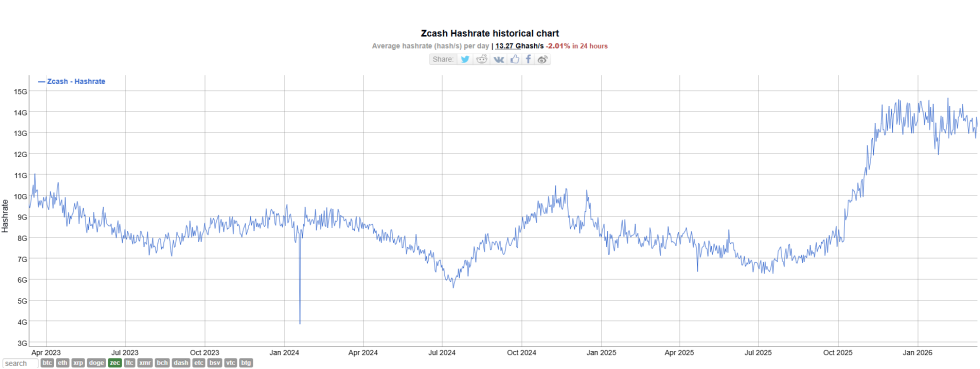
Foundry’s entry into the market comes at a time of unprecedented growth for the Zcash network’s security. Data from BitInfoCharts and other on-chain analytics providers indicate a significant surge in the network’s total computing power, or hashrate. In October 2025, the Zcash hashrate was hovering at approximately 8 Gigahashes per second (Ghash/s). As of March 2026, that figure has climbed to over 13 Ghash/s, representing a nearly 63% increase in network security in just a few months.
This surge in hashrate is indicative of several factors:
- ASIC Efficiency: The deployment of more efficient Equihash-based Application-Specific Integrated Circuits (ASICs) by manufacturers like Bitmain.
- Network Confidence: Increased miner confidence following recent protocol upgrades aimed at improving scalability and user experience.
- Speculative Positioning: Miners often increase their activity ahead of major infrastructure launches, such as the one announced by Foundry, in anticipation of higher liquidity and institutional interest.
A higher hashrate makes the network more resilient against 51% attacks, a vital metric for any institution considering a multi-million dollar investment in mining hardware or the underlying asset. Foundry’s involvement is expected to further stabilize this metric by bringing more professionalized management to the distribution of hashrate.
Chronology of Zcash and Foundry’s Integration
To understand the significance of this launch, it is essential to look at the timeline of both the asset and the mining giant’s trajectory:

- October 2016: Zcash is officially launched by the Electric Coin Company (ECC), introducing zk-SNARKs to the world.
- 2020-2021: Foundry USA is established and quickly ascends to become the dominant Bitcoin mining pool, emphasizing North American regulatory compliance.
- Late 2023: Discussions regarding the "Zcash Sustainability Fund" and potential shifts in consensus mechanisms begin to circulate within the community.
- October 2025: Zcash hashrate begins a steady climb from 8 Ghash/s, signaling renewed interest from industrial miners.
- March 2026: Foundry officially announces its institutional Zcash pool, backed by Shielded Labs.
- April 2026: The scheduled "Go-Live" date for the Foundry Zcash mining pool.
This chronology demonstrates a deliberate, multi-year path toward institutionalization. Foundry’s decision to wait until 2026 to launch suggests a focus on ensuring the technical stack is fully optimized for the Equihash algorithm and that all KYC (Know Your Customer) and AML (Anti-Money Laundering) protocols are perfectly aligned with US federal guidelines.
Official Responses and Ecosystem Support
The announcement has been met with significant enthusiasm from the core developers and support organizations within the Zcash ecosystem. Zooko Wilcox, the founder of Zcash and currently the Chief Product Officer at Shielded Labs, expressed his support for the move, noting the importance of having a North American powerhouse involved in the network.
"We at Shielded Labs are delighted that Foundry—the largest Bitcoin mining pool, and one based in North America—is launching an enterprise-grade Zcash mining pool," Wilcox stated. Shielded Labs, an independent organization based in Switzerland, has been instrumental in providing technical support and fostering the decentralized growth of the Zcash protocol.
The partnership between Foundry and Shielded Labs highlights a growing trend of collaboration between "Big Mining" and protocol-specific research labs. For Foundry, working with Shielded Labs ensures that their pool software is optimized for the latest network upgrades. For Zcash, the partnership provides a level of legitimacy that could attract further investment from Silicon Valley and Wall Street.
Economic Implications and Market Context
At the time of the announcement, Zcash (ZEC) was trading at approximately $209. While the coin has seen a retracement of roughly 11% over the past week, the broader trend over the last year has been one of gradual recovery from previous bear market lows. The introduction of an institutional mining pool is expected to have several long-term economic effects:
- Liquidity Improvements: Institutional pools often facilitate large-scale Over-The-Counter (OTC) trades, allowing miners to sell their rewards directly to buyers without causing massive price slippage on public exchanges.
- Reduced Volatility: As more "patient capital" enters the mining space through institutional channels, the frantic selling often associated with retail-dominated pools may subside.
- Increased Utility: A more secure and robust network encourages developers to build decentralized applications (dApps) that require privacy, further driving demand for the ZEC token.
The $209 price point reflects a market that is cautiously optimistic. Investors are weighing the benefits of Foundry’s entry against the general regulatory scrutiny that privacy coins face globally. However, the fact that a US-based firm like Foundry is moving forward suggests they have found a viable path toward compliance.
Broader Impact on the Mining Industry
Foundry’s expansion into Zcash may signal a broader shift in the mining industry. For years, the focus has been almost exclusively on Bitcoin due to its liquidity and the ease of manufacturing SHA-256 ASICs. However, as the Bitcoin mining market becomes increasingly saturated and competitive, large-scale operators are looking for "alt-coins" that offer similar proof-of-work security but different market dynamics.
By dominating the Zcash hashrate, Foundry could effectively become the "standard-setter" for privacy coin mining. This could force other mining pools to upgrade their transparency and reporting tools to compete. Furthermore, it validates the Equihash algorithm as a viable secondary market for industrial miners who want to hedge their bets against Bitcoin’s difficulty adjustments.
Conclusion: A New Chapter for Digital Privacy
The launch of Foundry’s Zcash pool in April 2026 represents more than just a new service for miners; it is a validation of the idea that privacy and regulation are not mutually exclusive. By providing a transparent, US-based platform for a privacy-focused asset, Foundry is bridging the gap between the cypherpunk ideals of the early crypto movement and the pragmatic requirements of modern finance.
As the 2026 launch date approaches, the industry will be watching closely to see how much of the ZEC hashrate migrates to Foundry. If their success in the Bitcoin space is any indication, Foundry could soon become the primary steward of the Zcash network’s security, ushering in an era where institutional privacy is not just a concept, but a standard operational reality. For the Zcash community, this is a moment of professionalization that has been nearly a decade in the making.