Foundry, the Rochester-based digital asset infrastructure giant and operator of the world’s largest Bitcoin mining pool, has officially announced its strategic entry into the Zcash (ZEC) ecosystem. This expansion marks a significant pivot for the firm, which currently dominates the global Bitcoin mining landscape through its Foundry USA pool. The company intends to launch a dedicated Zcash mining pool in April 2026, specifically designed to meet the rigorous compliance and operational standards required by institutional investors, public corporations, and large-scale mining enterprises. The move is viewed by industry analysts as a major endorsement of privacy-preserving blockchain technology and a vital step in professionalizing the infrastructure supporting decentralized privacy assets.
The decision to develop a Zcash-specific product stems from a perceived disparity between the asset’s market maturity and the technical infrastructure available to support its production. While Zcash has established itself as a cornerstone of the privacy-coin sector over the last decade, much of its mining ecosystem has remained fragmented or catered primarily to retail participants. By introducing an institutional-grade pool, Foundry aims to bridge this gap, offering the same level of security, transparency, and North American-based reliability that propelled its Bitcoin mining pool to the top of the global charts.
Bridging the Infrastructure Gap for Institutional Mining
Since its inception, Foundry has focused on providing a professionalized gateway for North American miners to participate in the Proof of Work (PoW) economy. Its flagship product, Foundry USA, currently accounts for a plurality of the global Bitcoin hashrate, often fluctuating between 25% and 30% of the total network power. This dominance has been built on a foundation of regulatory compliance, transparent payout structures, and robust technical support—features that have historically been less accessible in the Zcash mining space.
Mike Coyler, the CEO of Foundry, emphasized that the current state of Zcash infrastructure is no longer sufficient for the caliber of investors now entering the space. "Zcash has matured into an institutional-grade asset, but the mining infrastructure supporting it hasn’t kept pace," Coyler stated. His assessment highlights a broader trend in the cryptocurrency industry where traditional financial entities are seeking exposure to diverse digital assets but are often stymied by the lack of "enterprise-ready" service providers. By targeting an April 2026 launch, Foundry is positioning itself to be the primary liquidity and infrastructure partner for institutions looking to secure the Zcash network.

The new pool will operate out of the United States, adhering to domestic regulatory frameworks. This is a critical factor for public companies and regulated funds that face strict mandates regarding the geographic location of their service providers and the transparency of their counterparties. The "Foundry model" typically involves rigorous KYC (Know Your Customer) and AML (Anti-Money Laundering) protocols for participating miners, a standard that is expected to carry over to the Zcash pool.
The Technical Foundations and Evolution of Zcash
Zcash was launched in 2016 as a fork of the Bitcoin codebase, meaning it shares many of the same fundamental economic principles that have made Bitcoin a successful store of value. It features a hard cap of 21 million tokens and utilizes a halving mechanism roughly every four years to manage inflation and incentivize long-term security. However, Zcash diverges from Bitcoin in its implementation of advanced cryptography. While Bitcoin is pseudonymous—meaning all transaction details are visible on a public ledger—Zcash utilizes Zero-Knowledge Succinct Non-Interactive Arguments of Knowledge (zk-SNARKs).
This technology allows users to verify transactions without revealing the sender, receiver, or transaction amount. In the context of Foundry’s new pool, the company argues that this technology is not just for anonymity, but for "financial privacy." The press release accompanying the announcement noted that Zcash demonstrates how compliant digital infrastructure and financial privacy can coexist. For institutions, this privacy is often a matter of competitive necessity; public companies may require the ability to move funds or manage treasuries without alerting competitors to their exact movements on a public blockchain.
The Zcash network supports two types of addresses: transparent (t-addresses), which function like Bitcoin, and shielded (z-addresses), which utilize zk-SNARKs. Foundry’s entry into the space suggests a growing confidence that regulated entities can navigate the complexities of privacy coins by utilizing the transparent verification features of the blockchain while benefiting from the underlying privacy protections.
Analyzing the Zcash Hashrate Surge and Market Dynamics
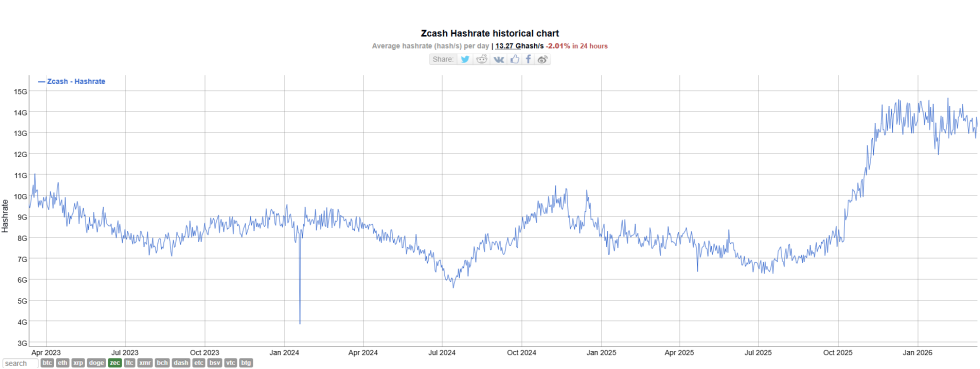
Foundry’s expansion comes at a time of renewed technical vigor for the Zcash network. Data from blockchain analytics platforms, including BitInfoCharts, indicates a substantial increase in the total computing power, or hashrate, securing the Zcash blockchain over the past six months. in October 2025, the ZEC hashrate was measured at approximately 8 Gigahashes per second (Ghash/s). By early 2026, that figure had climbed to over 13 Ghash/s, representing a nearly 63% increase in network security.

A rising hashrate is generally considered a bullish indicator for a Proof of Work network. it suggests that miners are committing more capital—in the form of specialized ASIC (Application-Specific Integrated Circuit) hardware and electricity—to the network, likely in anticipation of future price appreciation or network utility. Zcash uses the Equihash algorithm, which requires different hardware than Bitcoin’s SHA-256. The surge in hashrate suggests that manufacturers are producing more efficient Equihash miners and that existing mining operations are scaling up their ZEC deployments.
From a price perspective, Zcash has experienced the volatility typical of the broader altcoin market. At the time of the Foundry announcement, ZEC was trading near the $209 mark. While this represents a significant recovery from its cyclical lows, the asset has seen a retracement of approximately 11% over the week preceding the news. Foundry’s long-term commitment, evidenced by a launch date more than a year away, suggests the firm is looking past short-term price fluctuations and focusing on the underlying structural demand for privacy-centric assets.
Strategic Partnerships and Industry Reactions
The announcement has been met with enthusiasm from the core developers and support organizations within the Zcash ecosystem. Shielded Labs, an independent organization based in Switzerland dedicated to the advancement of Zcash, has been a vocal proponent of the partnership. Zooko Wilcox, the founder of Zcash and Chief Product Officer at Shielded Labs, hailed the move as a milestone for the network’s decentralization and institutional viability.
"We at Shielded Labs are delighted that Foundry—the largest Bitcoin mining pool, and one based in North America—is launching an enterprise-grade Zcash mining pool," Wilcox said. His comments underscore the importance of geographic diversity in mining. For years, mining concentration in specific regions has been a point of concern for blockchain security. Having a major US-based player like Foundry lead the Zcash mining charge provides a counterweight to overseas pools and enhances the overall resilience of the network.
Shielded Labs and the Electric Coin Company (the original developers of Zcash) have spent years refining the protocol to make it more efficient. Recent upgrades have focused on "Halo," a version of zk-SNARKs that eliminates the need for a "trusted setup," further enhancing the trustless nature of the privacy technology. Foundry’s decision to build on this tech stack signals that the protocol has reached a level of stability and scalability that can support large-scale industrial operations.
Broader Implications for the Crypto Infrastructure Landscape
Foundry’s move into Zcash is more than just a product launch; it is a signal of the "institutionalization" of the entire Proof of Work sector. For years, the narrative in the crypto space has shifted toward Proof of Stake (PoS) following Ethereum’s transition in 2022. However, Foundry’s continued investment in PoW assets like Bitcoin and now Zcash suggests that there remains a robust market for hardware-based security models.
Furthermore, this development highlights the evolving relationship between privacy and regulation. While some jurisdictions have moved to delist privacy coins from retail exchanges, Foundry’s approach focuses on the "compliant digital infrastructure" aspect. By providing a pool that operates under US law, Foundry offers a pathway for institutions to hold and mine ZEC while remaining within the bounds of traditional financial oversight. This could set a precedent for other privacy-focused protocols, suggesting that the path to mainstream adoption lies in professionalized, transparent service providers rather than obfuscation.
As the industry moves toward the April 2026 launch, several factors will determine the success of this venture. These include the continued growth of the Equihash hashrate, the regulatory climate surrounding privacy assets in the United States, and the ability of Zcash to maintain its technological edge against emerging privacy solutions on other blockchains. For now, Foundry’s entry stands as a landmark event, potentially transforming Zcash from a niche privacy tool into a standard component of the institutional digital asset portfolio.
The timeline also allows for the completion of any necessary protocol upgrades that may be required to facilitate enterprise-level mining and reporting. With the backing of the world’s most successful mining pool operator, Zcash is positioned to enter a new era of network security and institutional participation, potentially reshaping the competitive landscape of the privacy coin market for years to come.