Foundry, a premier digital asset infrastructure company and the operator of the world’s largest Bitcoin mining pool by total hashrate, has officially announced plans to introduce an enterprise-grade Zcash (ZEC) mining pool. Slated for an April 2026 rollout, this strategic expansion marks a significant milestone for the privacy-centric cryptocurrency ecosystem, addressing a historical shortage of institutional-tier mining infrastructure tailored for publicly traded companies and large-scale financial entities.
The announcement underlines a growing convergence between traditional corporate capital and privacy-preserving blockchain networks. By leveraging its extensive operational expertise gained from managing Foundry USA, the firm aims to bridge the gap between compliance-driven institutional investors and the technically complex requirements of proof-of-work (PoW) privacy coins.
Background and Context of the Expansion
The digital asset mining landscape has evolved dramatically over the past decade. Initially dominated by decentralized groups of hobbyists and small-scale miners, the sector has transformed into a capital-intensive industry characterized by publicly listed corporations, heavily capitalized data centers, and sophisticated hardware logistics. Despite this institutionalization, privacy coins have frequently struggled to attract mainstream corporate participation due to regulatory uncertainties, compliance hurdles, and a lack of specialized, institutional-grade infrastructure.
Zcash, launched in October 2016, occupies a unique position in the cryptocurrency ecosystem. Originally built upon Bitcoin’s foundational codebase, Zcash shares several core economic characteristics with the pioneer cryptocurrency. It features a strict supply cap of 21 million tokens, and its block rewards undergo halving events approximately every four years to control inflation.

However, what sets Zcash apart is its utilization of advanced zero-knowledge cryptography—specifically zk-SNARKs—which allows users to shield transaction details such as sender, receiver, and transferred amounts while maintaining the integrity of the decentralized ledger. Proponents argue that this architecture proves financial privacy and regulatory compliance can successfully coexist, offering a transparent verification layer alongside cutting-edge cryptographic confidentiality.
The Growth of Zcash Hashrate and Market Dynamics
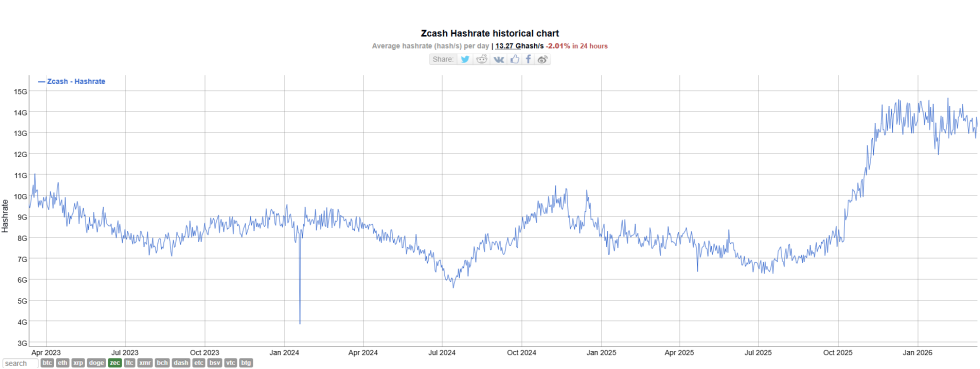
Foundry’s entry into the Zcash ecosystem does not happen in a vacuum. Over recent months, the Zcash network has experienced a substantial resurgence in computational power. According to market data from BitInfoCharts, the network’s total hashrate has surged notably. In October of the previous year, the Zcash hashrate hovered below 8 Gigahashes per second (Ghash/s). Since then, it has climbed steadily, stabilizing at over 13 Ghash/s as miners increasingly allocate resources toward the network.
This upward trajectory in network security and computational participation coincides with shifting market conditions for the asset itself. At the time of reporting, Zcash (ZEC) trades at approximately $209, experiencing a retracement of more than 11% over the preceding week. Despite short-term price volatility, the underlying network fundamentals—highlighted by increasing hashrate and growing institutional interest—suggest a strengthening baseline infrastructure.
Leadership and Official Responses
The decision by Foundry to expand its mining pool operations has drawn widespread praise from prominent figures within the privacy coin community and associated development organizations.
Mike Colyer, Chief Executive Officer of Foundry, emphasized the strategic necessity of the move during the announcement. "Zcash has matured into an institutional-grade asset, but the mining infrastructure supporting it hasn’t kept pace," Colyer stated, highlighting the vacuum that the upcoming April 2026 pool intends to fill.

The sentiment was warmly echoed by Zooko Wilcox, founder of Zcash and Chief Product Officer at Shielded Labs, an independent support organization based in Switzerland dedicated to the growth and resilience of the ZEC ecosystem.
"We at Shielded Labs are delighted that Foundry—the largest Bitcoin mining pool, and one based in North America—is launching an enterprise-grade Zcash mining pool," Wilcox remarked. The endorsement from a foundational figure in the Zcash community underscores the operational credibility that a North American heavyweight like Foundry brings to the privacy sector.
Chronology of Key Events
To fully understand the trajectory of Foundry’s expansion and the current state of Zcash infrastructure, a chronological review of key developments provides essential context:
- October 2016: Zcash officially launches, introducing zero-knowledge privacy technology to the proof-of-work mining community.
- 2020–2024: Foundry establishes and scales Foundry USA, growing it into the dominant Bitcoin mining pool globally by total hashrate, while navigating regulatory shifts and energy market fluctuations in North America.
- Late 2024 to Early 2025: The Zcash network experiences a notable renaissance in mining activity, with the global hashrate climbing from under 8 Ghash/s to surpassing 13 Ghash/s over several months.
- March 2026: Foundry officially releases a public press release detailing its plans to launch an institutional-grade, US-based Zcash mining pool.
- April 2026 (Projected): Foundry’s dedicated Zcash mining pool is scheduled to officially go live, welcoming institutional miners and public companies into the ecosystem.
Analysis of Implications for the Mining and Privacy Sectors
The launch of an institutional-grade Zcash mining pool by Foundry carries several broad implications for the cryptocurrency mining industry, regulatory compliance frameworks, and the market valuation of privacy coins.
First, it validates the operational viability of privacy-focused networks within regulated jurisdictions. Because Foundry operates primarily out of the United States and adheres to strict domestic compliance standards, its involvement signals to risk-averse institutional investors that mining Zcash can be executed within a transparent, legally sound framework. This could pave the way for other regulated entities, such as publicly traded mining companies, to diversify their operations away from purely Bitcoin-centric models.
Second, the introduction of enterprise-grade mining infrastructure typically leads to greater network stability and security. Institutional miners generally deploy the latest generation of application-specific integrated circuit (ASIC) hardware, backed by reliable power agreements and advanced monitoring systems. As these operators direct their hashrate toward Zcash via Foundry’s pool, the network’s overall defense against potential 51% attacks and other malicious vectors will inherently strengthen.
Finally, the move could influence broader market perceptions of privacy coins. Historically, privacy-centric digital assets have faced regulatory headwinds and potential delisting pressures from centralized exchanges concerned about illicit finance. However, by establishing a bridge between transparent corporate mining operations and zero-knowledge privacy technology, initiatives like Foundry’s Zcash pool demonstrate that transactional privacy can be maintained without sacrificing corporate accountability or regulatory visibility.
As the April 2026 launch date approaches, industry observers will closely monitor how institutional capital and hashing power integrate into the Zcash ecosystem, potentially setting a new benchmark for how privacy coins interface with mainstream corporate finance.