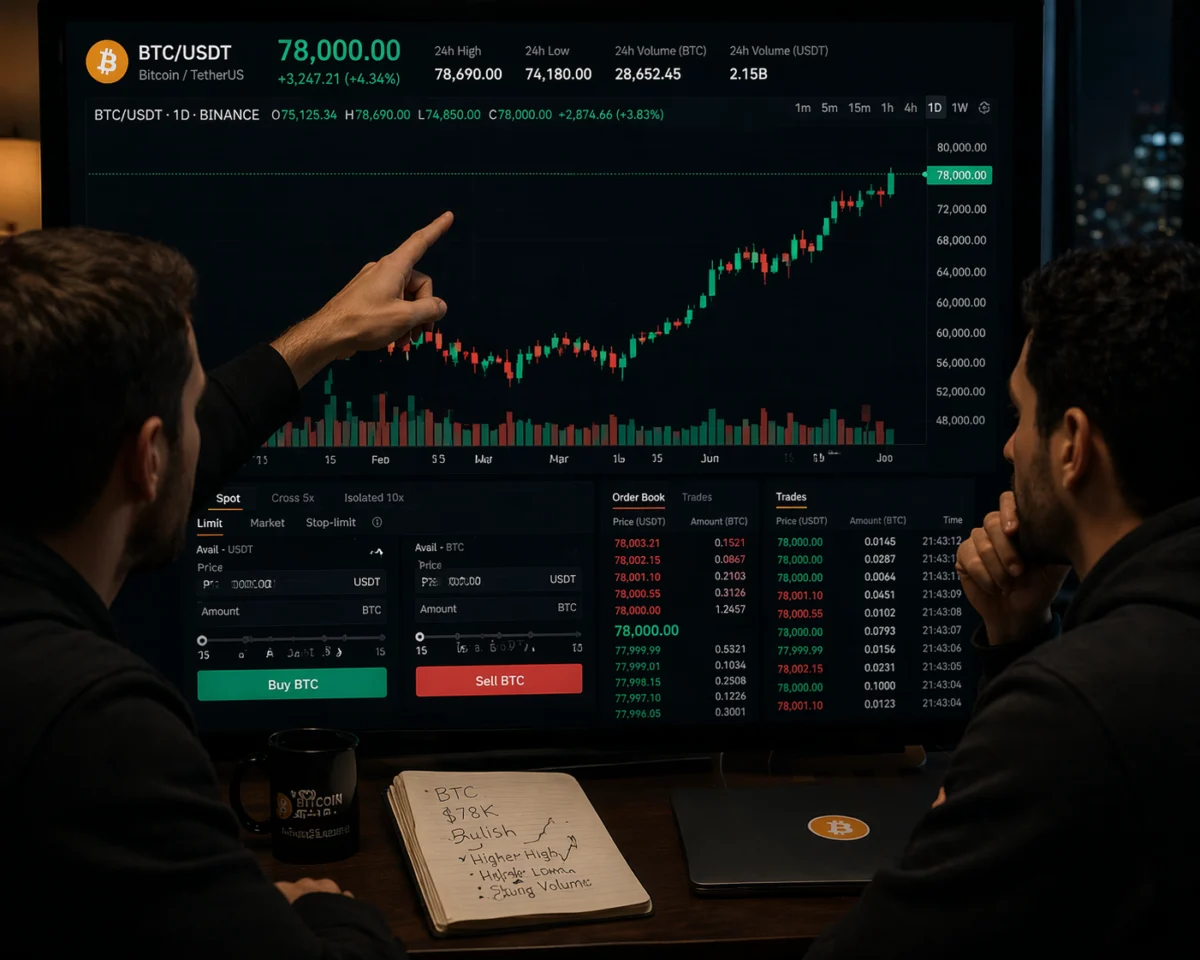
Bitcoin (BTC) continued its upward trajectory on Wednesday, solidifying its position above the $78,000 mark following a robust 6% rally over the course of the week. This price action comes amid a complex backdrop of shifting geopolitical tensions in the Middle East and strategic fiscal maneuvers by the United States Treasury, both of which have combined to create a "risk-on" environment for global investors. While institutional demand through spot Exchange-Traded Funds (ETFs) showed a temporary cooling period on Tuesday with a modest $11.84 million in net inflows, the broader market sentiment remains decidedly bullish as the digital asset reached its highest valuation since early February. The convergence of a critical ceasefire extension and a massive $15 billion government debt buyback program has provided the necessary tailwinds to push Bitcoin through several key resistance levels, placing the psychological $80,000 milestone within striking distance.
Geopolitical De-escalation: The Trump-Mediated Ceasefire Extension
The primary catalyst for the mid-week surge was the announcement late Tuesday by U.S. President Donald Trump regarding the extension of a two-week ceasefire. The original agreement, which was scheduled to expire on April 22, 2026, has been a focal point for global markets sensitive to energy prices and regional stability. According to White House statements, the extension was granted following a specific request from the Pakistani government, acting as a diplomatic intermediary. The objective of the extension is to allow more time for Washington to receive and review a unified proposal from Tehran aimed at a more permanent resolution to ongoing regional hostilities.
While President Trump maintained a firm stance, emphasizing that the U.S. naval blockade of Iranian seaports would remain in effect until a final agreement is reached, the mere avoidance of an immediate return to active conflict sparked a significant rally across risk assets. Bitcoin, which has increasingly been viewed as a barometer for global geopolitical tension and liquidity, responded with a sharp move upward. The asset reached a peak of $78,452 during the early Wednesday sessions, marking its strongest performance since February 3. Investors appear to be pricing in a "peace dividend," betting that a reduction in immediate military friction will stabilize global trade routes and reduce the "uncertainty premium" that has weighed on markets throughout the spring.
The US Treasury Buyback: A Massive Injection of Market Liquidity
Parallel to the geopolitical developments, the U.S. Treasury Department is preparing to execute a strategic financial maneuver that is expected to significantly alter market liquidity dynamics. This week, the Treasury is poised to buy back $15 billion of its own debt, a move that matches the largest buyback operation in the nation’s history. Debt buybacks are a tool used by the Treasury to manage the maturity profile of sovereign debt and, crucially, to improve the liquidity of the government bond market.
For Bitcoin and the broader cryptocurrency market, this is a highly significant development. When the Treasury buys back debt, it effectively injects cash into the financial system, increasing the overall supply of liquid capital. Historically, Bitcoin has shown a strong positive correlation with increases in global liquidity and the expansion of the M2 money supply. As excess capital enters the hands of institutional investors and primary dealers, a portion of that liquidity typically flows into high-growth risk assets and alternative stores of value. Analysts suggest that the timing of this $15 billion injection is particularly favorable for Bitcoin, as it provides a fundamental "floor" for the market at a time when technical indicators are already flashing bullish signals.
Institutional Inflows and the Spot ETF Landscape
Despite the price appreciation, the data from Bitcoin spot ETFs on Tuesday suggested a moment of institutional hesitation. Net inflows for the day totaled $11.84 million, a sharp decline from the $238.37 million recorded just twenty-four hours prior. This deceleration in ETF buying suggests that while retail and momentum traders are driving the current breakout, larger institutional players may be adopting a "wait-and-see" approach as they monitor the nuances of the US-Iran peace negotiations.
The cautiousness observed in the ETF sector is likely tied to the volatile nature of diplomatic talks. Institutional fund managers often prioritize risk mitigation, and the potential for a sudden breakdown in ceasefire negotiations represents a tail risk that many are unwilling to ignore. However, market observers note that even with the reduced inflow, the fact that the balance remained positive during a period of such high-level geopolitical flux is a testament to the underlying demand for Bitcoin. Should the ceasefire hold and the Treasury liquidity begin to circulate, many expect a resurgence in ETF activity as institutions move to capture the next leg of the rally.

Technical Analysis: Key Levels and Market Indicators
From a technical perspective, the BTC/USD 4-hour chart paints a picture of sustained bullish momentum. Bitcoin is currently trading well above its 50-day and 100-day Exponential Moving Averages (EMAs), which sit at $72,345 and $75,368, respectively. The separation between the current price and these moving averages indicates a strong trend, with the 100-day EMA serving as a critical dynamic support level that has held firm during recent minor retracements.
The Relative Strength Index (RSI) is currently hovering in the upper 60s, suggesting that while the asset is approaching overbought territory, there is still room for upward movement before a significant cooling-off period is required. Similarly, the Moving Average Convergence Divergence (MACD) indicator remains in positive territory, with the signal line trending upward, confirming that buyers currently maintain control of the market’s direction.
Looking ahead, the next major hurdle for Bitcoin is the 50% Fibonacci retracement level located near $78,962. A clean break above this level would likely trigger a wave of FOMO (fear of missing out) buying, potentially propelling the price toward the psychological resistance of $80,000. Beyond that, the 200-day EMA at $82,769 represents the ultimate target for the current bullish cycle. On the downside, the market has established several layers of protection. Immediate support is found at the previous channel top of $75,680, followed closely by the 100-day EMA and the 38.2% Fibonacci level at $74,487. The 50-day EMA at $72,345 serves as a secondary safety net, while the lower boundary of the current trading channel near $62,950 remains the "line in the sand" for the broader bullish structure.
Chronology of Events Leading to the $78,000 Breakout
To understand the current market state, it is essential to look at the timeline of events over the past week:
- April 15-18: Bitcoin consolidates between $71,000 and $73,000 as markets await clarity on the April 22 ceasefire deadline.
- April 20: Rumors of a US Treasury buyback begin to circulate, providing a 3% boost to BTC, pushing it toward $75,000.
- April 21 (Monday): Heavy institutional buying via ETFs ($238M) drives Bitcoin to $76,500.
- April 22 (Tuesday): President Trump announces the extension of the ceasefire following Pakistan’s request. BTC hits $78,452 in overnight trading.
- April 23 (Wednesday): Bitcoin maintains its $78,000 level as the market prepares for the $15 billion Treasury liquidity injection.
Broader Implications for the Digital Asset Ecosystem
The current surge in Bitcoin’s price has broader implications for the entire cryptocurrency ecosystem. Typically, a sustained Bitcoin rally serves as a precursor to an "altcoin season," where capital begins to rotate into Ethereum and other high-beta crypto assets. If Bitcoin can successfully flip the $78,000 level from resistance to support, it may provide the stability necessary for the rest of the market to follow suit.
Furthermore, the interplay between geopolitical stability and sovereign debt management highlights Bitcoin’s evolving role in the global financial architecture. By reacting positively to both peace talks and central liquidity injections, Bitcoin is demonstrating its dual nature: it acts as a "risk-on" asset during times of economic expansion and a "hedge" during periods of fiscal manipulation. The $15 billion Treasury buyback, in particular, underscores the ongoing challenges within the traditional bond market, further strengthening the narrative for decentralized, hard-money alternatives like Bitcoin.
As the week progresses, the market’s focus will remain squarely on the developments in Tehran and the actual execution of the Treasury’s buyback program. While the "bullish bias" remains the dominant theme, the upcoming days will be a critical test of Bitcoin’s ability to maintain its momentum in the face of high-stakes global diplomacy. If the $80,000 level is breached, it would mark a historic milestone for the asset, potentially ushering in a new era of price discovery.