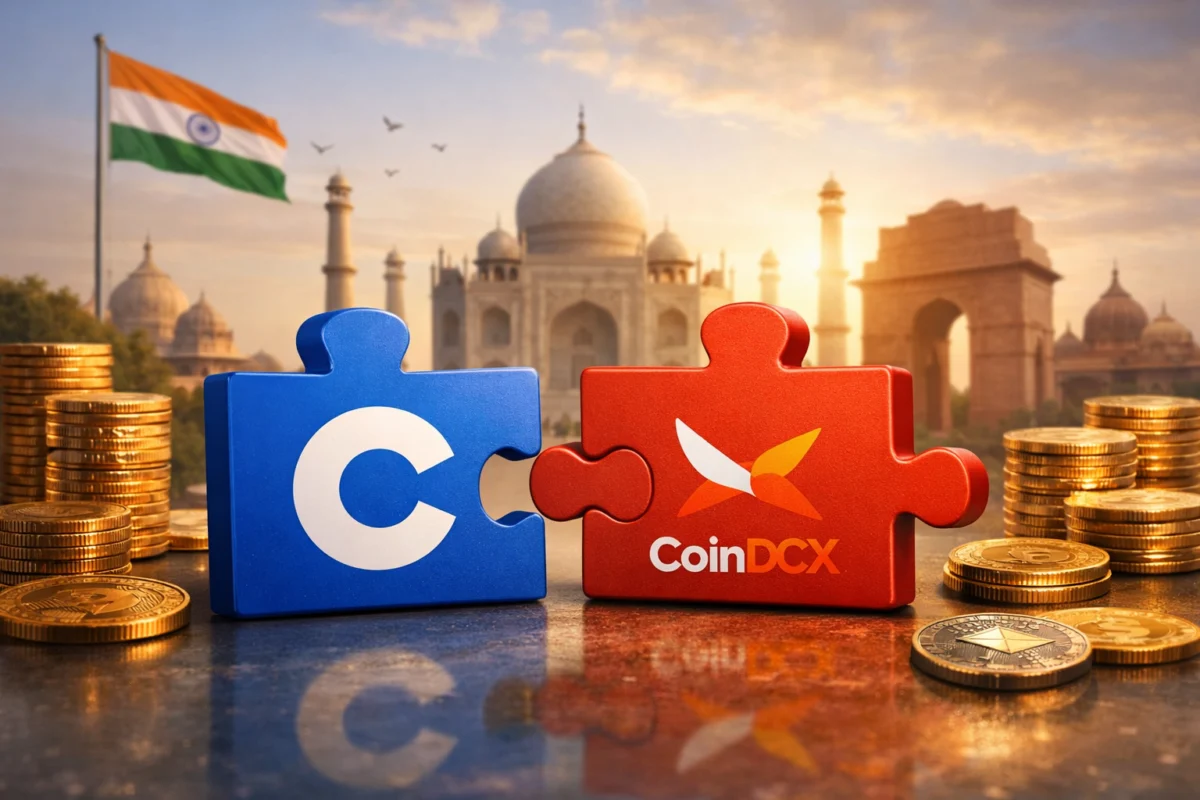
The Competition Commission of India (CCI) has formally approved a proposal by Coinbase Global, Inc. to acquire a minority shareholding in DCX Global Limited, the parent company of the prominent Indian cryptocurrency exchange CoinDCX. This regulatory green light marks a pivotal moment in the landscape of digital asset investment within the Indian subcontinent, signaling a renewed appetite for institutional engagement despite a historically complex and often friction-filled regulatory environment. The approval, announced through an official disclosure on Wednesday, follows a comprehensive review by the antitrust watchdog to ensure the transaction does not adversely affect market competition.
The transaction involves a strategic capital infusion from Coinbase, the largest cryptocurrency exchange in the United States, into one of India’s leading domestic players. While Coinbase has maintained a relationship with CoinDCX since 2022, this latest move represents a deepening of ties and a calculated bet on the long-term viability of the Indian Web3 ecosystem. The clearance by the CCI comes at a time when the global crypto industry is navigating a bifurcated path: increasing institutional adoption in Western markets and rigorous, often restrictive, oversight in emerging economies like India.
Historical Context and the Coinbase India Journey
To understand the significance of this approval, one must look back at Coinbase’s tumultuous history within the Indian market. In April 2022, Coinbase CEO Brian Armstrong traveled to India to announce a high-profile launch that included the integration of the Unified Payments Interface (UPI), India’s ubiquitous real-time payment system. However, the launch was short-lived. Within days of the announcement, the National Payments Corporation of India (NPCI) issued a statement claiming it was unaware of any crypto exchange using UPI for transactions. Under immense pressure from banking partners and regulatory uncertainty, Coinbase was forced to suspend UPI support, effectively crippling its ability to offer fiat-to-crypto services to Indian users.
Following this setback, Coinbase scaled back its direct operations in the country throughout 2023, refocusing its efforts on developer grants and indirect investments through its venture arm, Coinbase Ventures. The decision to now pursue a formal minority stake in DCX Global Limited suggests a shift in strategy. Rather than attempting to navigate the retail banking hurdles alone, Coinbase is aligning itself with a local entity that has already established the necessary infrastructure, compliance frameworks, and user trust within the domestic market.
The Strategic Importance of CoinDCX
CoinDCX, founded by Sumit Gupta and Neeraj Khandelwal, has emerged as a cornerstone of the Indian crypto industry. As the country’s first crypto unicorn, it has weathered multiple market cycles and regulatory shifts. However, the exchange has not been without its challenges. In July 2024, CoinDCX reported a security breach involving one of its wallets, resulting in the loss of approximately $44.2 million. While the company was quick to reassure users that customer funds remained safe and that the loss would be covered by the firm’s internal reserves and insurance, the incident highlighted the inherent risks of operating in the digital asset space.
The capital infusion from Coinbase is expected to bolster CoinDCX’s balance sheet and provide the resources necessary to enhance security protocols and expand product offerings. For Coinbase, the investment provides "skin in the game" without the immediate necessity of managing the day-to-day regulatory friction that comes with being a primary service provider in India. This "partnership-first" approach allows Coinbase to benefit from India’s massive retail potential while the local entity handles the intricacies of the Financial Intelligence Unit (FIU) reporting and domestic tax compliance.
A Phased Re-entry Strategy
The CCI approval is only one component of Coinbase’s broader roadmap for India. Just last week, Coinbase announced the reopening of user registrations for Indian residents, albeit with significant limitations. Currently, the platform allows for crypto-to-crypto trading, catering to seasoned investors who already hold digital assets in external wallets.
The company has disclosed a phased approach to its services:
- Phase 1 (Current): Onboarding of new users and enabling token-to-token swaps.
- Phase 2 (Mid-Term): Enhancement of the user interface and expansion of the supported asset list.
- Phase 3 (2026): Implementation of a rupee (INR) on-ramp and off-ramp, allowing users to buy and sell crypto directly with local currency.
The decision to delay the fiat on-ramp until 2026 is a pragmatic acknowledgment of the current banking climate in India. Most Indian banks remain hesitant to process transactions related to virtual digital assets (VDAs) due to informal guidance from the Reserve Bank of India (RBI), which has maintained a consistently skeptical stance toward private cryptocurrencies.
The Indian Regulatory Landscape: High Taxes and Strict Oversight
India presents a unique paradox for global crypto firms. On one hand, the country consistently ranks near the top of the Chainalysis Global Crypto Adoption Index, driven by a tech-savvy youth population and a robust developer community. On the other hand, the fiscal policy surrounding crypto is among the most stringent in the world.
In 2022, the Indian government introduced a 30% flat tax on all crypto gains with no provision to offset losses against profits. Additionally, a 1% Tax Deducted at Source (TDS) is levied on every transaction. These measures led to a dramatic migration of trading volume from domestic exchanges to offshore platforms. However, recent enforcement actions by the FIU—which included the temporary banning of several global exchanges like Binance and KuCoin until they registered as reporting entities—have leveled the playing field, forcing international players to comply with local laws or lose access to the market.
By securing a stake in CoinDCX, Coinbase is positioning itself within the "compliant" circle of the Indian market. The CCI’s approval suggests that the Indian government is not opposed to foreign direct investment (FDI) in the sector, provided it occurs through transparent, regulated channels.
Chronology of Recent Events
The timeline of Coinbase’s renewed engagement and the CoinDCX deal highlights a deliberate pace:
- April 2022: Coinbase attempts a full-scale launch in India; UPI integration is blocked shortly after.
- May 2023: Coinbase pauses new registrations in India to reassess its operational model.
- July 2024: CoinDCX suffers a $44.2 million wallet breach but maintains operational stability.
- October 2024: Coinbase discloses a planned capital infusion into DCX Global Limited.
- December 2024 (Early): Coinbase re-opens registrations for crypto-to-crypto trading in India.
- December 18, 2024: The Competition Commission of India officially clears the Coinbase-CoinDCX deal.
Market Implications and Future Outlook
The broader implications of this deal are significant for the venture capital and Web3 landscape in South Asia. Firstly, it serves as a signal to other global investors that the Indian crypto market is "open for business" in a structured capacity. If a NASDAQ-listed company like Coinbase can receive antitrust clearance for an investment in a local crypto firm, it paves the way for other strategic partnerships.
Secondly, the move strengthens the domestic exchange ecosystem. With WazirX—another major Indian exchange—currently navigating a complex restructuring following a massive hack, CoinDCX’s ability to attract a partner like Coinbase positions it as a potentially dominant leader in the Indian market.
Analysts suggest that the next two years will be a "wait and watch" period. The success of Coinbase’s 2026 goal for a rupee on-ramp will depend largely on whether the Indian government provides more clarity in its upcoming budget cycles or through the long-awaited crypto framework, which the G20 under India’s presidency helped move toward a global consensus.
For now, the CCI’s approval stands as a rare piece of positive regulatory news for the Indian crypto community. It acknowledges the maturity of the sector and the reality that digital assets are becoming a permanent fixture of the global financial system. While the road to 2026 remains fraught with potential policy shifts and banking hurdles, the partnership between Coinbase and CoinDCX creates a formidable bridge between the world’s most influential crypto company and one of the world’s most promising digital economies.
The focus now shifts to how CoinDCX will utilize this capital and how Coinbase will manage its dual identity in India: as a minority investor in a local giant and as a direct service provider navigating the complexities of a 1.4-billion-person market. As the digital asset industry continues to mature, such cross-border collaborations are likely to become the blueprint for navigating jurisdictions where innovation moves faster than legislation.