Cryptocurrency markets are currently experiencing a wave of broad bearish momentum, with flagship digital asset Bitcoin hovering below the pivotal $90,000 threshold, changing hands around $89,800. This macroeconomic and sector-wide hesitation has created an environment of heightened caution among retail and institutional investors alike. Against this backdrop of suppressed sentiment and fading market liquidity, Ethereum co-founder Vitalik Buterin has once again drawn the intense scrutiny of the altcoin community. On-chain analytics provided by Arkham Intelligence reveal that Buterin recently reduced several of his digital asset holdings, executing transactions that involved the liquidation of 1,400 Uniswap (UNI) tokens, alongside 10,000 KNC coins and 40 trillion DINU tokens. The total proceeds from these digital asset transfers netted approximately 16,796 USDC.
While the absolute dollar value of these specific transactions is relatively modest in the context of the multi-billion-dollar cryptocurrency ecosystem, wallet movements executed by high-profile figures such as Buterin routinely carry an outsized psychological weight. Market participants frequently monitor the public wallet addresses of industry pioneers for clues regarding their sentiment on specific protocols or the broader economic outlook. Consequently, even minor portfolio rebalancing acts by key opinion leaders can induce temporary market volatility, prompting reactive trading strategies among short-term speculators and decentralized finance (DeFi) participants.
Chronology of Market Pressures and High-Profile Wallet Movements
The timing of Buterin’s token reduction aligns with a broader deterioration in market structure that has persisted over recent weeks. Cryptocurrencies across the board have struggled to sustain upward trajectories, characterized by a market dynamic where bullish catalysts—such as macroeconomic rate cuts or protocol upgrades—generate only brief, short-lived rallies. These minor recoveries are frequently met with immediate selling pressure, reflecting a general exhaustion of incoming liquidity.

For Uniswap, a pioneer and market leader in the decentralized exchange (DEX) sector, the price action has closely mirrored this deteriorating macro sentiment. Over the past month, UNI experienced a notable rejection near the $9.80 to $10.00 region, a level that had previously inspired optimism among holders. As broader selling pressure intensified throughout late autumn, the token relinquished those gains, entering a prolonged downtrend that compressed its valuation into a tight, highly scrutinized trading range. The convergence of Buterin’s token offloading with this technical weakness has amplified discussions within the community regarding whether the transactions represent routine personal financial management or a lack of short-term conviction in the protocol’s near-term performance.
Underlying Data and Technical Outlook for Uniswap (UNI)
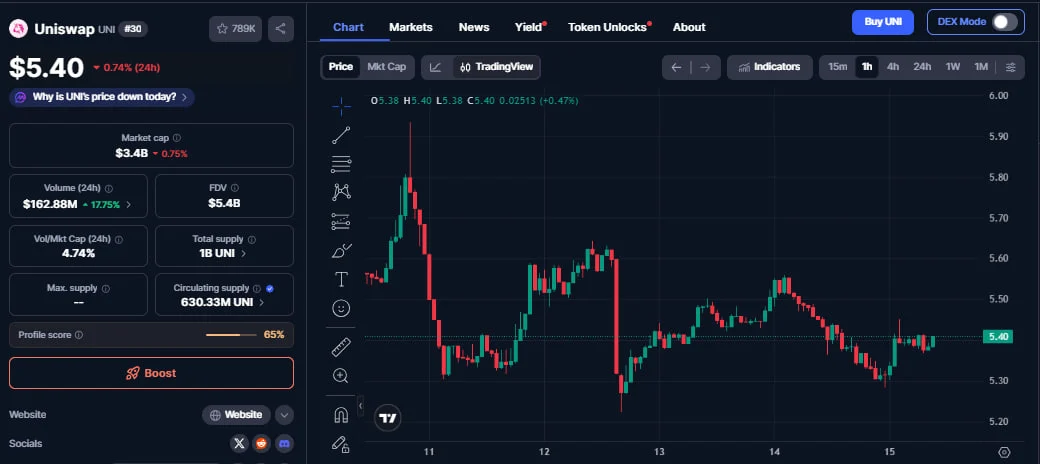
As the market absorbs the implications of recent on-chain activity, UNI is currently wavering near the $5.40 mark, reflecting a marginal 2.78% downward adjustment over a 24-hour window. The asset’s daily and weekly charts illustrate a classic post-rally retracement phase, where aggressive buying momentum has fully dissipated, giving way to extended periods of consolidation near local lows.
From a technical perspective, market analysts are closely monitoring key support and resistance boundaries to determine the next directional move for the decentralized exchange token. The immediate overhead hurdle rests within the $5.80 to $6.00 supply zone. Should broader market conditions improve and trading volumes expand sufficiently to clear this barrier, bullish momentum could propel the altcoin toward a secondary target of $6.50. Sustained buying pressure beyond that level might open the door for a more aggressive recovery rally toward $7.50, and potentially test the $8.50 resistance ceiling. Achieving this upper target would represent a recovery of approximately 60% from the token’s current market valuation.
Conversely, the downside risks remain prominent given the lack of robust macroeconomic catalysts. Uniswap currently boasts a critical historical support foundation between $5.10 and $5.20. A failure by the bulls to defend this crucial range would likely invalidate any immediate bullish upside scenarios, inviting intensified selling pressure. Persistent bearish momentum below this support zone could drag the token down toward psychological floors at $5.00, with further downside exposure potentially extending toward $4.50 and the foundational $4.00 support level. Given the prevailing macro headwinds and the symbolic exit of influential stakeholders, market technicians note that the path of least resistance for UNI currently tilts toward the downside.

Implications for the Broader DeFi Ecosystem and Bitcoin’s Dominance
The recent price behavior of Uniswap underscores a broader truth within the digital asset economy: altcoins and decentralized finance tokens remain fundamentally tethered to the performance of the sector’s bellwether, Bitcoin. As long as Bitcoin remains constrained beneath vital psychological and technical milestones, sustained independent rallies across the altcoin market face severe structural limitations.
Market analysts emphasize that a true reversal of sentiment across the entire cryptocurrency landscape will likely require Bitcoin to decisively conquer immediate overhead resistance at $94,000 and subsequently reclaim the milestone $100,000 threshold. Until flagship assets establish a decisive bullish trend supported by robust institutional inflows and expanding market liquidity, secondary tokens like UNI will likely remain vulnerable to macroeconomic pressures, localized profit-taking, and the psychological ripple effects caused by high-profile on-chain transactions. As the market navigates this period of consolidation and uncertainty, participants across the ecosystem continue to monitor macroeconomic indicators, exchange reserves, and wallet movements from industry leaders to gauge the trajectory of the upcoming market cycles.