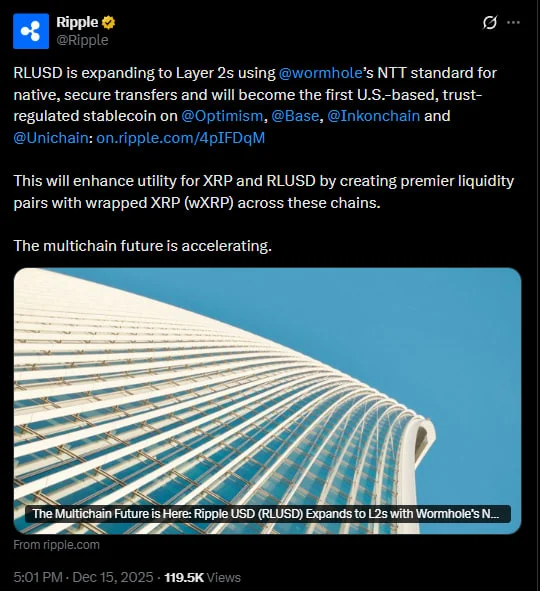
The modern cryptocurrency landscape is undergoing a structural transformation, shifting away from isolated blockchain ecosystems toward a highly interconnected, multi-chain environment. As institutional players, developers, and everyday users increasingly demand the flexibility to move capital seamlessly across different networks based on utility and market opportunities, stablecoins have emerged as the foundational pillars of the digital asset economy. Recognizing this paradigm shift, blockchain infrastructure firm Ripple has officially announced the commencement of testing for its flagship U.S. dollar-pegged stablecoin, RLUSD, across several prominent Ethereum Layer 2 (L2) networks.
Announced on December 15, this strategic testing phase represents a critical milestone leading up to the asset’s anticipated public debut in 2026, pending final regulatory approval. By deploying RLUSD onto high-throughput Layer 2 environments—specifically Base, Unichain, and Ink—Ripple is positioning its regulatory-compliant stablecoin directly where high-frequency user engagement and decentralized finance (DeFi) activity are concentrated. To facilitate secure and fluid cross-chain operability, Ripple has integrated Wormhole’s Native Token Transfers (NTT) standard, ensuring that RLUSD maintains unified liquidity and native issuance control while operating across diverse blockchain ecosystems.
The Strategic Evolution of Ripple’s RLUSD Stablecoin
The journey of Ripple’s RLUSD stablecoin is rooted in the company’s broader vision to bridge traditional financial systems with decentralized infrastructure. As the regulatory framework surrounding digital assets matures, institutional market participants have repeatedly emphasized the need for stablecoins that not only offer deep liquidity and price stability but also adhere to stringent compliance and regulatory standards. RLUSD has been meticulously engineered to fulfill these prerequisites, operating under a U.S. Trust regulatory framework designed to give institutional investors the confidence required to enter the on-chain economy.
Jack McDonald, Ripple’s Senior Vice President of Stablecoins, underscored the significance of the latest deployment during the December announcement. He noted that RLUSD was conceptualized from the ground up to serve as a trusted, highly liquid medium of exchange, empowering users to seamlessly enter, interact with, and exit the broader digital asset economy. According to McDonald, introducing the first U.S. trust-regulated stablecoin to these advanced L2 networks does more than simply expand utility; it establishes a definitive industry standard where strict regulatory compliance and optimal on-chain efficiency converge.
Chronology of Ripple’s Stablecoin Development and Expansion
To understand the weight of the current Layer 2 testing phase, it is essential to examine the chronological progression of Ripple’s stablecoin initiatives. The conceptualization and private testing phases of RLUSD began well before its public disclosures, driven by Ripple’s ambition to capture a significant share of the rapidly growing stablecoin market, which has historically been dominated by a few legacy issuers.
Following initial developmental milestones and internal stress-testing on proprietary ledgers, Ripple steadily advanced toward broader network integrations. Throughout 2024 and 2025, the company focused on establishing the necessary compliance frameworks, custodial partnerships, and technological architecture required for a secure multi-chain rollout. The decision to initiate live testing on Ethereum Layer 2 networks in December 2025 marks the transition from closed-environment engineering to real-world infrastructure validation. This testing phase will run concurrently with ongoing regulatory reviews, paving the way for a fully sanctioned public rollout slated for 2026.
Why Ethereum Layer 2 Networks Matter for Enterprise Stablecoins
The choice of Ethereum Layer 2 networks as the proving ground for RLUSD is a calculated response to the technical and economic realities of the current blockchain sector. While the primary Ethereum mainnet remains the premier settlement layer for high-value transactions and foundational security, it frequently suffers from network congestion and elevated gas fees during periods of peak market demand. These friction points render mainnet transactions less practical for high-frequency trading, microtransactions, and day-to-day decentralized applications.
Layer 2 scaling solutions—such as Optimism-stack chains and rollups—have successfully addressed these limitations by offloading execution from the mainnet while inheriting Ethereum’s robust cryptographic security. Consequently, L2s have evolved into the primary economic hubs for retail users, decentralized finance protocols, and digital payment systems. By launching RLUSD across platforms like Base, Unichain, and Ink, Ripple is ensuring that its stablecoin is directly accessible where organic user activity and developer innovation are thriving.
Furthermore, the initial rollout leverages Optimism-based infrastructure, allowing RLUSD to tap into established liquidity pools and active user communities. This strategic alignment minimizes friction for developers seeking to incorporate a fully compliant, fiat-backed stablecoin into their decentralized applications without sacrificing transaction speed or cost-efficiency.

The Technological Backbone: Wormhole’s Native Token Transfers (NTT) Standard
A major engineering challenge in multi-chain stablecoin deployment is avoiding liquidity fragmentation. When a token is bridged across multiple blockchains, it often results in wrapped versions of the asset, which can introduce security vulnerabilities, liquidity silos, and user confusion. To circumvent these hurdles, Ripple has partnered with Wormhole to utilize its Native Token Transfers (NTT) standard.
The Wormhole NTT framework provides a standardized architecture for moving tokens natively across different blockchain networks without the security risks associated with traditional lock-and-mint bridging models. Under this configuration, Ripple retains absolute native issuance control and governance over RLUSD, ensuring that the supply remains strictly backed and compliant. Simultaneously, users benefit from the flexibility and security of transferring liquidity fluidly across newly integrated ecosystems like Base, Unichain, and Ink.
By utilizing the NTT standard, Ripple avoids the pitfalls of fragmented liquidity, ensuring that an RLUSD token on one L2 network holds equal value, utility, and security guarantees as an RLUSD token on any other supported chain. This unified approach is widely regarded by blockchain architects as the optimal method for scaling enterprise-grade assets across a fractured multi-chain universe.
Broader Market Context and Impact on the XRP Ecosystem
The rollout of RLUSD does not occur in a vacuum; it is deeply intertwined with the broader macroeconomic and cryptocurrency market trends. Stablecoins serve as the lifeblood of the digital asset economy, acting as the primary quoting currency for spot and derivatives trading, the collateral asset for decentralized lending markets, and the preferred vehicle for cross-border remittances. By embedding RLUSD into active Layer 2 environments, Ripple is actively expanding its footprint across the entire crypto value chain, indirectly reinforcing the utility and prominence of the broader XRP ecosystem.
At the time of the announcement, the wider cryptocurrency market was experiencing a period of macroeconomic consolidation and downward pressure. Bitcoin (BTC) was trading at approximately $87,700, struggling to break back above the crucial $90,000 threshold amid cautious investor sentiment. Concurrently, XRP was hovering near $1.93, reflecting a modest 3% retracement over the preceding 24 hours in alignment with broader market trends. Despite short-term price fluctuations dictated by macro sentiment, institutional developers and infrastructure providers continue to focus on long-term utility expansions, such as Ripple’s multi-chain stablecoin strategy.
Fact-Based Analysis of Implications for Competitors and Regulators
The entry of an enterprise-grade, U.S. trust-regulated stablecoin into the bustling Ethereum Layer 2 ecosystem carries significant implications for the existing competitive landscape. Currently, the stablecoin market is heavily concentrated, with a small number of issuers capturing the vast majority of market capitalization and daily trading volume. However, as institutional adoption accelerates, regulatory compliance, audit transparency, and cross-chain native interoperability are becoming the primary competitive differentiators.
By positioning RLUSD as a strictly regulated digital dollar that operates natively across multiple high-performance networks, Ripple is directly appealing to institutional clients who require legal certainty alongside technological efficiency. Regulators globally have increasingly scrutinized the stablecoin sector, demanding rigorous reserve attestations, transparent backing, and robust anti-money laundering (AML) controls. Ripple’s adherence to a U.S. Trust regulatory framework positions RLUSD favorably in an era of tightening compliance standards, potentially setting a compliance benchmark for future stablecoin issuances.
Conclusion and Outlook Toward 2026
Ripple’s decision to test RLUSD on Ethereum Layer 2 networks via Wormhole’s NTT standard marks a decisive step in the company’s multi-chain evolution. By bridging the gap between stringent regulatory compliance and high-speed on-chain efficiency, Ripple is building an infrastructure designed to accommodate the next wave of institutional and retail stablecoin adoption.
As the testing phase progresses across Base, Unichain, and Ink throughout the coming months, market observers will closely monitor technical performance, cross-chain liquidity depth, and developer adoption rates. With a targeted public launch in 2026 contingent upon regulatory milestones, RLUSD is well-positioned to become a major contender in the global stablecoin economy, redefining how compliant digital cash moves across the fragmented landscapes of modern decentralized finance.