The intersection of decentralized finance and traditional regulatory frameworks reached a notable milestone as Payward, the parent company of major cryptocurrency exchange Kraken, announced its intention to become the first Commodities Futures Trading Commission (CFTC)-regulated deployer on HIP-3 markets. Revealed through an official announcement on the social media platform X by Hyperliquid, the strategic initiative aims to bridge the gap between decentralized infrastructure and strict U.S. compliance standards. Pending final regulatory approval, the proposed arrangement will leverage the Hyperliquid network as the underlying infrastructure layer to deploy regulated perpetual futures markets tailored for clients residing in the United States.
Under the structural framework of the proposal, Bitnomial—Payward’s designated contract market (DCM) and derivatives clearing organization (DCO) that operates under the direct oversight of the CFTC—will assume the responsibilities of creating, owning, and administering the markets. Furthermore, Bitnomial will handle the critical functions of contract clearing and settlement, ensuring that the operations remain fully compliant with federal commodities regulations. The integration relies heavily on the HIP-3 extension framework, a technological update designed to introduce optional deployer configurations for permissioned markets. This activation mechanism functions through an on-chain allowlist that is strictly managed by the deployer, allowing institutional-grade compliance to merge seamlessly with high-throughput decentralized trading architecture.
Background Context of the Regulatory Integration
The digital asset industry has long faced regulatory friction regarding the offering of leveraged products, particularly perpetual futures, to retail and institutional participants based in the United States. While offshore decentralized exchanges (DEXs) have experienced exponential growth due to their permissionless nature and deep liquidity, they have simultaneously operated outside the perimeter of U.S. consumer protection and market integrity laws enforced by agencies like the CFTC.
Payward’s initiative represents a calculated shift in industry strategy. By utilizing a decentralized infrastructure layer while retaining centralized, regulatory-compliant oversight via Bitnomial, the firm is attempting to pioneer a hybrid model. This approach satisfies the stringent demands of U.S. regulators by embedding KYC (Know Your Customer) and AML (Anti-Money Laundering) protocols directly into the deployment layer via on-chain allowlists, while still benefiting from the technological efficiencies and speed offered by Hyperliquid. Market observers note that if this framework successfully clears regulatory hurdles, it could serve as a template for other traditional financial institutions and regulated crypto entities seeking to access decentralized liquidity pools without running afoul of federal laws.
Technical Architecture of the HIP-3 Framework

The deployment is anchored by the HIP-3 framework update, which introduces modular flexibility to decentralized order books and execution layers. Traditionally, decentralized exchanges operate on a fully permissionless basis, where any wallet can interact with deployed smart contracts. However, institutional adoption requires strict adherence to jurisdictional boundaries and regulatory mandates.
The HIP-3 extension addresses this challenge by introducing optional deployer configurations that allow regulated entities to establish permissioned markets. In the case of Payward’s proposed deployment, the activation and maintenance of these markets rely on an on-chain allowlist. This means that only verified U.S. clients who meet the eligibility criteria established by Bitnomial’s DCM and DCO mandates will be permitted to trade the perpetual futures contracts. By combining this cryptographic access control with Hyperliquid’s high-performance infrastructure, Payward aims to deliver an institutional-grade trading experience that preserves the transparency of on-chain settlement while adhering to traditional regulatory mandates.
HYPE Token Market Dynamics and Technical Overview
While the regulatory announcement marks a significant milestone for infrastructure integration, the native token associated with the underlying network, HYPE, has experienced a period of precarious short-term price consolidation and market testing. Over a recent 24-hour monitoring window, HYPE posted a modest gain of approximately 0.63%, a performance that closely mirrored the broader macro movements of Bitcoin and the wider altcoin sector.
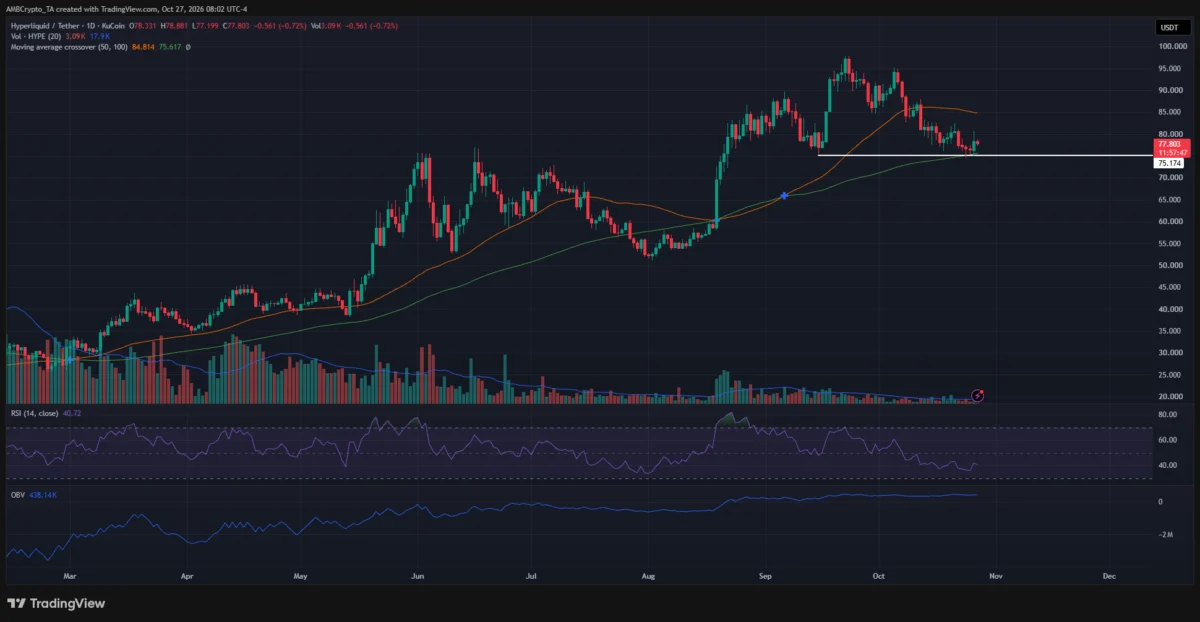
Despite enjoying a robust bullish trend for the majority of the year, daily timeframe charts indicate that HYPE’s upward trajectory faces a rigorous technical test. In recent sessions, token prices retreated to a local low of $74.50, placing immense pressure on critical technical support levels. Most notably, the 100-day moving average, positioned at $75.61, alongside the primary structural anchor of the bullish trend at $75.17, has come under siege. Financial analysts note that a definitive daily session close below either of these foundational thresholds would serve as an early warning indicator of a broader trend reversal into a bearish market phase.
On-Chain Volume Analysis and Selling Pressure
An examination of underlying market metrics reveals nuanced behavior among market participants. Despite a sustained price correction spanning a five-week period, on-chain analytics indicate that selling pressure has not reached overwhelming proportions. According to the On-Balance-Volume (OBV) indicator, trading volume metrics have managed to remain relatively close to yearly highs, even as overall trading activity experienced a slight contraction in recent weeks.
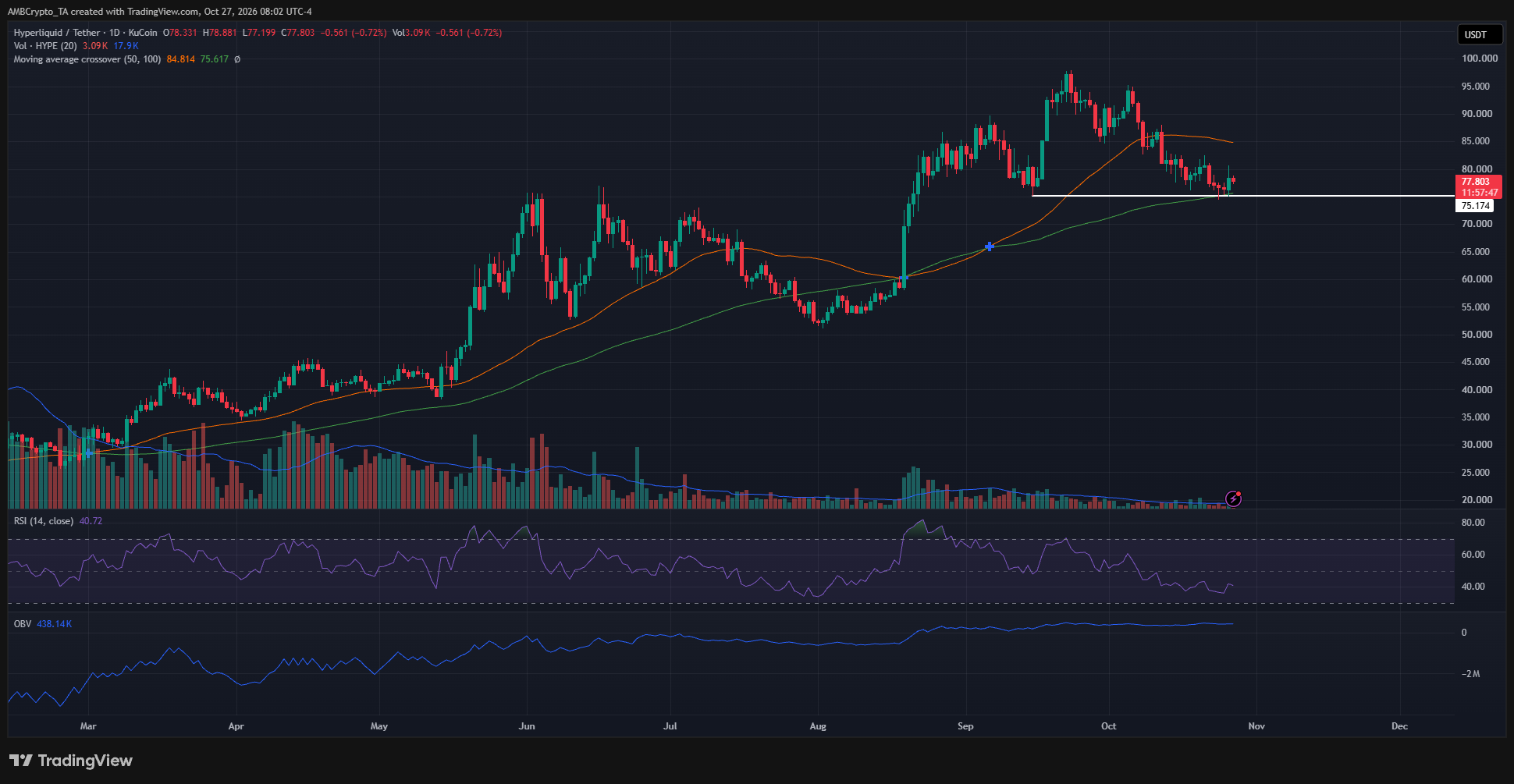
This relative resilience in volume metrics has provided a crucial buffer against more severe downside momentum. Market analysts suggest that the absence of aggressive liquidation selling is the primary factor preventing a steeper collapse in valuation, cushioning the blow of the broader correction that the decentralized exchange (DEX) altcoin sector has endured since September. Nonetheless, the lack of robust buying volume leaves the token vulnerable to prevailing macro trends until definitive bullish catalysts emerge.
Short-Term Price Action and 4-Hour Chart Structure
Zooming in on shorter timeframes, the market structure on the 4-hour chart remains predominantly bearish, though price action has established the $74.00 to $76.00 price band as a reliable local demand zone. Throughout October, HYPE prices have traded consistently below both the 50-period and 100-period moving averages on the 4-hour timeframe, indicating persistent short-term downward pressure.
A continuation of the bearish trend remains a distinct possibility, particularly if sellers manage to force a daily session close beneath the critical $75.17 support level. Conversely, for the market to regain its bullish momentum, short-term price action must decisively reclaim the 100-period moving average, supported by a resurgence in genuine buying demand. Until such a technical recovery materializes, traders are maintaining a cautious stance while monitoring macro regulatory developments and on-chain deployment updates.
Broader Industry Implications and Future Outlook
The collaboration between Payward, Bitnomial, and Hyperliquid underscores a broader evolution in the digital asset landscape, characterized by the convergence of decentralized technology and traditional regulatory compliance. As regulatory agencies globally increase their scrutiny of derivatives trading and cross-border financial services, firms are forced to innovate structurally to remain operational in key jurisdictions like the United States.
If Payward successfully secures regulatory approval to become the first CFTC-regulated deployer on HIP-3 markets, it could fundamentally alter how institutional derivatives are traded. By bridging the compliance framework of a designated contract market with the technological architecture of a high-performance decentralized ledger, the initiative paves the way for a new generation of hybrid financial products. Market participants and regulators alike will be closely monitoring the progress of this regulatory filing, as its success or failure could dictate the blueprint for institutional engagement with decentralized finance infrastructure for years to come.