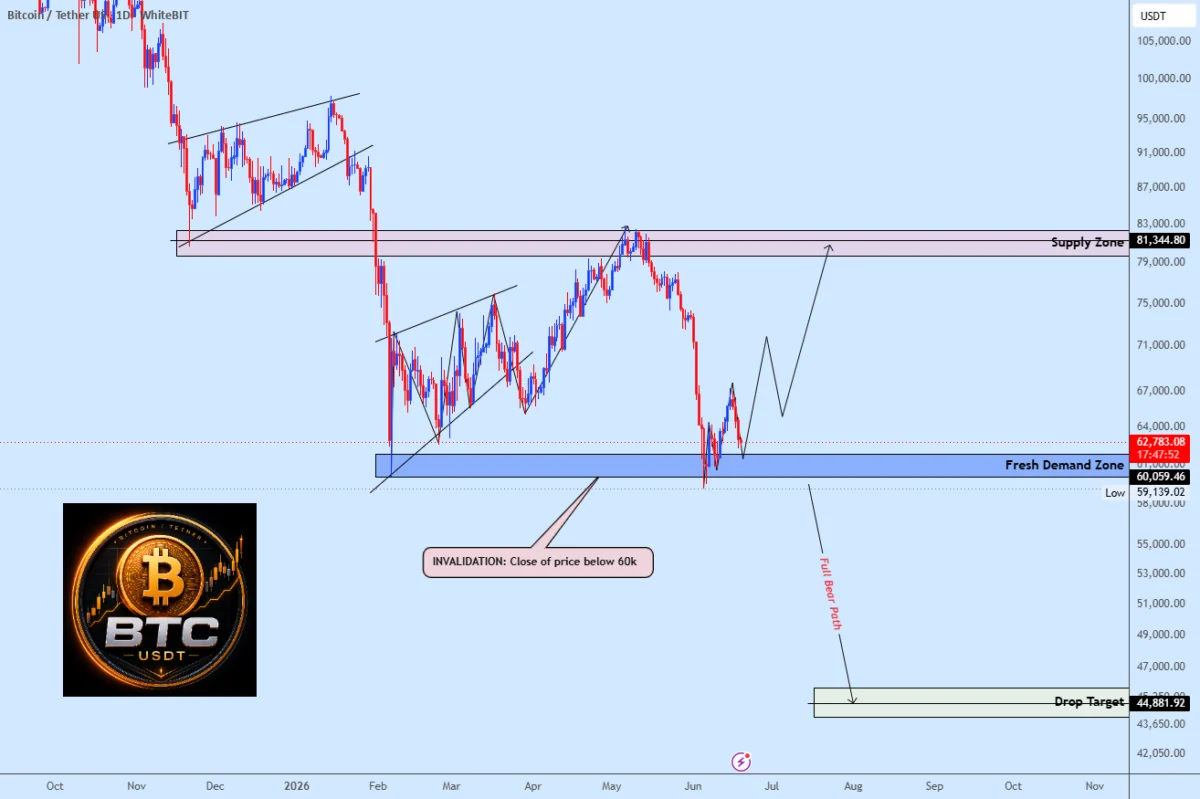
Bitcoin is currently navigating a pivotal juncture as its price tests the critical $60,000 threshold, a zone that market participants view as both a psychological anchor and a significant technical foundation. In a recent market assessment, technical analyst weslad highlighted the BTC/USDT pair’s descent into a fresh demand zone, characterizing the current price action as a high-stakes battle between institutional buyers and those looking to capitalize on recent downward momentum. As the cryptocurrency market grapples with this volatility, the $60,000 level has emerged as the definitive line in the sand, separating a potential recovery toward previous highs from the risk of a more protracted structural breakdown.
The Technical Significance of the $60,000 Support
The importance of the $60,000 mark is rooted in more than just round-number psychology; it represents a confluence of historical support and active order flow. When a digital asset consistently revisits a specific price level, it attracts liquidity from market makers, retail traders, and institutional algorithmic systems. According to technical analysis provided via TradingView, the current demand zone is acting as a "do-or-die" threshold for bullish sentiment.
For traders and analysts, the $60,000 level is considered the primary defense for the prevailing uptrend. If buyers can maintain their presence within this zone, it provides a logical foundation for a relief rally. Conversely, a failure to defend this area could trigger a cascading effect. When major support levels are breached, they often result in the liquidation of long positions, as stop-loss orders are triggered across centralized and decentralized exchanges. This forced selling pressure can exacerbate a decline, turning a technical retracement into a deeper market correction.
Chronology of the Recent Market Contraction
To understand the current volatility, one must look at the broader timeline of Bitcoin’s performance over the second quarter. Following a period of relative stability, Bitcoin faced downward pressure throughout June, driven by a combination of macroeconomic headwinds and reduced appetite for risk-on assets.
In early June, Bitcoin maintained a trading range between $65,000 and $68,000. However, mid-month reports indicated a shift in market sentiment, with selling pressure mounting as global interest rate expectations remained uncertain. By June 20, the asset had officially breached the $62,000 floor, sliding into the $60,000 range. This period was marked by increased volume on major exchanges, suggesting that market participants were actively rebalancing portfolios in response to the tightening price action. The current phase, beginning in the final week of June, is defined by this ongoing test of support, with market watchers monitoring the hourly and daily closing prices for signs of a definitive reversal or a continuation of the trend.

Market Data and Liquidity Dynamics
Liquidity plays a central role in the current price environment. Market analysts often refer to the $81,000 level as a primary "supply area"—a price point where previous selling volume was concentrated. If Bitcoin successfully holds the $60,000 floor, the path of least resistance for a short-term recovery leads toward this $81,000 target. This move would represent a return to the origin of the recent decline, effectively "sweeping" liquidity and validating the bull case.
Data from derivative markets currently reflect a cautious outlook. Open interest—the total number of outstanding derivative contracts—has remained high despite the price drop, indicating that traders are still heavily positioned, albeit with increased anxiety. The funding rates on perpetual futures, which measure the cost of holding long or short positions, have fluctuated, suggesting that the market is currently in a state of equilibrium, awaiting a clear catalyst to dictate the next directional move.
Implications of a Potential Breakdown
The consequences of a breach below $60,000 are significant for the broader crypto ecosystem. Historically, Bitcoin acts as the bellwether for the entire digital asset class. A decisive close below this psychological barrier would likely invalidate the prevailing bullish thesis that has dominated the market since the start of the year.
If $60,000 fails to hold, the next major support levels—historically identified by volume profile indicators—lie significantly lower, potentially in the $52,000 to $55,000 range. Such a breakdown would likely lead to a shift in market narrative from "buying the dip" to "capital preservation." Institutional investors, who have become increasingly involved through spot Bitcoin ETFs, would also be forced to re-evaluate their entry strategies, potentially slowing the rate of inflows into the sector.
Expert Perspectives on Market Resilience
While the technical indicators suggest caution, many analysts argue that the current market structure is inherently more resilient than in previous cycles. The presence of institutional-grade custody solutions and the maturation of the ETF market provide a buffer that was absent during the 2021-2022 market cycles.
"The current test is a healthy exercise in market discovery," noted one industry commentator. "While the $60,000 level is technically vulnerable, the underlying demand for Bitcoin as a hedge against fiat debasement remains robust." This perspective suggests that even if a deeper correction occurs, it may not signify the end of the long-term cycle, but rather a necessary recalibration of the market’s leverage ratios.

Strategic Considerations for Market Participants
For those monitoring the market, the current setup is inherently binary. The recovery case rests on the ability of bulls to defend the $60,000 zone, reclaim local resistance levels, and prove that the recent selloff has reached an exhaustion point. A sustained period of consolidation within this zone could provide the necessary base for a trend reversal.
However, caution remains the prevailing sentiment. Professional traders are advised to watch for "volume confirmation" on any moves away from the $60,000 level. A move upward without a corresponding increase in volume might be viewed as a "dead cat bounce," whereas a move upward supported by high volume would signal a stronger conviction among buyers.
Broader Macroeconomic Context
The volatility in Bitcoin cannot be divorced from the wider macroeconomic climate. Central bank policies, particularly those from the U.S. Federal Reserve regarding interest rates, continue to dictate the liquidity environment for risk assets. When interest rates are elevated, capital tends to flow toward safer, yield-bearing assets, reducing the flow of liquidity into more volatile instruments like Bitcoin.
Furthermore, geopolitical tensions and their subsequent impact on inflation expectations serve as background noise that can influence market sentiment at any moment. As Bitcoin continues to transition from a niche asset to a mainstream institutional investment, its correlation with traditional market indicators—such as the S&P 500 and the U.S. Dollar Index—has become increasingly complex. Traders must now account for these macroeconomic variables alongside the standard technical patterns identified by analysts like weslad.
Conclusion: The Road Ahead
As the market moves into the next phase of its cycle, the $60,000 test remains the defining event of the quarter. The ability of Bitcoin to maintain its footing will dictate not only its own price trajectory but also the confidence levels of retail and institutional participants alike.
Whether the market experiences a swift recovery toward the $81,000 supply zone or a deeper correction, the current period serves as a critical reminder of the volatility inherent in digital assets. Market participants are advised to monitor official exchange data and technical trends closely, as the market is expected to remain reactive to any new information regarding interest rates or institutional accumulation. For now, all eyes remain fixed on the $60,000 handle, waiting to see if the bulls can hold the line or if a new, more difficult chapter for the cryptocurrency market is set to begin.