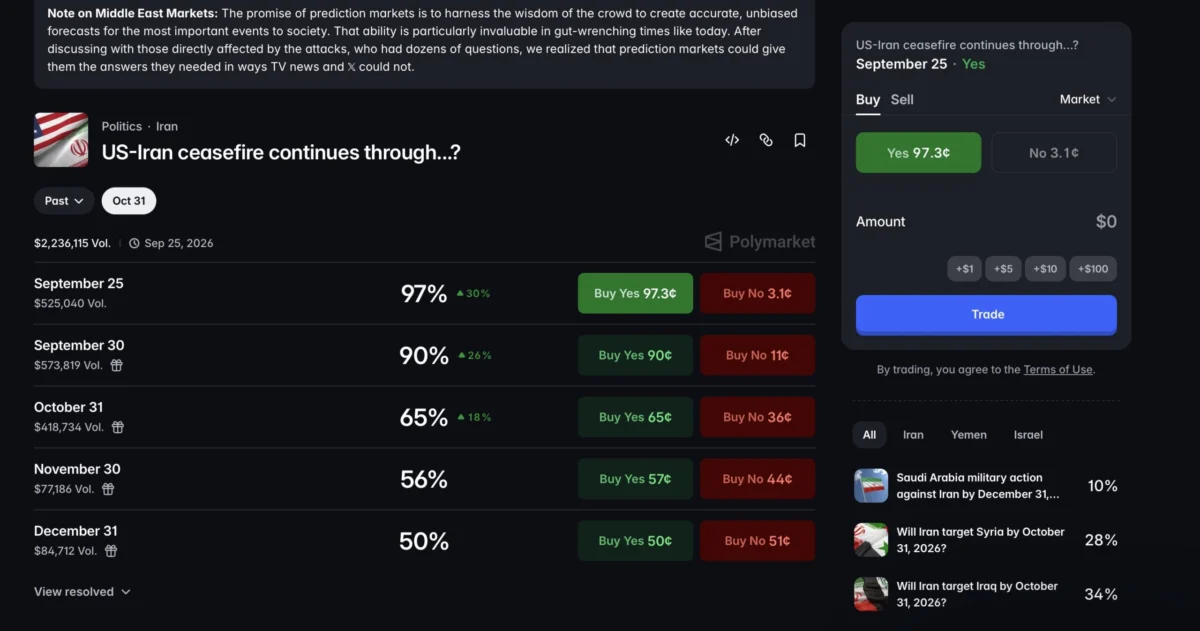
Prediction markets on Polymarket have registered a dramatic surge of short-term optimism regarding US-Iran relations, pricing the continuation of a fragile de-facto ceasefire at roughly 97% through September 25, 2026. As the window extends slightly to September 30, confidence softens marginally to approximately 90%. However, geopolitical analysts and market participants emphasize that these high probabilities do not reflect a permanent peace settlement or a finalized diplomatic accord. Instead, they represent narrow, date-specific wagers contingent upon a single binary condition: whether the United States initiates a qualifying military action against Iran before the specified deadlines.
The nuanced mechanics of these contracts highlight the hypersensitivity of decentralized prediction platforms to shifting geopolitical winds. While diplomatic channels remain active via international intermediaries, the underlying structural conflict between Washington and Tehran remains largely unresolved. The rapid drop of seven percentage points between the September 25 and September 30 contracts underscores how quickly market confidence erodes as the time horizon for potential escalation expands.
Understanding the Mechanics of US-Iran Prediction Market Contracts
To properly interpret the pricing on Polymarket, observers must look past surface-level assumptions about global peace. The current market listings price the September 25 outcome at roughly 97% in favor of "Yes" and 3% for "No," while the September 30 outcome hovers around 90% "Yes" and 10% "No." The lower valuation for the longer-dated contract directly correlates with the cumulative risk of an unforeseen military escalation over a more extended period.
The definitive trigger for these contracts is strictly mechanical. The resolution hinges entirely on whether the United States conducts a qualifying military operation against Iranian assets or personnel before the expiration of the respective deadlines. Broader geopolitical tensions, regional proxy skirmishes, verbal threats, and diplomatic standoffs do not inherently invalidate the "Yes" outcome unless they cross the threshold into direct, qualifying US military action. Consequently, traders are pricing near-term operational calm rather than a verified, comprehensive geopolitical treaty. This distinction is critical for researchers and analysts who utilize prediction market odds as real-time sentiment indicators rather than definitive forecasts of state behavior.

Chronology of a Collapsed Framework and Renewed Mediation
The current state of US-Iran relations is the product of a volatile trajectory marked by alternating cycles of military confrontation and hurried diplomatic intervention. The modern diplomatic framework trace back to a Memorandum of Understanding established in June 2026. That agreement was designed to formalize a pause in hostilities following a series of kinetic strikes in February 2026. The primary objectives of the June framework included reopening the critical maritime transit corridor through the Strait of Hormuz and initiating a strict 60-day window for comprehensive nuclear and sanctions-relief negotiations.
However, the framework proved exceptionally brittle. Throughout June and early July 2026, both Washington and Tehran accused each other of persistent violations. The situation deteriorated further following renewed US military strikes and Iranian-backed disruptions targeting commercial shipping lanes in the Persian Gulf. By early July 2026, US President Donald Trump publicly declared the diplomatic framework defunct, leading to a return of intermittent military exchanges and heightened regional posturing.
Despite the collapse of the formal framework, backdoor diplomacy persisted through regional intermediaries, most notably Pakistan and Qatar. By late September 2026, diplomatic pressure intensified. On September 22, President Trump offered optimistic remarks during a public address, suggesting that a formal settlement with Iran might materialize sooner than previously anticipated. Concurrently, Iranian Foreign Minister Abbas Araghchi engaged with international counterparts, formally submitting Iran’s baseline conditions for reopening the Strait of Hormuz. Tehran’s demands centered on the immediate lifting of the active US naval blockade and the release of billions of dollars in frozen Iranian assets overseas. While these diplomatic exchanges signal a desire on both sides to de-escalate immediate maritime tensions, neither development has culminated in a signed, legally binding bilateral treaty.
Key Variables Shaping Prediction Market Odds
Market analysts tracking decentralized prediction platforms have identified four primary variables that historically drive sudden fluctuations in US-Iran event contracts:
- Shifts in US Military Posture: Any unscheduled movement of carrier strike groups, strategic bomber deployments, or changes in regional force readiness immediately rattles short-term contracts.
- Iranian Compliance and Signaling: Official statements from Tehran regarding uranium enrichment levels, ballistic missile testing, or cooperation with international maritime monitors serve as immediate catalysts for market re-pricing.
- Proxy Dynamics and Regional Flashpoints: Activities involving aligned militant networks in Lebanon, Iraq, or Yemen introduce systemic risk, testing the boundaries of what constitutes a localized skirmish versus a wider state-level escalation.
- Diplomatic Breakthroughs or Breakdowns: Sudden announcements regarding backchannel talks mediated by neutral third-party states often trigger rapid buying or selling sprees on platform event pages.
Historical Precedents and Market Sensitivity
This is not the first instance in which decentralized prediction markets have reacted violently to diplomatic headlines concerning the Middle East. Earlier in the 2026 legislative and geopolitical cycle, similar peace-deal signals triggered sharp reactions across both prediction markets and correlated risk-on assets, including brief rallies in cryptocurrencies such as Bitcoin as traders priced in the deflation of geopolitical risk premiums.
However, historical episodes demonstrate that prediction market odds can shift dramatically within minutes based on unverified rumors or abrupt press briefings, often decoupling from the deeper realities of protracted state conflicts. While the 97% probability for late September reflects strong short-term confidence among traders, it serves primarily as a barometer of immediate operational restraint rather than an institutional guarantee of long-term regional stability.
Broader Implications and Analytical Takeaways
The heavy reliance on binary, event-driven contracts on platforms like Polymarket highlights a broader evolution in how global macroeconomics and geopolitical intelligence are consumed and priced. Traditional intelligence assessments often rely on classified briefings, diplomatic cables, and delayed reporting. In contrast, prediction markets aggregate crowd-sourced sentiment in real-time, providing an instantaneous reflection of how capital views imminent existential risks.
Nevertheless, experts caution against treating prediction market probabilities as infallible geopolitical oracles. The distinction between a temporary cessation of hostilities and a permanent diplomatic resolution remains vast. As the deadlines for the September 25 and September 30 contracts approach, traders and analysts will continue to monitor military telemetry, official state communications, and mediator updates to assess whether the fragile status quo can hold against the persistent friction of deep-seated geopolitical rivalries.