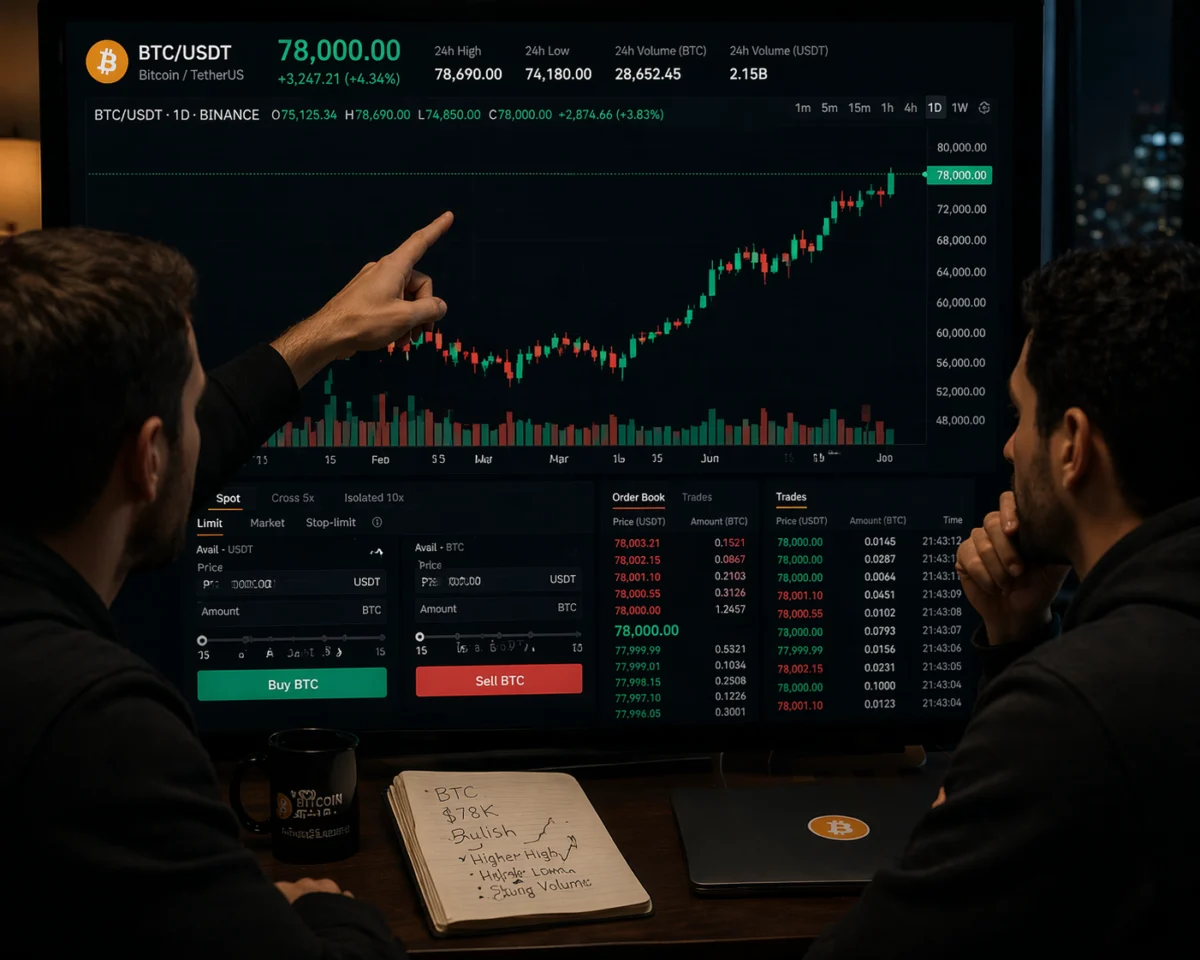
Bitcoin extended its robust weekly recovery on Wednesday, breaching the $78,000 threshold following a notable 6% market-wide rally. The world’s leading cryptocurrency reached its highest valuation since February 3, touching $78,452, as macro-economic tailwinds and geopolitical developments converged to revitalize risk-on sentiment across global digital asset exchanges. While institutional demand via spot Exchange-Traded Funds (ETFs) experienced a temporary cooling off-period, broader macroeconomic factors—specifically a historic debt buyback program by the United States Treasury and a crucial extension of regional ceasefires—provided the primary catalysts for the upward price movement.
Geopolitical De-escalation Fuels Risk-On Rally
The primary driver behind Bitcoin’s mid-week surge stems from unexpected geopolitical developments in the Middle East and South Asia. Late Tuesday, US President Donald Trump announced the extension of a critical two-week ceasefire agreement. Originally scheduled to expire on April 22, the truce was prolonged following a formal diplomatic request from Pakistan, pending the delivery of a unified, comprehensive peace proposal from Tehran to Washington.
Although the White House stressed that existing economic sanctions and the strategic blockade of Iranian seaports would remain fully operational to maintain pressure, the diplomatic extension was widely interpreted by global markets as a significant step away from imminent military escalation. Financial markets reacted swiftly to the news of prolonged talks. Equities, commodities, and risk-sensitive assets experienced broad relief rallies. As a premier macro-hedge and digital risk asset, Bitcoin captured a substantial share of this renewed capital inflow, climbing steadily through Asian and European trading hours before consolidating above the $78,000 mark.
US Treasury Liquidity Injection Set to Bolster Markets
Compensating for what appeared to be a momentary plateau in direct institutional crypto product purchasing, macroeconomic liquidity injections are expected to provide foundational support for Bitcoin’s ongoing price action.
The US Treasury is poised to execute a $15 billion debt buyback operation, matching the largest such liquidity-injection maneuver in modern financial history. When sovereign treasuries buy back their own debt, they systematically release excess capital back into the broader financial system. Historically, this liquidity tends to overflow into alternative risk-on assets, equities, and cryptocurrencies. Market analysts note that Bitcoin, which has increasingly correlated with global liquidity cycles over the past several years, stands to benefit immensely from this influx of fresh capital. The injection acts as a monetary tailwind, potentially insulating digital assets against minor macroeconomic corrections and driving sustained retail and institutional interest.
Institutional Inflows Cool as Investors Exercise Caution
Despite the soaring price action, institutional metrics revealed a more cautious approach among traditional investors on Tuesday. US-based Bitcoin spot ETFs recorded a modest net inflow of $11.84 million, marking a sharp deceleration from the $238.37 million registered just 24 hours prior.
Market analysts attribute this sudden contraction in ETF volume to persistent uncertainty surrounding the fragile peace negotiations between the United States and Iran. While macro traders have embraced the ceasefire extension, institutional allocators often require prolonged stability and concrete diplomatic resolutions before committing large-scale capital to volatile asset classes. However, financial experts emphasize that even minor positive net inflows during a period of geopolitical uncertainty signal underlying structural demand. Should formal peace proposals materialize in the coming days, institutional inflows are widely anticipated to rebound, providing the necessary volume to challenge higher psychological resistance levels.

Technical Analysis: Bullish Momentum Remains Intact
From a technical perspective, the short-term outlook for the BTC/USD trading pair remains decisively bullish. On the 4-hour chart, Bitcoin continues to trade comfortably above its key moving averages, reinforcing the strength of the current rally.
As of Wednesday, Bitcoin is well above both its 50-day and 100-day Exponential Moving Averages (EMAs), which currently sit at $72,345 and $75,368, respectively. These moving averages have transformed from overhead resistance barriers into robust floors for the asset, limiting downside risk during intraday retracements.
Momentum indicators further validate the bullish thesis. The Relative Strength Index (RSI) remains in positive territory without entering overbought conditions, while the Moving Average Convergence Divergence (MACD) histogram continues to print constructive, upward-trending values. This indicates that buyers retain firm control over the market structure.
Key Resistance and Support Levels to Watch
Navigating the current price landscape requires close monitoring of established technical boundaries. On the upside, immediate resistance is clustered around the 50% Fibonacci retracement level, positioned near $78,962. A decisive break above this threshold would open the path toward the psychological $80,000 milestone. Further up, the 200-day EMA at $82,769 represents the ultimate medium-term barrier for the ongoing bull cycle.
Conversely, should the market experience a localized correction due to profit-taking or sudden geopolitical developments, initial support is anticipated at the prior channel top near $75,680. Additional downside protection is provided by the 100-day EMA at $75,368 and the 38.2% Fibonacci retracement level at $74,487. Deeper support levels rest at the 50-day EMA near $72,345, with the lower boundary of the prevailing ascending channel offering a final major structural safety net around $62,950.
Broader Market Implications and Future Outlook
The convergence of geopolitical de-escalation, massive sovereign debt buybacks, and resilient technical indicators has positioned Bitcoin for a potentially transformative second quarter. While retail traders are aggressively driving spot prices upward, the cautious stance of ETF investors underscores a market transitioning between macro-driven speculation and institutional maturation.
As global central banks and treasuries navigate complex economic landscapes, the role of decentralized, alternative stores of value continues to evolve. Whether Bitcoin can sustain its momentum past the $80,000 threshold will largely depend on the tangible outcomes of ongoing diplomatic talks in Washington and Tehran, as well as the immediate velocity of the capital injected by the upcoming Treasury buyback. For now, market participants remain cautiously optimistic, with technical setups favoring continued consolidation and upward continuation in the near term.