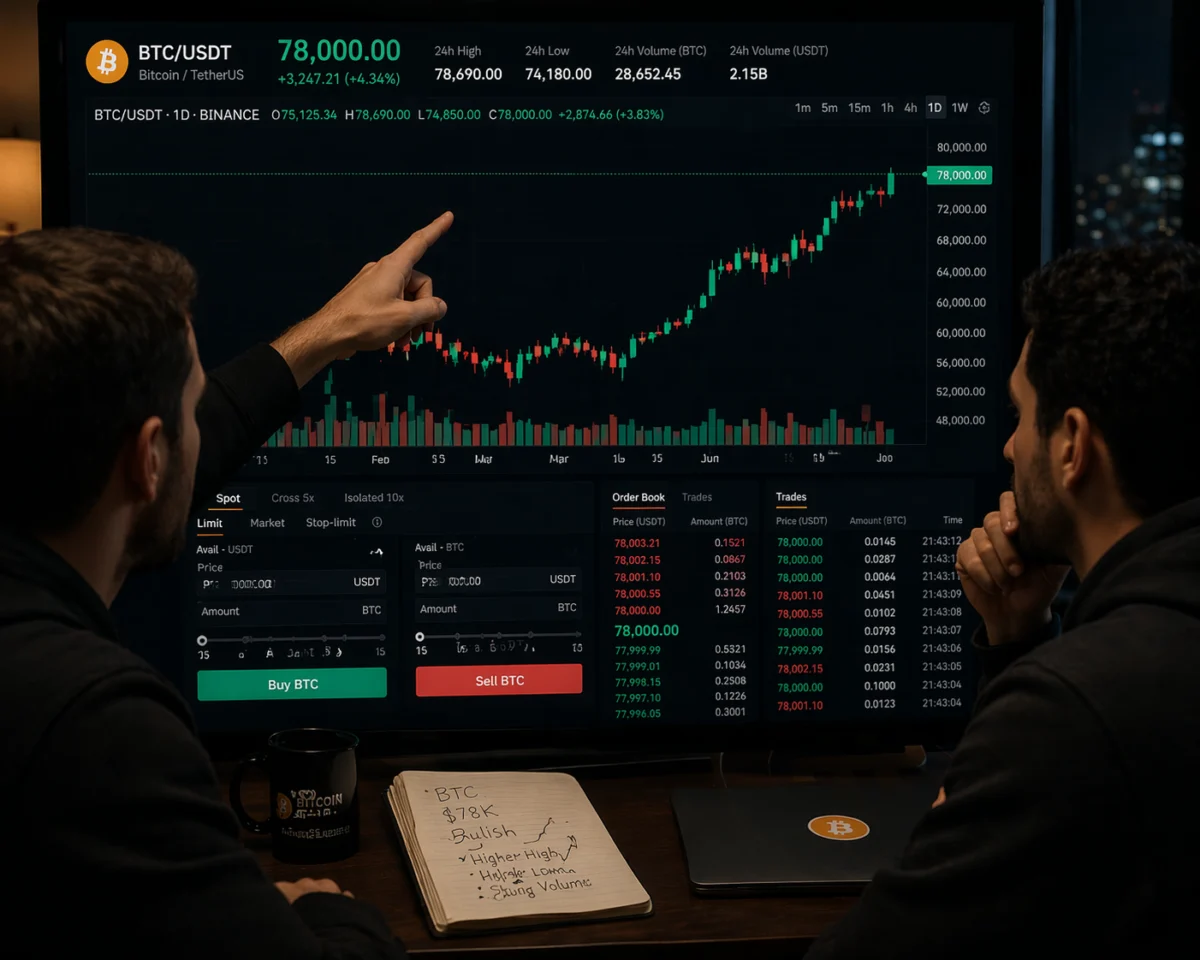
Bitcoin (BTC) pushed past the $78,000 threshold on Wednesday, extending a robust 6% weekly rally that has propelled the world’s leading digital asset to its highest valuation since February 3. The upward movement was catalyzed by a combination of macro-level geopolitical developments, specifically an extension to an ongoing regional ceasefire brokered by the United States, and impending macroeconomic liquidity injections from the US Department of the Treasury. While institutional appetite, as measured by spot exchange-traded fund (ETF) inflows, temporarily cooled, the broader technical and fundamental outlook remains firmly tilted in favor of the bulls.
Geopolitical Catalysts: Ceasefire Extension Lifts Risk Sentiment
The primary driver behind Bitcoin’s latest mid-week rally stems from foreign policy updates emanating from Washington. Late Tuesday, US President Donald Trump announced an extension to a critical two-week ceasefire agreement originally designed to calm tensions in a tense bilateral standoff involving Iran. The truce, which had faced an impending expiration date on April 22, was extended following a diplomatic request from Pakistan until Washington receives a comprehensive and unified peace proposal directly from Tehran.
Despite the diplomatic opening, the administration maintained a hardline stance on specific economic pressure points, emphasizing that the ongoing US blockade of Iranian seaports would remain fully intact. Nevertheless, financial markets interpreted the preservation of the ceasefire as a vital de-escalation signal. Risk assets globally reacted favorably, with equities and cryptocurrencies experiencing broad relief rallies. For Bitcoin, the renewed risk-on appetite served as the necessary catalyst to breach resistance zones, driving the cryptocurrency to a peak of $78,452 during Wednesday’s trading session.
Market analysts note that Bitcoin has increasingly behaved as a high-beta risk asset during periods of acute geopolitical uncertainty, initially dipping on conflict fears before staging sharp recoveries once diplomatic channels yield tangible pauses in hostilities.
Macroeconomic Tailwinds: US Treasury Readies Historic Buyback
Beyond geopolitical shifts, cryptocurrency markets are bracing for a massive injection of domestic liquidity that could further undergird Bitcoin’s price momentum through the remainder of the quarter. The US Treasury is poised to execute a $15 billion debt buyback program, matching one of the largest such operations in the nation’s history.
Debt buybacks by the central government typically inject substantial liquidity back into the primary financial system by retiring outstanding securities and returning cash to institutional balance sheets. As a recognized liquidity-sensitive asset, Bitcoin has historically flourished in environments characterized by expanding monetary liquidity and excess capital looking for yield or alternative stores of value. Market participants are anticipating that a portion of the newly released capital will find its way into digital asset portfolios, providing a sustained floor for prices even if traditional equity markets experience volatility.
This upcoming liquidity wave comes at a crucial time for market structure, offsetting what has otherwise been a period of cautious capital deployment by institutional investors.
Institutional Inflows Moderate Amid Ongoing Policy Uncertainty
While macroeconomic and geopolitical factors provided strong tailwinds, institutional engagement through US-listed spot Bitcoin ETFs experienced a notable cooling-off period on Tuesday. According to market tracking data, spot Bitcoin ETFs recorded modest net inflows of just $11.84 million, marking a steep contraction compared to the $238.37 million registered just one day prior.

This dramatic deceleration highlights a lingering sense of caution among institutional allocators, who continue to weigh the fragile nature of the ongoing US-Iran peace talks against long-term macroeconomic trends. Wealth managers and corporate treasuries appear hesitant to commit large blocks of capital while the final terms of any potential long-term diplomatic accord remain unwritten.
However, market observers emphasize that the persistence of net-positive inflows—even at reduced volumes—demonstrates that institutional investors are maintaining exposure rather than executing mass liquidations. Industry analysts suggest that if peace talks formalize into a lasting treaty or if ETF inflows rebound toward their previous multi-hundred-million-dollar averages, Bitcoin will have the requisite institutional backing to challenge higher psychological resistance levels.
Technical Outlook: Bullish Momentum Firmly Intact
From a technical perspective, the short-term price structure for the BTC/USD pair remains firmly constructive. On the 4-hour charts, Bitcoin continues to trade comfortably above its primary trend indicators, specifically the 50-day and 100-day Exponential Moving Averages (EMAs), which currently sit at $72,345 and $75,368, respectively.
Momentum oscillators support the continuation of the bullish trend. Both the Relative Strength Index (RSI) and the Moving Average Convergence Divergence (MACD) indicator remain in positive territory, signaling that buyers retain control of the intraday market dynamics.
Immediate overhead resistance is concentrated near the 50% Fibonacci retracement level, calculated at approximately $78,962. A decisive break above this barrier would open the path toward the psychological $80,000 threshold, followed by a sterner test at the 200-day EMA, positioned at $82,769.
Conversely, should macroeconomic headwinds or sudden geopolitical headlines trigger a short-term correction, the market benefits from a dense cluster of supportive price floors. Initial downside support is located around the prior channel top at $75,680, reinforced closely by the 100-day EMA at $75,368 and the 38.2% Fibonacci retracement level at $74,487. Deeper pullbacks would likely find robust institutional defense at the 50-day EMA near $72,345, with the ultimate structural boundary resting along the lower ascending channel near $62,950.
Broader Implications and Market Outlook
The convergence of geopolitical de-escalation in the Middle East and expansive fiscal maneuvering by the US Treasury has created a uniquely supportive environment for digital assets as the second quarter progresses. While risks remain—particularly regarding the unpredictable trajectory of international diplomacy and regulatory oversight—Bitcoin’s ability to hold critical moving averages above the $75,000 mark underscores the maturation of its market structure.
As institutional products continue to absorb capital and global liquidity measures begin to take effect, market participants will closely monitor upcoming macroeconomic releases and diplomatic communiqués from Washington and Tehran. For now, the path of least resistance for the world’s premier cryptocurrency appears skewed to the upside, with traders eyeing a sustained push toward the $80,000 milestone.