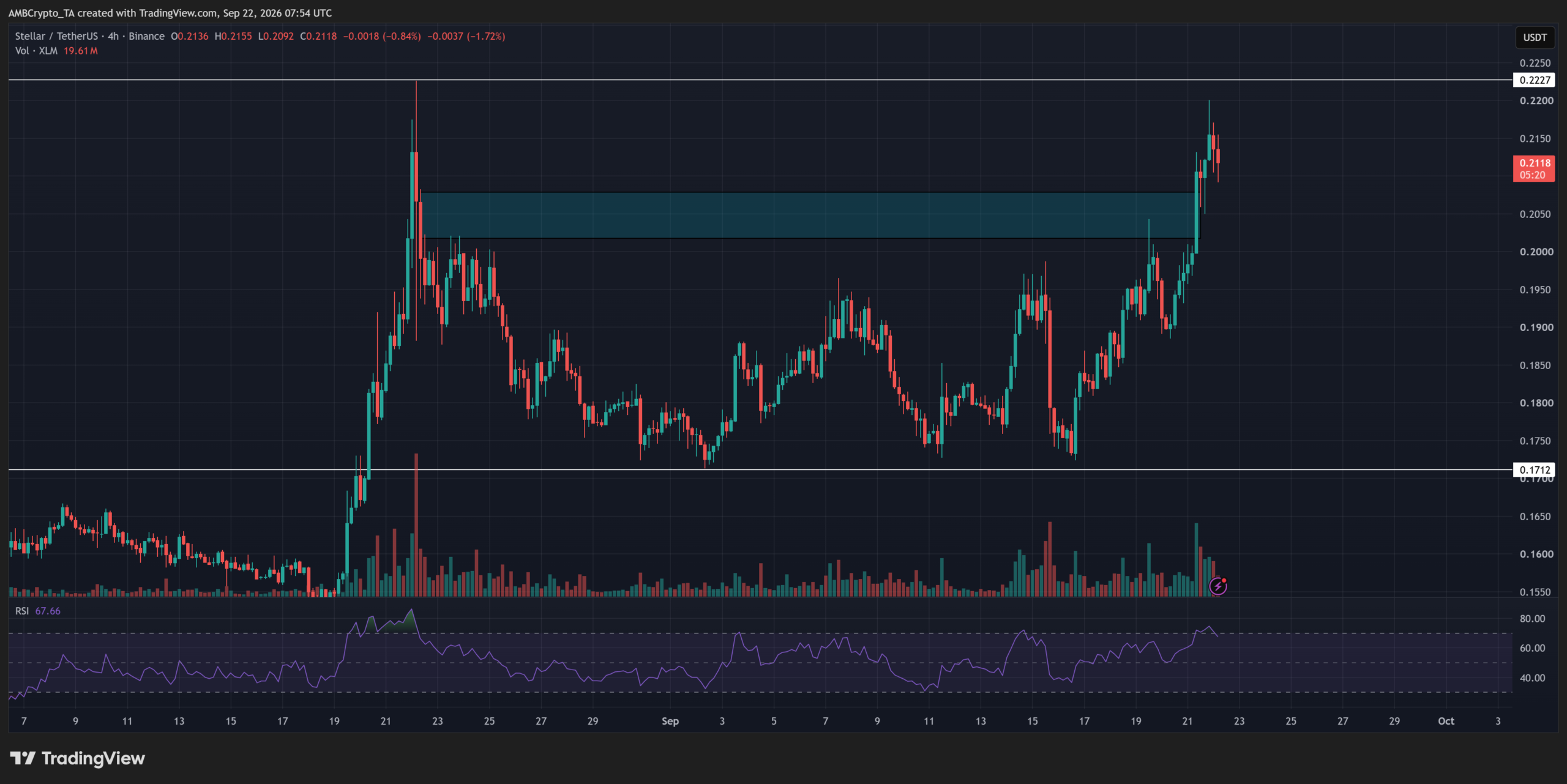
Stellar (XLM) experienced a notable bullish resurgence, climbing 6.84% to trade back toward the $0.22 threshold following weeks of largely range-bound and subdued price action across broader digital asset markets. The upward price movement gathered decisive momentum on September 22, when aggressive market buyers successfully reclaimed the critical $0.2000 psychological level and pushed firmly into the established $0.2020–$0.2075 demand zone.
Rather than succumbing to the selling pressure that has frequently rejected previous rallies, market participants utilized this historical demand pocket as a launchpad. The influx of buying interest propelled XLM past the upper boundaries of the zone toward $0.2200. This particular price trajectory carries increased technical significance for traders, as the exact same price band served as the foundational launchpad for Stellar’s major August breakout. Market analysts observed that the successful retest of this zone validates growing organic interest and sustained accumulation in an area that previously saw heavy transactional participation. Furthermore, trading volumes expanded concurrently with the recent price appreciation, injecting a heightened degree of credibility into the breakout and signaling that a broader base of investors and retail participants are actively engaging with the asset.
Technical Landscape and Price Action Dynamics
Despite the robust intraday performance, XLM experienced a mild cooling-off period, trading down toward $0.1118 at press time. Market technicians note that this retracement increases the statistical probability of a secondary retest of the recently reclaimed demand zone. As long as XLM maintains a defensive stance above the $0.208 support level, the broader short-term uptrend remains structurally intact, keeping open the possibility of another test of the immediate overhead resistance at $0.2227.
Conversely, a failure to defend this critical threshold and a subsequent loss of the demand zone could invalidate the current bullish structure, potentially opening a swift downward path back toward the established $0.180–$0.185 support floor. When contextualized against historical movements, the recent September rally remains comparatively modest relative to the impressive 44% explosive surge from $0.1550 witnessed during August. This disparity suggests that the current leg up still possesses untapped structural room to match the scale of previous rallies, provided that buyers can decisively overcome the stubborn $0.2227 ceiling.
Successfully clearing $0.2227 would clear a technical runway toward the broader $0.235–$0.260 overhead supply zone. However, market strategists emphasize that a push into this upper range represents a continuation of the established trend rather than a transition into true price discovery. Because XLM continues to trade well below its historical all-time high of approximately $0.93, substantial layers of historical resistance loom overhead, requiring sustained capital inflows to break through legacy supply walls.
Expanding On-Chain Liquidity and Stablecoin Ecosystem
Beyond the immediate technical indicators governing XLM’s price charts, Stellar’s underlying network fundamentals reveal a robust expansion in on-chain liquidity. This structural growth helps explain why an increasingly diverse array of institutional financial activities, settlement procedures, and tokenized operations are migrating onto the network architecture.
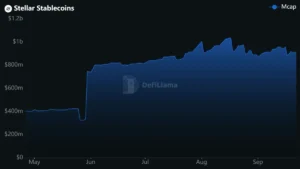
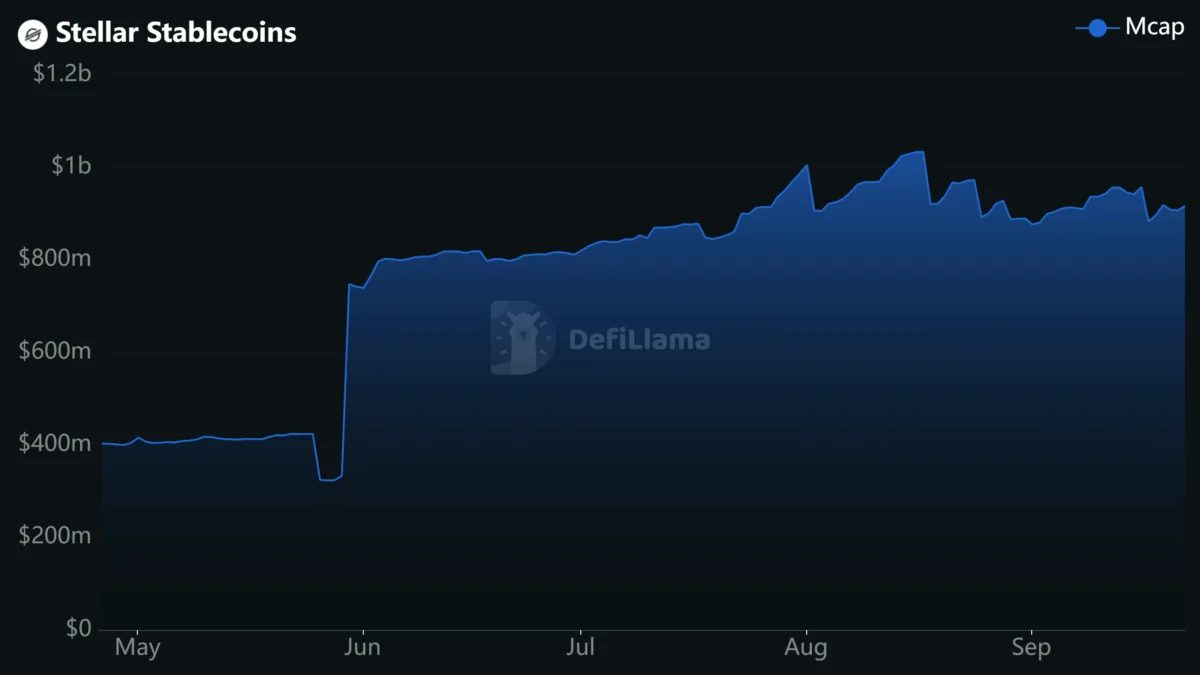
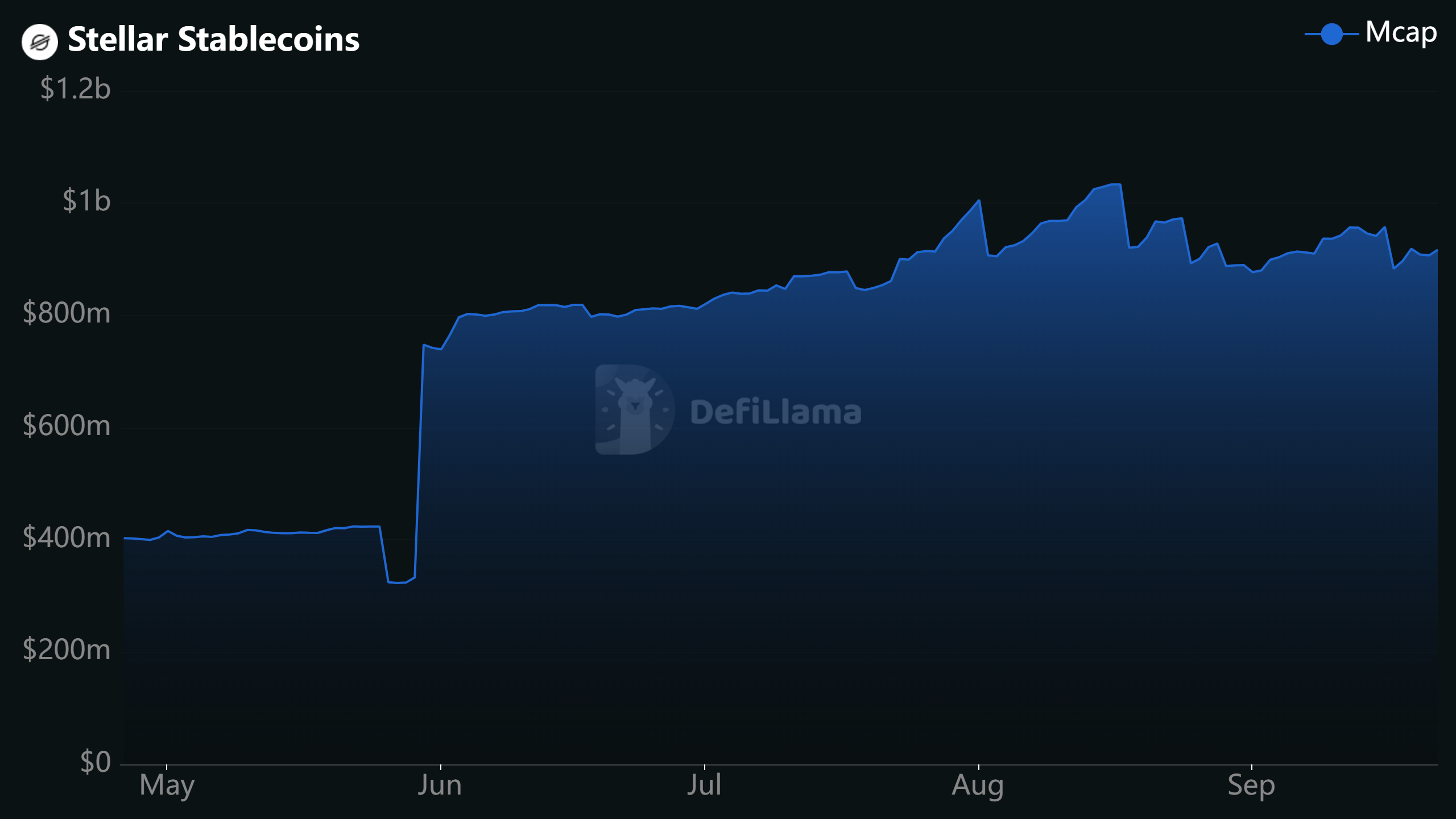
A primary driver of this utility is Stellar’s flourishing stablecoin ecosystem, which has seen its total market capitalization cross the $0.9 billion milestone. This substantial pool of pegged digital assets provides deep, reliable liquidity necessary for high-speed cross-border settlements and enterprise-grade corporate payments. More importantly, on-chain metrics indicate that this capital is actively utilized rather than passively held in stagnant wallets. Over a recent thirty-day observation window, stablecoin transfer volumes on the network averaged an impressive $8.94 billion. This figure demonstrates that transactional volume is cycling at a rate equivalent to more than nine times the total outstanding stablecoin supply, pointing to rapid, repeated settlement velocity and high capital efficiency across the network’s liquidity base.
The Rise of Real-World Assets (RWAs) on Stellar
Parallel to the surge in stablecoin utilization, Stellar has established itself as a preferred environment for the tokenization of Real-World Assets (RWAs). The cumulative market value of tokenized RWAs hosted on the network has scaled to reach $3.33 billion. Concurrently, the user base interacting with these tokenized financial instruments has expanded by 10.23%, bringing the total count of active RWA holders to 21,124. Daily transactional activity within this sector has proven equally robust, averaging $542.41 million.
This burgeoning on-chain activity significantly diversifies Stellar’s value proposition, anchoring XLM’s underlying network foundation in tangible, utility-driven financial infrastructure rather than relying purely on speculative market sentiment. Financial analysts note that as tokenized finance continues to transition from traditional legacy frameworks to distributed ledger technology, networks capable of supporting high-velocity settlement alongside deep stablecoin and RWA liquidity are uniquely positioned to capture long-term enterprise market share.
Broader Market Implications and Future Outlook
The convergence of technical price resilience, surging stablecoin velocity, and multi-billion-dollar RWA adoption paints a comprehensive picture of a network maturing past its initial iterations. While short-term price action remains beholden to immediate support and resistance levels—such as the crucial defense of the $0.208 floor and the impending battle at the $0.2227 ceiling—the macro trajectory of the ecosystem suggests underlying strength.
Industry observers and market participants will be closely monitoring whether XLM can consolidate its recent gains and mount a sustained challenge against higher overhead resistance zones in the final quarter of the year. Ultimately, the durability of Stellar’s current market momentum will depend not only on broader macroeconomic cryptocurrency trends, but also on the continued translation of on-chain RWA growth and high stablecoin turnover into sustained structural demand for the native XLM token.