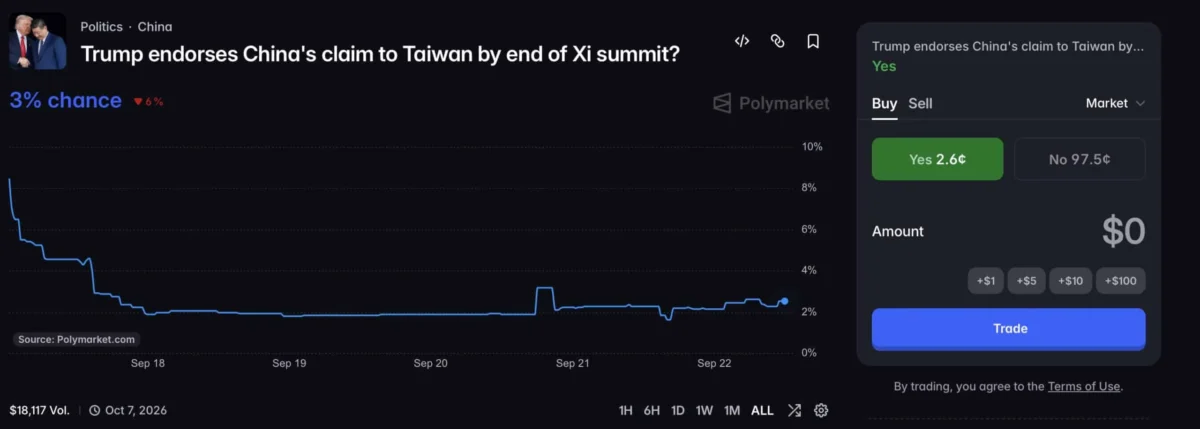
As global diplomats and regional security analysts turn their attention toward Washington ahead of the anticipated high-stakes diplomatic summit, prediction markets are painting a definitive picture regarding the future of U.S. foreign policy in East Asia. Betting data from decentralized platforms like Polymarket indicates that traders assign an overwhelming 97.6% probability that former and incoming U.S. leadership will avoid crossing a historically sensitive geopolitical threshold. Specifically, the market suggests there is only a 2% to 3% implied chance that Donald Trump will explicitly endorse Beijing’s contested sovereignty claims over Taiwan before the conclusion of his scheduled meeting with Chinese President Xi Jinping.
This narrow contract does not evaluate general bilateral tensions, trade tariffs, or broader diplomatic engagement between Washington and Beijing. Instead, it monitors a specific rhetorical line that successive U.S. administrations have carefully avoided for decades: a public, formal declaration that Taiwan is an inalienable part of the People’s Republic of China, or an explicit statement that the United States formally backs Beijing’s territorial assertions. As the diplomatic community braces for the bilateral engagement, the divergence between general summit friction and this precise policy hurdle highlights the sophisticated nature of modern geopolitical forecasting.
Decoding the Polymarket Contract: Separating Rhetorical Drift from Formal Policy Reversal
To understand the 97.6% "No" sentiment dominating prediction markets, observers must examine the exact mechanics of the prediction contract. The market’s operational framework prices policy continuity rather than an absence of friction during discussions. Historically, U.S. policy toward Taiwan has been governed by the "One China" policy—a framework distinct from Beijing’s "One China" principle, wherein Washington acknowledges Beijing’s claim over Taiwan without officially endorsing it, while simultaneously maintaining robust unofficial relations, arms sales, and security commitments with Taipei under the Taiwan Relations Act.
Traders assessing national security and geopolitical wagers emphasize that standard diplomatic posturing, adjustments to arms delivery schedules, or rhetorical compromises do not automatically trigger a "Yes" resolution on this specific contract. For the market to resolve in favor of a positive outcome, Trump would need to make an unprecedented verbal departure from decades of strategic ambiguity. Consequently, assigning a near-single-digit probability to an explicit endorsement reflects the market’s assessment that institutional guardrails and longstanding diplomatic norms remain remarkably resilient against sudden, radical revisions.

Chronology of Tensions: Leading Up to the Washington Summit
The build-up to the September 24, 2026, Washington summit has been characterized by escalating anxiety across allied capitals in the Indo-Pacific region. The timeline of events leading directly to the bilateral meeting underscores the volatile backdrop against which these prediction markets operate:
May 2026: President Trump and President Xi hold their first face-to-face meeting of the year in Beijing, where initial frameworks for bilateral trade, technology restrictions, and regional stability are revisited. During this period, public remarks by Trump labeling U.S. arms sales to Taiwan as a potential "negotiating chip" spark immediate alarm among defense analysts and U.S. allies in Asia.
September 12, 2026: Regional media reports, including coverage from The Straits Times, reveal that Beijing has issued stern diplomatic warnings, threatening to outright cancel the upcoming September summit if Washington proceeds with any new packages of military arms sales to Taiwan prior to the meeting.
September 17, 2026: Reuters publishes comprehensive reporting highlighting mounting apprehension among regional allies—specifically Japan and South Korea—over the possibility that Washington might sacrifice long-term security commitments to Taipei in exchange for sweeping economic concessions, agricultural purchases, or rare-earth mineral agreements from Beijing.
September 22, 2026: Market intelligence updates, supported by automated data feeds and financial research firms like Yardeni Research, indicate that Wall Street and political analysts expect no "grand bargain" or sweeping geopolitical breakthrough from the summit. Instead, forecasts center on an extension of the existing trade truce and selective commercial deals involving agricultural commodities and commercial aviation.

September 24, 2026: The anticipated date for the high-profile Washington summit, serving as the definitive deadline for the resolution of the Polymarket contract regarding Taiwan’s sovereignty endorsement.
Economic Realities and Market Intelligence: The Yardeni Research Perspective
Financial institutions and macroeconomic research firms have consistently urged caution against overhyping the outcomes of high-profile geopolitical summits. Commentary from institutional analysts, such as those at Yardeni Research, points out that while the optics of a presidential summit command global headlines, the practical outcomes are frequently constrained to pragmatic, transactional agreements.
Markets anticipate that the discussions in Washington will likely yield incremental commercial achievements rather than foundational shifts in international law or territorial recognition. Potential areas of mutual agreement include extensions to agricultural purchasing agreements—such as increased quotas for American soybeans—commitments regarding commercial aircraft orders with manufacturers like Boeing, and tentative frameworks for managing critical supply chains involving rare-earth minerals and advanced semiconductor components.
By keeping the agenda anchored to commercial pragmatism and trade management, both Washington and Beijing reduce the pressure to confront intractable sovereignty disputes head-on. This economic insulation further reinforces the prediction market’s confidence that substantive, radical departures on sensitive territorial questions remain highly improbable.
The Broader Implications of Geopolitical Prediction Markets

The reliance on decentralized forecasting platforms like Polymarket to gauge international relations has introduced a novel dimension to political analysis. However, the intersection of blockchain-based prediction markets and sensitive national security topics has not been without controversy. Recent high-profile regulatory investigations and federal inquiries—such as the Department of Justice’s arrest of a military serviceman accused of leaking classified intelligence to inform wagers on sensitive national security events—have underscored the ethical and legal complexities surrounding prediction market participation.
Despite these regulatory hurdles, financial and political analysts increasingly view well-capitalized prediction markets as valuable barometers of collective sentiment. Unlike traditional polling, which often struggles to capture the nuance of conditional policy statements, prediction markets force participants to weigh specific legal, rhetorical, and historical constraints.
In the case of the Trump-Xi summit, the market’s steadfast refusal to price in a sovereignty endorsement serves as a sophisticated reminder of the gap between campaign rhetoric and formal statecraft. While politicians frequently utilize transactional language to exert leverage during negotiations, the foundational architectures of international diplomacy and national security strategy are structurally resistant to abrupt, unilateral overhauls.
As the diplomatic delegations gather in Washington, the overwhelming consensus of market participants remains clear: while economic truces and trade concessions are well within the realm of possibility, the inviolable red line surrounding Taiwan’s sovereignty status is expected to remain firmly intact.