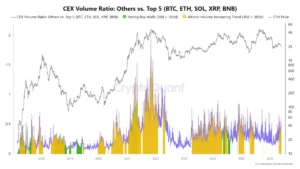
The broader altcoin market is currently enduring its most severe and sustained period of spot-market selling pressure since the market turbulence of 2020, according to recent on-chain metrics and market intelligence provided by analytics platform CryptoQuant. As institutional and retail capital continues to concentrate heavily within primary digital assets, secondary and tertiary cryptocurrencies are experiencing a profound liquidity drain. This dynamic has left market participants grappling with prolonged defensive positioning, stagnant price action, and a cumulative net-selling volume that highlights a deep-seated loss of investor confidence across the alternative asset class.
The latest on-chain telemetry reveals a staggering cumulative buy-and-sell volume discrepancy of approximately $209 billion across an extended timeline. This massive capital outflow underscores a structural shift in how market participants are engaging with altcoins. Rather than accumulating assets during market pullbacks or positioning aggressively for an impending cyclical recovery, traders are predominantly utilizing rallies as liquidity exits. Consequently, the prevailing market sentiment has transformed from speculative optimism into defensive capital preservation, leaving the vast majority of altcoin projects trading under intense, unrelenting headwinds.
Anatomy of the 2020-2025 Sell Pressure Continuum
To fully understand the gravity of the current market structure, it is essential to examine the chronological evolution of altcoin liquidity over the past several years. Following the unprecedented liquidity injection of the 2020-2021 bull run—which was largely fueled by macroeconomic stimulus, low-interest rates, and explosive retail participation—the cryptocurrency landscape underwent a dramatic recalibration.
During the subsequent bear market of 2022, triggered by aggressive global monetary tightening and high-profile industry collapses, altcoins suffered catastrophic drawdowns. However, even as Bitcoin and select mega-cap assets began a multi-year recovery path heading into 2023 and 2024, the broader altcoin sector failed to regain its former market-wide buoyancy. Instead of a unified rising tide lifting all digital assets, capital became acutely selective.
By late 2024 and early 2025, this selectivity morphed into outright aversion. The current CryptoQuant dataset captures this culmination: a persistent, multi-month streak where aggregate spot selling has vastly outpaced buying volume. Unlike previous phases of transient panic—which were often swiftly reversed by speculative retail inflows—the current phase is characterized by an agonizingly slow bleed, where diminishing liquidity meets a backlog of underwater holders looking to break even.
The Bifurcated Market: Why Institutional Flows Bypass Altcoins
A primary driver of the prolonged sell pressure is the fundamental evolution of market access and institutional participation. In previous crypto cycles, capital flowed relatively freely down the risk curve, moving from Bitcoin into Ethereum, and subsequently cascading into mid-cap and small-cap altcoins in search of higher yields.
In the current economic cycle, that traditional cascading mechanism has broken down due to the maturation of financial products surrounding the industry. Bitcoin has successfully established itself as a mainstream institutional asset class, largely driven by the explosive success of spot exchange-traded funds (ETFs) in major global markets. These regulated financial vehicles have absorbed tens of billions of dollars in institutional capital, anchoring liquidity firmly within the world’s largest cryptocurrency.
Concurrently, Ethereum has maintained its stronghold on institutional and decentralized finance (DeFi) attention through structured staking yields, layer-2 scalability upgrades, and the burgeoning narrative of real-world asset (RWA) tokenization. Meanwhile, stablecoins and high-yield digital dollar products have provided conservative traders with attractive, risk-free or low-risk yields natively on-chain, eliminating the necessity to venture into volatile small-cap altcoins to generate returns.
This structural shift leaves the vast majority of altcoins stranded in an unfavorable market position. They are deemed excessively risky for conservative institutional allocators, yet they frequently lack the hyper-volatile momentum required to entice short-term retail speculators who are increasingly drawn to meme-coin ecosystems or derivative trading platforms. When broader retail demand contracts, the liquidity supporting these altcoins evaporates almost instantly. Each attempted price bounce is systematically met by selling pressure from legacy holders eager to minimize their losses, forcing new buyers to demand progressively deeper discounts before entering the market.
Contrarian Perspectives and Market Sentiment Indicators

Despite the overwhelmingly bearish implications of a $209 billion net-selling volume, seasoned market analysts and contrarian investors note that extreme statistical readings frequently precede significant structural turning points. Market stress and capitulation do not inherently signal an immediate market bottom, but they do provide vital telemetry regarding market positioning.
When selling pressure reaches historic extremes, it often indicates that weak hands—investors prone to panic-selling or those holding leveraged, short-term positions—have been thoroughly flushed out of the system. Under such conditions, the total amount of new demand required to stabilize and eventually reverse price trends decreases significantly, as the overhead supply of distressed sellers is diminished.
This dynamic is further illuminated by various altcoin-season gauges and market breadth indicators. Current readings largely hover within mid-range territories rather than surging into the euphoric extremes historically associated with speculative market tops. For analytical traders, this lack of widespread mania suggests that the market is currently grounded in skepticism rather than irrational exuberance. Consequently, any future revitalization of the altcoin sector would likely be built upon a foundation of fundamental re-accumulation rather than transient hype cycles.
Macroeconomic Headwinds and the Absence of a Clean Bottom Signal
Nevertheless, institutional analysts and market researchers warn against misinterpreting structural exhaustion as a definitive confirmation of a market bottom. Altcoins have historically demonstrated an ability to remain depressed and range-bound for significantly longer periods than market participants anticipate, particularly when macroeconomic liquidity remains constrained or when Bitcoin dominance maintains a stranglehold on market capitalization.
A deep reading of spot sell pressure serves as an effective barometer of market stress, but it does not independently guarantee that buyers are prepared to assume control of the order books. The definitive signal of a bullish transition would require a measurable, sustained shift from net spot selling to continuous spot accumulation, accompanied by an expansion of market breadth across multiple altcoin sectors rather than isolated, narrative-driven spikes.
Until such fundamental shifts materialize, the current market environment functions less as a guaranteed catalyst for an altcoin season and more as a high-fidelity pressure gauge. It demonstrates unequivocally that traditional altcoins are currently out of favor with global capital allocators. Whether this prolonged period of undervaluation ultimately resolves into a generational buying opportunity or merely yields another series of failed relief rallies remains entirely dependent upon the return of organic, sustained demand to the spot markets.
Implications for Traders, Exchanges, and the Broader Digital Asset Ecosystem
The ongoing capital contraction across secondary digital assets carries significant implications for the broader cryptocurrency ecosystem, extending far beyond simple price fluctuations. Decentralized finance (DeFi) protocols, automated market makers (AMMs), and alternative layer-1 and layer-2 networks rely heavily on robust spot liquidity and healthy token valuations to maintain operational security, incentivize liquidity providers, and fund ongoing development.
When spot volumes experience multi-year lows, the economic security models of proof-of-stake networks and decentralized applications face severe strain. Projects with high token emission schedules, designed to reward network participants during more favorable market conditions, find themselves facing compounding downward price pressure as rewards are rapidly converted into stablecoins or fiat currency. This has forced numerous development teams to drastically restructure tokenomics, implement aggressive supply-reduction mechanisms, or pivot toward sustainable revenue-generation models to survive the liquidity drought.
Furthermore, digital asset exchanges and market-making firms are forced to adapt to shifting volume dynamics. With spot volumes migrating toward Bitcoin and select derivative instruments, liquidity providers are reallocating risk capital away from long-tail altcoins, exacerbating the bid-ask spreads and slippage for retail traders attempting to navigate these markets. This self-reinforcing cycle highlights the absolute necessity for altcoin projects to establish genuine utility, clear product-market fit, and resilient economic foundations that transcend pure speculative enthusiasm.
As the cryptocurrency market continues to mature through evolving regulatory frameworks and institutional integration, the divergence between foundational assets and speculative tokens is expected to widen. The current CryptoQuant dataset serves as both a historical marker of the deepest spot sell pressure since 2020 and a stark reminder that the altcoin sector is undergoing a painful, yet potentially necessary, structural cleansing. Whether the market can successfully transition from defense to accumulation will depend heavily on upcoming macroeconomic liquidity shifts, regulatory clarity, and the ability of altcoin developers to prove long-term value in an increasingly competitive financial landscape.