The decentralized finance (DeFi) sector is once again grappling with mounting security apprehensions following a coordinated series of exploits that drained over $35 million from cross-chain infrastructure in a single day. This latest breach of protocol defenses arrives at a delicate juncture for the industry, which had only recently begun to claw back liquidity following a catastrophic first quarter. Compounding the market anxiety, the movement of funds associated with historical exploits has reignited discussions regarding the enduring vulnerabilities embedded within smart contract architectures and interoperability bridges.
Anatomy of a Triple Breach: Cross-Chain Infrastructure Under Siege
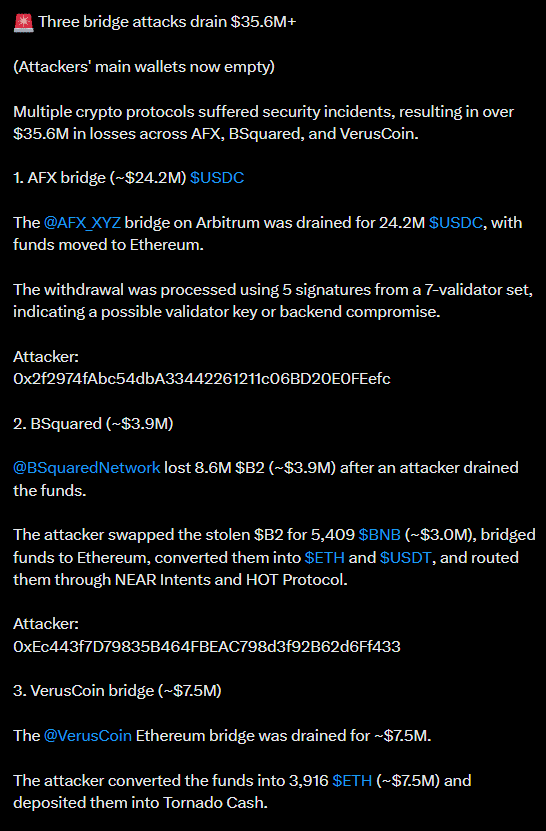
The recent wave of security incidents targeted three distinct protocols within a 24-hour window, collectively resulting in losses amounting to $35.55 million. While the total financial impact pales in comparison to the multi-hundred-million-dollar disasters witnessed earlier in the year, the concentration of attacks on a single technological vector has alarmed security analysts and protocol developers alike.
AFX absorbed the heaviest blow during the incident, sustaining a loss of $24.2 million in USD Coin (USDC). According to on-chain tracking, the attackers compromised the protocol’s bridge on the Arbitrum network before rapidly funneling the stolen assets onto the Ethereum mainnet to obscure their tracks and facilitate liquidation.
Shortly after the AFX breach, VerusCoin reported a bridge exploit that resulted in the unauthorized extraction of approximately $7.5 million. Simultaneously, the BSquared Network fell victim to a separate security failure, losing an estimated $3.9 million after an attacker successfully drained 8.6 million native B2 tokens from its liquidity pools.
Despite the operational diversity of these platforms—operating across different layer-2 scaling solutions and modular frameworks—the underlying vulnerability remained consistent. All three exploits targeted cross-chain bridges, the complex messaging and asset-transfer conduits that allow disparate blockchain networks to communicate. This architectural commonality has once again placed bridge security under intense scrutiny, reinforcing the consensus that interoperability layers represent the most fragile component of the modern DeFi stack.
A Turbulent Year: The Q1-Q2 Security Crisis
To fully grasp the market’s nervous reaction to the latest breaches, one must examine the turbulent historical context of the preceding months. During the first and second quarters of the year, the broader cryptocurrency ecosystem endured one of its most severe security stress tests in recent history. A succession of three consecutive, high-profile hacks systematically wiped out more than $600 million in digital assets within a compressed timeframe.

The immediate fallout from those major incidents triggered a severe liquidity contraction across the entire decentralized economy. Total Value Locked (TVL) across all tracked DeFi protocols plummeted drastically, retreating to Q2 2024 baseline levels and settling just above the $65 billion threshold. The contagion was not limited to minor altcoins; blue-chip ecosystems experienced heavy capital flight. Ethereum alone suffered a staggering reduction of more than $10 billion in TVL within a frantic 48-hour window as institutional and retail liquidity providers rushed to withdraw capital from lending markets, automated market makers (MMs), and yield aggregators.
This historical trauma explains why the loss of $35 million—while objectively smaller than previous quarters—has generated an outsized psychological reaction. Market participants and liquidity providers remain hyper-sensitive to any indication of systemic vulnerabilities, viewing localized exploits as potential precursors to broader contagion.
The Drift Protocol Ghost: Stolen Funds Return to Movement
Adding fuel to the prevailing market uncertainty, the shadows of past disasters have lengthened with the reactivation of wallets tied to historical exploits. Most notably, the hacker responsible for the massive Drift Protocol breach earlier in the year has initiated a new phase of fund movement.
The Drift exploit, which occurred earlier in the year, remains one of the largest single security failures in recent DeFi history, resulting in the unauthorized drainage of $285 million. The sheer scale of the incident crippled confidence in high-performance margin trading protocols and generated a prolonged risk-off sentiment that took months to dissipate.
Recent on-chain intelligence provided by analytics firm Onchain Lens reveals that the Drift attacker has begun systematically funneling substantial amounts of Ethereum through the Tornado Cash privacy router. The illicit funds are being moved in repetitive batches of 100 ETH, with multiple execution transactions occurring every minute.
While blockchain investigators emphasize that the mere transfer and obfuscation of funds through mixing services do not inherently signal an immediate market dumping campaign, the timing could not be more precarious. The sudden revival of the Drift wallet activity coincides precisely with the fresh $35 million bridge exploits, doubling the psychological pressure on a sector that was just beginning to regain its footing.
Fragile Recovery: TVL Momentum Threatened by FUD
Despite the headwinds, macroeconomic and sector-specific data indicated that DeFi was staging a robust comeback. According to aggregated metrics from DeFiLlama, the ecosystem experienced a substantial influx of capital throughout July, with total value locked climbing by more than $10 billion. This performance marked the strongest monthly capital expansion the sector had witnessed since the devastating hack waves of the first quarter.
Analysts had cautiously interpreted this rebound as a sign of maturing market resilience, suggesting that users were willing to re-engage with decentralized protocols despite historical risks. However, the sudden clustering of bridge exploits and the simultaneous movement of historical plunder threaten to reverse this positive sentiment.
The primary concern among market observers is the potential return of pervasive Fear, Uncertainty, and Doubt (FUD). If the recent security breaches inspire a fresh wave of risk aversion, capital could once again flee decentralized applications in favor of centralized custodial platforms or fiat-equivalent assets. Such a shift would choke off yield generation, reduce market depth, and stall the ongoing adoption of decentralized financial primitives.
Industry Implications and the Path Forward
The recurring vulnerability of cross-chain bridges highlights a fundamental engineering dilemma within the blockchain industry. Interoperability is essential for the growth of a multi-chain future, allowing assets and data to flow freely between Ethereum, layer-2 networks, and alternative layer-1 chains. However, bridges act as massive centralized honeypots of liquidity locked within smart contracts, making them exceptionally lucrative targets for sophisticated threat actors.
In the wake of these latest events, cybersecurity auditors and protocol architects are intensifying calls for structural reforms. Recommendations from leading blockchain security firms increasingly emphasize the adoption of decentralized validation models, formal verification of smart contract logic, and the implementation of real-time circuit breakers that can automatically halt bridge operations upon the detection of anomalous outbound transaction volumes.
Furthermore, institutional participants assessing exposure to decentralized finance are expected to demand more rigorous insurance frameworks and transparent incident-response protocols before committing significant capital to cross-chain applications.
As the industry navigates this latest security test, the immediate trajectory of DeFi TVL will depend heavily on the ability of core developers to secure existing infrastructure and restore user confidence. Whether the $35 million exploit wave proves to be an isolated anomaly or the catalyst for a broader market contraction remains one of the most critical questions facing the digital asset economy.