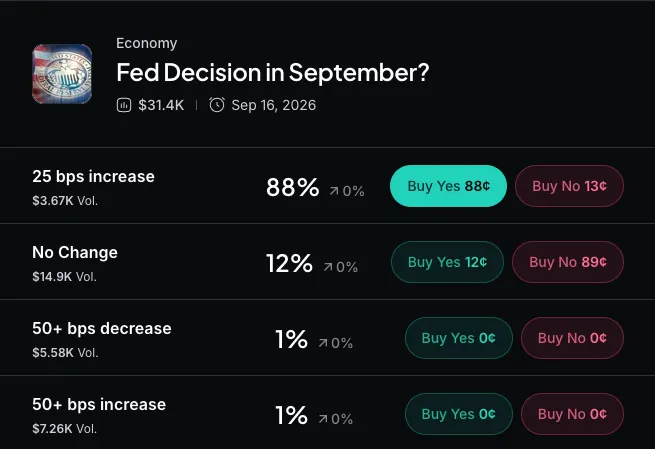
Financial markets are bracing for a watershed moment this week as the Federal Open Market Committee (FOMC) prepares to conclude its crucial two-day policy meeting. Wall Street analysts and institutional investors overwhelmingly anticipate that the U.S. central bank will execute an interest rate hike, a monetary policy maneuver the Federal Reserve has not deployed since 2023. According to data from the Chicago Mercantile Exchange’s (CME) FedWatch tool, market sentiment has shifted drastically over the past month, pricing the probability of a quarter-percentage-point rate increase at an imposing 94.5%, up sharply from less than 50% just thirty days prior.
This dramatic repricing reflects a broader realization across global financial ecosystems that stubbornly high consumer inflation, persistent geopolitical conflicts, and heated domestic political pressures have backed central bankers into a corner. As traders, corporate executives, and digital asset investors await the official policy statement and the updated economic projections—commonly known as the dot plot—the repercussions are already reverberating through equity markets, government bond yields, and the nascent cryptocurrency sector.
A Rapid Shift in Wall Street Consensus
The pivot from monetary policy easing to potential tightening happened with remarkable speed. A comprehensive survey published by the Wall Street Journal revealed that virtually all major financial institutions now expect the FOMC to deliver a rate hike on Wednesday. Most premier investment banks, including Barclays, Citigroup, JPMorgan Chase, Morgan Stanley, and UBS, have adjusted their baseline forecasts to price in a total of 50 basis points of monetary tightening before the conclusion of the calendar year.
Meanwhile, a more hawkish faction of major financial institutions—consisting of Bank of America, Deutsche Bank, and RBC Capital Markets—anticipates an even more aggressive path, calling for a cumulative 75 basis points of tightening throughout the year. Conversely, Goldman Sachs occupies a more dovish position within the consensus, modeling just the anticipated quarter-point hike this week with no subsequent moves. Outlier institutions such as Jefferies and Oxford Economics stand alone in forecasting a reversal of direction, projecting a potential rate cut as early as December and well into 2027, respectively.
This widespread uncertainty over the terminal rate has intensified market volatility. Higher interest rates inherently increase the cost of borrowing for corporations and consumers alike, thereby subduing economic aggregate demand, dampening retail spending, and compressing valuations for asset classes that rely heavily on low-cost liquidity, such as high-growth equities and decentralized digital currencies. Furthermore, rising yields on risk-free government securities incentivize capital flight away from risk-on environments, drawing institutional and retail capital toward fixed-income products.
Economic Catalysts and the Case for Tightening
The primary driver behind the Federal Reserve’s anticipated policy pivot is an inflation rate that has persistently refused to align with the central bank’s long-term objectives. Headline Consumer Price Index (CPI) inflation printed at an annualized rate of 3.4% in August, while core inflation—which strips out volatile food and energy components—remained elevated at 2.5%. Both figures sit comfortably above the Federal Reserve’s targeted 2% threshold, signaling that price stability has not yet been fully achieved.
Compounding these domestic inflationary pressures are external supply shocks, notably in global energy markets. Surging crude oil prices, fueled by prolonged geopolitical tensions and the ongoing conflict involving Iran, have injected an additional layer of cost-push inflation into the global supply chain. These energy shocks have proven resilient to traditional monetary interventions, leaving policymakers with limited tools to counteract rising input costs.
The institutional momentum toward a rate hike also highlights growing internal divisions within the central bank. During the previous FOMC meeting in July, the committee voted to hold the benchmark federal funds rate steady within a target range of 3.50% to 3.75%. However, that decision was far from unanimous, passing by a narrow 9-3 margin. Three prominent regional Fed presidents dissented, actively advocating for an immediate rate hike. This internal fracture, coupled with a surprisingly robust August employment report that demonstrated continued labor market resilience, fundamentally shifted the committee’s consensus heading into the current meeting.
Political Friction and the Independence of the Central Bank
The looming interest rate adjustment places newly appointed Federal Reserve Chair Kevin Warsh in an exceptionally delicate political position. President Donald Trump, who handpicked Warsh for the central bank’s top post in January, publicly urged him to maintain absolute institutional independence during his swearing-in ceremony in May, while simultaneously making it abundantly clear that the White House expected a trajectory of lower borrowing costs.
The reality of incoming economic data, however, has set the central bank on a direct collision course with the executive branch. Over the preceding two weeks, President Trump, Vice President JD Vance, and Treasury Secretary Scott Bessent have engaged in coordinated public pressure campaigns urging the Fed to slash interest rates to stimulate domestic manufacturing and consumer purchasing power. President Trump went so far as to issue stern warnings regarding potential trade restrictions against nations running trade surpluses with the United States if monetary easing was not implemented.
In response, Chair Warsh has maintained a strict adherence to data-dependent decision-making, asserting publicly that executive branch rhetoric has exerted zero influence over the independent framework of the FOMC.
This impending tightening cycle carries substantial domestic political ramifications, arriving a mere two months before the crucial November midterm elections. Voter sentiment polls consistently indicate high levels of public frustration regarding persistent inflation, elevated cost-of-living metrics, and punishing borrowing costs for mortgages and auto loans. Ironically, the policy tightening currently underway is necessitated in part by the economic fallout from tariff policies and geopolitical frictions that the administration itself has championed.
Bond Market Reactions and Fixed-Income Stress
While equity traders and retail investors often focus on central bank press conferences, the global bond market has already aggressively priced in the shifting monetary landscape. The benchmark 10-year U.S. Treasury yield touched 5.04% this week, marking its highest level since July 2007. This multi-year high reflects bond traders positioning themselves not only for Wednesday’s expected rate hike but also for a prolonged plateau of elevated interest rates.
Simultaneously, the two-year Treasury yield—which historically exhibits high sensitivity to near-term shifts in Federal Reserve policy—surged to its highest level since July 2024. The inversion and subsequent movement of the yield curve underscore a pervasive market consensus that loose monetary policy has been decisively shelved in favor of capital preservation and yield optimization.
The appreciation of Treasury yields naturally enhances the relative attractiveness of government-backed debt over risk assets, concurrently providing upward pressure on the U.S. dollar index. A strengthening dollar traditionally acts as a significant macroeconomic headwind for risk-sensitive sectors, including commodities and cryptocurrency markets, which historically thrive in low-interest-rate environments characterized by abundant liquidity.
Implications for Bitcoin, Cryptocurrencies, and Risk Assets
Digital asset markets are navigating this critical macroeconomic event from a position of relative vulnerability. Bitcoin entered the week under heavy selling pressure, trading near $75,700 following a sharp 3.2% single-day drawdown. This downward correction was exacerbated by legislative setbacks on Capitol Hill, where the "Clarity Act"—a landmark digital asset market structure bill—failed to clear a crucial Senate cloture vote, temporarily dashing hopes for near-term regulatory certainty in the United States. Consequently, Bitcoin prices remain significantly depressed compared to their September intra-month highs approaching $82,000.
Technical analysts are closely monitoring $73,200 as a critical psychological and structural line in the sand for Bitcoin. A confirmed daily close below this support threshold could trigger further algorithmic liquidations, potentially dragging the benchmark cryptocurrency down toward secondary support levels at $71,000 and $66,900, thereby invalidating the bullish price momentum that recently sparked a technical golden cross formation across daily charts.
Conversely, not all market participants interpret a potential rate hike through a strictly bearish lens. A segment of macroeconomic analysts argues that a modest, quarter-point rate adjustment designed primarily to anchor long-term inflationary expectations and stabilize Treasury yields may already be fully priced into asset valuations. Under this hypothesis, the ultimate market reaction will depend less on the rate hike itself and more on the nuanced tone struck by Chair Warsh during his post-meeting press conference, particularly regarding whether the Fed signals further tightening ahead or pauses to evaluate economic conditions.
Higher-beta altcoins—characterized by thinner market liquidity and elevated levels of retail leverage—are widely expected to experience amplified price volatility relative to Bitcoin, regardless of the directional outcome of the Fed’s announcement.
Looking Ahead
The official policy announcement, accompanied by the updated economic projections and the Fed’s dot plot, is scheduled for release at 2:00 p.m. Eastern Time on Wednesday. This will be immediately followed by Chair Kevin Warsh’s press conference at 2:30 p.m. ET. Financial markets will parse every word for clues regarding whether central bank officials envision a singular insurance hike or if they intend to mirror the more aggressive trajectory projected by institutions like Bank of America and Deutsche Bank, setting the tone for global risk assets as the fourth quarter approaches.