The decentralized non-fungible token (NFT) marketplace Blur and its native governance token, BLUR, have entered a period of heightened market scrutiny following a notable correction from their recent yearly highs. After experiencing a meteoric rise fueled by aggressive trading incentives and the highly anticipated conclusion of its Season 2 airdrop, BLUR has tumbled by over 30% from its November peaks. Compounding the downward pressure, on-chain analytics have flagged a series of heavy deposits by large-scale token holders—commonly referred to as "whales"—into leading centralized cryptocurrency exchanges, raising widespread market speculation regarding potential large-scale liquidations.
The ongoing market dynamics surrounding Blur arrive at a critical juncture for the broader NFT ecosystem. Having successfully challenged established giants like OpenSea for market share dominance through sophisticated liquidity-mining strategies, Blur has positioned itself as a cornerstone of modern digital asset trading. However, the intersection of macro-level crypto market fluctuations and localized tokenomics has created a complex environment for investors attempting to navigate the asset’s next directional move.
Whale Activity and Exchange Inflows Spark Liquidation Concerns
On-chain tracking data highlights a pronounced wave of capital movement directed toward centralized trading platforms by prominent whale addresses. According to metrics published by blockchain intelligence firm Lookonchain, cumulative deposits totaling roughly 16.85 million BLUR tokens—valued at approximately $8.43 million at the time of transfer—were routed to various centralized exchanges within a single 24-hour window in early December.
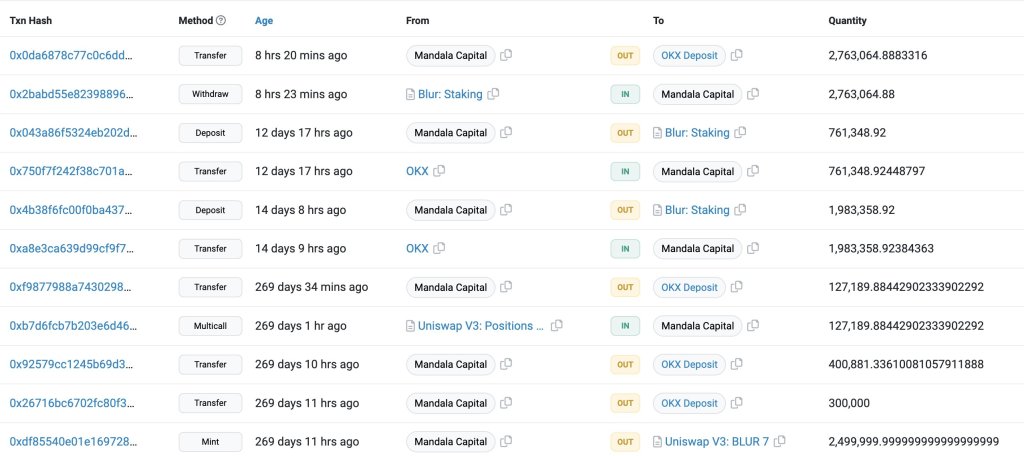
Among the most notable transactions recorded by on-chain monitors was a direct deposit of 2.54 million BLUR tokens, worth approximately $1.26 million, originating from a Season 2 airdrop allocation and sent straight to Binance. Simultaneously, institutional-backed entities have also adjusted their holdings; Mandala Capital reportedly transferred 2.76 million BLUR tokens, valued at roughly $1.4 million, to the OKX exchange.

Further complicating the sentiment is the behavior of individual whale addresses demonstrating mixed timing strategies. On-chain data identified an address designated by the prefix “0x68b5” that previously withdrew 3.31 million BLUR tokens—worth about $1.79 million—from Binance between November 25 and November 29. Shortly thereafter, as token valuations drifted downward, the same entity deposited the entire batch back onto Binance on December 1, locking in an estimated unrealized loss of approximately $65,000 based on prevailing market rates.
While blockchain analytics cannot definitively confirm whether these transferred assets have been immediately swapped for stablecoins like USDT or alternative digital currencies, traditional market interpretation views exchange inflows of this magnitude with caution. Large-scale transfers from cold storage or private wallets to centralized order books are historically correlated with an intent to sell, creating psychological downward pressure among retail traders who monitor these movements closely.
The Rise of Blur: Season 2 Airdrop and October-November Rally
The recent volatility in BLUR’s price action follows one of the most aggressive accumulation phases in the decentralized finance and NFT sectors. From its multi-month lows recorded in October, BLUR embarked on a remarkable upward trajectory, surging by an impressive 220% to reach its November peak.
This sustained bullish momentum was primarily driven by the mechanics surrounding the completion of Blur’s Season 2 airdrop, which officially concluded on November 20. The protocol’s incentive structure—designed to reward platform loyalty, bidding activity, and the migration of volume away from legacy competitors—has historically driven massive speculative demand for the native asset. In the weeks leading up to the airdrop finale, BLUR experienced a staggering 150% appreciation, demonstrating the powerful impact of gamified liquidity mining on token valuations.
However, once the distribution event concluded and the immediate utility of the farming phase cooled off, the token began to retrace its steps. The first week of December ushered in a period of consolidation, testing the conviction of both short-term speculators and long-term believers who accumulated during the early autumn troughs.
Technical Analysis: Bulls Defend Critical Support Levels
Despite the 30% pullback from its yearly highs, technical market analysts evaluating daily candlestick charts suggest that the overarching macro uptrend remains structurally intact. Market participants are closely watching how price action interacts with established moving averages.
Bears have thus far failed to force a decisive breakdown beneath the critical 20-day moving average (MA) on the daily timeframe, a technical indicator widely viewed as the demarcation line between short-term bullish control and a deeper correction. Analysts note that structural support rests near the $0.46 threshold, which marks the base of the current bull flag formation on the daily chart. A sustained breach below this critical level could invite accelerated selling pressure and trigger a more severe liquidation cascade.
Conversely, bulls retain a pathway toward renewed upside momentum if broader market conditions stabilize. A sustained recovery above immediate resistance levels at $0.58, followed by a successful test of the November highs near $0.69, could catalyze fresh capital inflows. Such a breakout has the potential to propel BLUR toward psychological targets at $0.84 and beyond in subsequent trading sessions.
Broader Market Implications and Future Outlook
The current crossroads for Blur highlights the fragile balance between incentive-driven token economies and organic platform utility. While Blur has successfully cemented its status as a primary venue for high-volume NFT traders—consistently outpacing competitors in daily trading volume—the sustainability of its native token price relies heavily on continuous ecosystem growth and user retention post-airdrop.
Market observers and institutional participants continue to monitor on-chain metrics, exchange reserves, and governance proposals to gauge the long-term viability of the marketplace. As the crypto industry navigates shifting macroeconomic conditions, the interplay between large-scale whale maneuvers and foundational technical support levels will undoubtedly dictate the near-term trajectory of BLUR and set a precedent for how specialized utility tokens perform in a maturing digital asset landscape.