The broader digital asset ecosystem is currently navigating a period of heightened macroeconomic uncertainty and persistent bearish sentiment, underscored by Bitcoin struggling to maintain momentum above the $90,000 threshold and recently hovering around $89,800. Against this delicate backdrop, on-chain intelligence platforms have captured notable wallet activity from one of the industry’s most influential figures. Ethereum co-founder Vitalik Buterin has executed a series of token reductions, shedding several altcoin holdings including 1,400 Uniswap (UNI) tokens. While the absolute monetary value of these transactions remains modest in the context of the multi-billion-dollar cryptocurrency market, the psychological impact of asset liquidation by a foundational industry leader has immediately resonated across decentralized finance (DeFi) communities and trading desks alike.
The transaction data, initially flagged by blockchain analytics firm Arkham Intelligence, highlights that Buterin’s recent offloading extended beyond UNI to include 10,000 KNC tokens and 40 trillion DINU tokens. The aggregate conversion yielded approximately 16,796 USDC. In traditional financial markets and the crypto sector alike, insider or high-profile wallet movements are heavily scrutinized. Even when such actions represent routine portfolio management, charitable donations, or personal liquidity provisioning rather than a definitive lack of fundamental confidence, market participants frequently interpret them as leading indicators. This dynamic often triggers knee-jerk reactions, brief surges in volatility, and recalibration of short-term trading strategies among retail and institutional investors.
Broader Market Context and Macroeconomic Pressures
To properly evaluate Buterin’s recent token reduction, it is essential to examine the macro environment defining the digital asset sector. Cryptocurrencies have labored under sustained selling pressure, characterized by a market structure where bullish macroeconomic catalysts—such as central bank interest rate cuts or favorable regulatory developments—provoke only temporary, short-lived rallies. These relief bounces are frequently met with aggressive profit-taking and systemic liquidations, highlighting a chronic scarcity of fresh liquidity entering the market.
As the preeminent decentralized exchange (DEX) governance and utility asset, Uniswap heavily mirrors broader sentiment within the decentralized finance sector. When liquidity contracts across the macro landscape, high-profile sell-offs can act as localized catalysts, accelerating downside momentum and exacerbating short-term price fluctuations. Consequently, trader attention has concentrated acutely on UNI’s immediate technical structure, price boundaries, and capacity to withstand ongoing macroeconomic headwinds.

Chronology of Uniswap Price Action and Recent Volatility
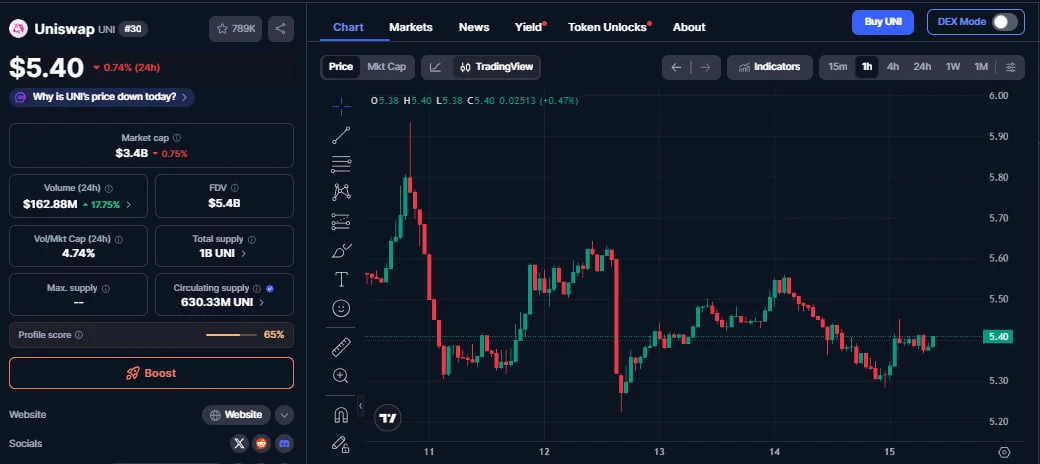
The timing of Buterin’s asset reduction coincides with a challenging phase of underperformance for the UNI token. Over a recent 24-hour monitoring window, UNI hovered near $5.40, registering a marginal decline of approximately 0.87%. This localized movement is symptomatic of a broader structural retracement that has dominated the token’s charts following an optimistic rally earlier in the quarter.
Looking back at the historical price trajectory over the preceding weeks, UNI displayed notable bullish strength, mounting a concerted charge toward the $9.80 to $10.00 psychological resistance band early last month. However, as broader market-wide selling pressure intensified and macroeconomic liquidity evaporated, the momentum underpinning that rally rapidly faded. The subsequent downtrend forced Uniswap into a tightly compressed trading range, characterized by lower highs and prolonged periods of market consolidation.
Technical Analysis: Key Support and Resistance Levels
Market analysts and technical traders are currently monitoring several pivotal price thresholds to determine the near-term trajectory of the Uniswap ecosystem. On the upside, UNI faces its first formidable barrier at the $5.80 to $6.00 resistance zone. A sustained daily candlestick close above this range would signal a shift in market structure, potentially empowering buyers to challenge the subsequent resistance level at $6.50.
Should trading volumes expand significantly alongside a broader market recovery, bullish proponents argue that the altcoin could extend its advance toward $7.50 and potentially retest the $8.50 threshold. Reaching this higher target would represent an upside appreciation of nearly 60% from Uniswap’s current valuation.

Conversely, the downside risks remain pronounced given the prevailing market sentiment. UNI maintains a critical line of defense at the $5.10 to $5.20 support region. A decisive breach below this localized floor would invalidate the bullish thesis, likely triggering cascading liquidations that could push Uniswap down toward the psychological $5.00 mark. In an environment of persistent and systemic bearishness, further downside extension could drag the token toward deeper support levels at $4.50 and $4.00. Given the combination of macro headwinds and the symbolic exit of key ecosystem figures, market strategists note that the path of least resistance currently tilts toward the downside.
The Ripple Effect on DeFi and the Broader Ecosystem
The intersection of high-profile wallet movements and delicate technical conditions underscores the fragility of the current altcoin market. While figures like Vitalik Buterin frequently manage diversified digital portfolios for various philanthropic, developmental, and personal objectives, the decentralized finance community remains hypersensitive to any perceived shift in conviction. For Uniswap, a protocol that commands billions in Total Value Locked (TVL) and serves as a foundational pillar of decentralized trading infrastructure, the health of its native token is closely tied to overall market participation.
Market observers emphasize that UNI’s medium-term outlook cannot be decoupled from the trajectory of the broader digital asset bellwether, Bitcoin. For market-wide sentiment to definitively flip from defensive bearishness to aggressive bullishness, Bitcoin must overcome stiff overhead resistance at the $94,000 level and successfully reclaim the highly coveted $100,000 threshold. Until flagship assets establish a decisive macro trend, altcoins like Uniswap will likely remain tethered to choppy, range-bound consolidation, leaving traders to navigate heightened volatility driven by both macroeconomic data releases and on-chain whale activity.