The company behind Odos, a prominent decentralized finance (DeFi) aggregator, has announced its decision to permanently cease all operational activities this month. The platform’s application is scheduled to transition into a read-only mode on July 27, leading to a complete shutdown of all Odos-operated services by July 30. This development marks a significant event in the DeFi space, prompting immediate action from its user base while raising broader questions about the sustainability and challenges faced by projects within the competitive aggregator sector.
Operational Wind-down and Critical User Deadlines
The official announcement from the Odos team detailed a phased wind-down process, designed to allow users sufficient time to manage their assets. Prior to the full cessation of services, new account registrations, wallet creation functionalities, and the placement of new limit orders have already been disabled. This initial step aimed to prevent new users from joining the platform while focusing existing users on necessary exit procedures.
Current users retain the ability to execute token swaps and close existing positions until July 30. This critical window provides a limited opportunity for active participants to finalize their on-chain activities through the Odos interface. Following this, from July 27 to July 30, the application will enter its read-only phase. During this period, users will only be able to view their transaction history and current balances, with all transactional capabilities being suspended. The final deadline, July 30, signifies the complete and irreversible termination of all Odos-operated services, including any further development, customer support, or maintenance for the platform.
For users who utilized Odos’s social or email login features to create wallets, the team has issued an urgent advisory: transfer assets to an external, independently controlled wallet or export private keys before the July 30 shutdown. The company has assured that instructions for accessing these wallets will remain available via its official support page even after operations cease. This measure underscores the non-custodial nature of Odos, where user assets are held on-chain and not by the company, a crucial distinction that mitigates direct loss of funds due to the company’s closure.
The Odos Protocol and its Vision in a Crowded Landscape
Odos emerged as a DeFi aggregator, a crucial type of platform designed to optimize token swaps across multiple decentralized exchanges (DEXs). By routing trades through various liquidity pools and protocols, aggregators like Odos aim to provide users with the best possible exchange rates and minimize slippage. This service became increasingly valuable as the DeFi ecosystem expanded, leading to fragmented liquidity across numerous DEXs such as Uniswap, SushiSwap, Curve, and others.
The core technology behind Odos often involved sophisticated routing algorithms that analyzed real-time market data to identify the most efficient paths for large trades. These algorithms could split trades across multiple DEXs or even across different blocks on a single blockchain to achieve optimal execution. For users, this meant convenience, efficiency, and potentially better returns on their swaps, especially for larger transactions where small price differences across exchanges could accumulate.
The competitive landscape for DeFi aggregators has always been intense, featuring established players like 1inch, Matcha, ParaSwap, and OpenOcean. These platforms constantly innovate to offer better routing, lower fees, and broader blockchain support. The challenges for any aggregator include maintaining a technological edge, attracting and retaining users in a market often driven by loyalty and fee structures, and navigating the inherent volatility and security risks of the broader DeFi space. While Odos had carved out its niche, the decision to wind down operations suggests that the company faced significant hurdles, potentially related to funding, scalability, or the ability to achieve sustainable product-market fit in a rapidly evolving and fiercely competitive environment.
Company Shutdown Leaves Token and DAO Intact: A Decentralized Paradox?
A key aspect of the announcement, and one that highlights the unique structure of many blockchain projects, is the explicit distinction between the operating company, the ODOS token, and the Odos DAO (Decentralized Autonomous Organization). The team emphatically stated that while the company is ceasing operations, the ODOS token itself will remain on-chain, unaffected in its underlying mechanics. This means the token’s smart contract code and its existence on the blockchain are independent of the now-defunct operating entity.
Similarly, the Odos DAO, envisioned as the decentralized governance body for the protocol, operates independently from the company. The announcement clarified that the DAO would communicate its future plans separately, implying a potential path for community-driven continuation or evolution of the protocol, even without the original development team. This situation presents a fascinating, albeit challenging, case study in decentralization. It tests the resilience of a project when its core commercial backing dissolves, placing the onus of future development and direction squarely on the token holders and the community.
However, the team issued stern warnings to users regarding potential scams. They stressed that there would be "NO new Odos products, token migrations, token claims, or airdrops from us." Users were explicitly cautioned against any direct messages, fake support accounts, or fraudulent migration websites claiming otherwise. This proactive warning is critical given the common tactic of scammers to exploit user confusion and fear during project shutdowns. The advisory to "never share seed phrases or sign transactions from websites claiming to facilitate an Odos migration or relaunch unless announced through the DAO’s official channels" underscores the importance of vigilance and reliance on verified, decentralized communication channels.
The separation of the company from the token and DAO is a testament to the design principles of many decentralized projects. In theory, a well-decentralized project should be able to persist and evolve even if its initial development team or founding company dissolves. However, in practice, the absence of a dedicated, funded team often leads to a decline in development, maintenance, and community engagement, potentially diminishing the token’s utility and value over time. The future of the ODOS token and DAO will largely depend on the community’s ability to rally, organize, and perhaps even fund new initiatives or maintenance efforts.
Market Reaction: The ODOS Token’s Decline Amid Uncertainty
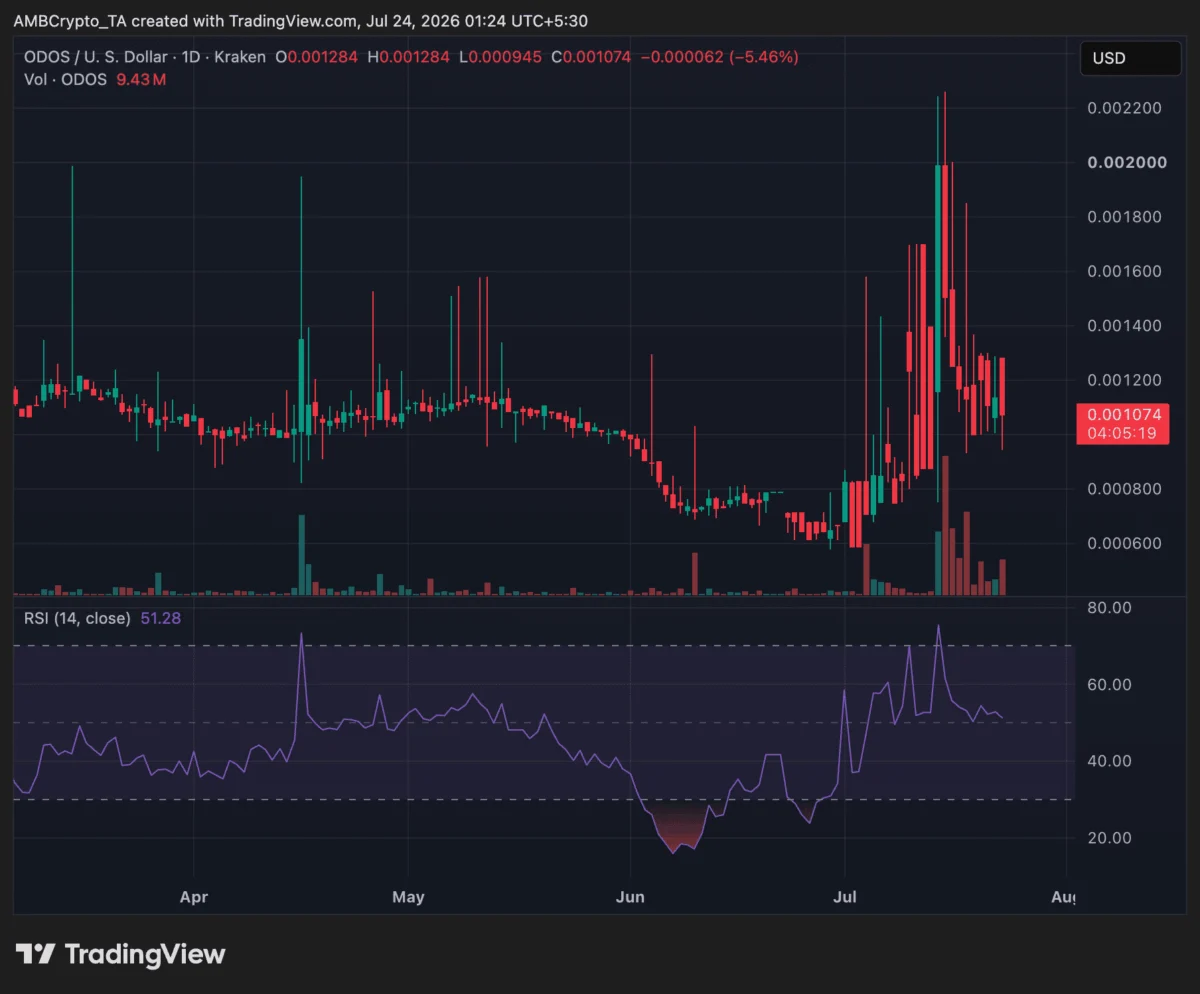
The news of the shutdown predictably triggered a negative reaction in the market for the ODOS token. According to TradingView data, the ODOS token was trading around $0.00107 at press time, reflecting an approximate 5.5% decline over the previous 24 hours immediately following the announcement. This downward price movement was accompanied by an elevated trading volume, indicating that market participants were actively reacting to the news, primarily through selling pressure.
While a 5.5% drop might seem modest in the highly volatile cryptocurrency market, it signals a clear loss of investor confidence and a reduction in perceived future utility for the token. For many, the value of a governance token is intrinsically linked to the ongoing development, utility, and success of the protocol it governs. The cessation of operations by the core development company removes a significant pillar of that perceived value.
Despite the selling pressure, the token’s Relative Strength Index (RSI) remained near 51. The RSI is a momentum oscillator that measures the speed and change of price movements, typically ranging from 0 to 100. An RSI around 51 indicates neutral momentum, suggesting that while there was selling, the token was not yet in an "oversold" condition where a rebound might be imminent. This neutral reading implies that while the market reacted, there wasn’t a panic-driven capitulation, possibly due to the relatively small market capitalization of ODOS or the immediate clarity provided by the team regarding asset safety.
To put this into broader context, the ODOS token’s performance must be viewed against its historical trajectory and the overall DeFi market. Many altcoins, especially those associated with smaller or niche protocols, have experienced significant downturns during recent bear market cycles. While specific historical highs for ODOS are not detailed, it is common for such tokens to trade significantly below their all-time highs as market conditions shift and project momentum wanes. The market capitalization of ODOS, likely in the lower tiers, also makes it more susceptible to price swings based on significant news. The absence of a company providing development and support services can severely impact a token’s long-term viability, even if the token’s underlying smart contract remains functional.
Broader Implications for the DeFi Ecosystem
The winding down of Odos’s operations carries several broader implications for the decentralized finance ecosystem. Firstly, it serves as a stark reminder of the inherent risks and rapid pace of innovation and obsolescence within the DeFi space. Projects, even those with promising technology, can struggle to find a sustainable business model or compete effectively against well-funded rivals.
Secondly, it reinforces the importance of truly decentralized governance. While the Odos DAO technically remains, its ability to function effectively without the backing of a development company will be a critical test case. Many DAOs struggle with low voter participation, complex decision-making processes, and the practical challenges of funding ongoing development or marketing efforts. The success or failure of the Odos DAO to pick up the mantle could provide valuable lessons for other projects designed with similar decentralized structures.
Thirdly, this event highlights the ongoing tension between centralized entities (the companies developing protocols) and the decentralized nature of the protocols and tokens themselves. While decentralization is a core tenet of DeFi, the reality is that many projects still rely heavily on a centralized team for development, maintenance, and strategic direction. When that team departs, the "decentralized" aspect is truly put to the test.
Finally, the incident underscores the need for user education and vigilance. The clear instructions and warnings against scams issued by the Odos team are vital. As the DeFi space matures, users must become more adept at identifying reputable projects, understanding the risks associated with various platforms, and securely managing their private keys and assets, especially during periods of uncertainty or project shutdowns. The "not your keys, not your coins" mantra remains paramount.
Conclusion: An Uncertain Future for Odos Beyond the Company
The permanent shutdown of the company behind Odos marks the end of an operational chapter for the DeFi aggregator. While the immediate focus is on users securing their assets before the July 30 deadline, the longer-term implications for the ODOS token and the Odos DAO present a complex and uncertain future. The theoretical resilience of decentralization will now be practically tested as the community grapples with the task of steering a protocol without its original architects.
This event serves as a significant case study for the DeFi industry, emphasizing the cyclical nature of innovation, the fierce competition among protocols, and the critical importance of robust, community-driven governance to ensure the longevity of truly decentralized projects. As the Odos application fades into read-only mode and then ceases entirely, the legacy of its technology and the fate of its token will depend on the collective will and actions of its decentralized community.