Foundry Digital LLC, the architect behind the world’s most dominant Bitcoin mining pool, has officially announced its strategic expansion into the privacy-preserving cryptocurrency sector with the upcoming launch of a dedicated Zcash (ZEC) mining pool. Slated for a commercial debut in April 2026, the new venture aims to provide a robust, enterprise-ready infrastructure for institutional investors, public corporations, and large-scale mining operations that have historically lacked a North American-based, compliant gateway into the Zcash ecosystem. This move signals a significant shift in the landscape of privacy-focused digital assets, as one of the industry’s most influential infrastructure providers lends its weight to a protocol often scrutinized by regulators but increasingly valued by advocates of financial confidentiality.
Foundry USA, the company’s flagship Bitcoin mining pool, currently commands the largest share of the global Bitcoin hashrate, often representing over 25% to 30% of the network’s total computational power. By leveraging this established expertise, Foundry intends to address what it perceives as a critical deficit in the Zcash mining market: the absence of professional-grade pooling services that meet the rigorous auditing and operational standards required by publicly traded entities. Mike Coyler, the CEO of Foundry, emphasized that while Zcash has matured as an asset class since its inception in 2016, the underlying mining support has remained fragmented and less sophisticated than its Bitcoin counterpart. The introduction of a US-based, institutional-grade pool is expected to bridge this gap, offering a localized solution for miners who prioritize regulatory transparency and operational reliability.
The Evolution of Zcash and the Need for Institutional Infrastructure
Zcash was launched nearly a decade ago as a pioneering fork of the Bitcoin codebase, designed specifically to address the inherent lack of privacy in transparent blockchains. While Bitcoin and Ethereum operate on public ledgers where transaction amounts and wallet addresses are visible to any observer, Zcash utilizes advanced cryptographic techniques known as Zero-Knowledge Succinct Non-Interactive Arguments of Knowledge (zk-SNARKs). This technology allows users to transact without revealing the sender, receiver, or transaction value, provided they utilize "shielded" addresses.
For years, the privacy coin sector has existed in a state of tension with global financial regulators. However, the narrative surrounding Zcash has begun to shift toward "compliant privacy." The protocol allows for selective disclosure, where users can provide viewing keys to auditors or regulators for compliance purposes while maintaining default privacy against the general public. Foundry’s entry into this space suggests a growing conviction that financial privacy and institutional compliance are not mutually exclusive. The company’s press release noted that Zcash represents a unique intersection of cutting-edge privacy and transparent verification, a combination that is increasingly attractive to businesses looking to protect proprietary financial data while remaining within the bounds of the law.
The decision to launch in April 2026 follows a period of significant technical maturation for the Zcash network. Recent upgrades, such as the "Halo" discovery which eliminated the need for a "trusted setup" in its cryptography, have made the network more scalable and secure. Foundry’s involvement is seen as the final piece of the puzzle—providing the industrial-scale mining power necessary to secure the network as it attracts larger capital inflows.

Analyzing the Surge in Zcash Network Hashrate
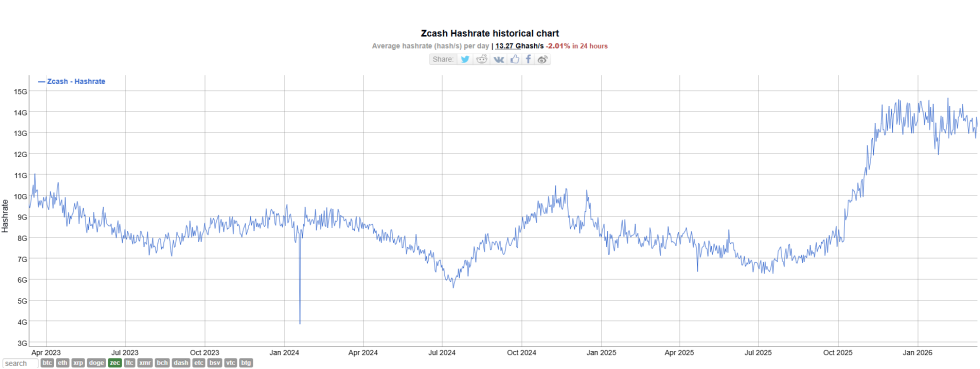
The timing of Foundry’s announcement coincides with a remarkable period of growth for the Zcash network’s security. Data from blockchain analytics platforms, including BitInfoCharts, reveals a substantial upward trend in the total computing power dedicated to the ZEC blockchain. In October 2025, the Zcash hashrate was measured at approximately 8 Gigahashes per second (Ghash/s). By early 2026, this figure had surged to over 13 Ghash/s, representing a nearly 63% increase in just a few months.
A rising hashrate is generally considered a bullish indicator for a Proof-of-Work (PoW) blockchain. It signifies that more miners are committing hardware and electricity to the network, which increases the cost of a 51% attack and enhances overall security. For Zcash, which utilizes the Equihash algorithm, this growth is particularly noteworthy as it suggests a deployment of newer, more efficient ASIC (Application-Specific Integrated Circuit) mining hardware. The entry of Foundry into this market is expected to accelerate this trend further, as the firm’s "institutional-grade" label will likely attract miners who were previously hesitant to join smaller or less transparent pools based in overseas jurisdictions.
Foundry’s operations are primarily based in North America, a region that has become a global hub for crypto mining following the 2021 mining ban in China. By offering a ZEC pool that operates under the same professional standards as its Bitcoin pool, Foundry is positioning itself to capture the "hashrate migration" of miners looking for diversification beyond Bitcoin.
Strategic Responses from Zcash Leadership
The news of Foundry’s expansion has been met with significant enthusiasm from the core architects of the Zcash ecosystem. Zooko Wilcox, the founder of Zcash and current Chief Product Officer at Shielded Labs, hailed the development as a milestone for the cryptocurrency’s adoption. Shielded Labs, an independent organization based in Switzerland that supports the Zcash protocol, has been instrumental in fostering global partnerships to improve the coin’s utility and security.
"We at Shielded Labs are delighted that Foundry—the largest Bitcoin mining pool, and one based in North America—is launching an enterprise-grade Zcash mining pool," Wilcox stated. His reaction underscores the importance of geographic and institutional diversity in mining. Having a dominant pool operator based in the United States provides a level of comfort for domestic investors and public companies that must adhere to strict internal risk management and external regulatory oversight.
The collaboration between a North American mining giant and a Swiss-based support organization highlights the globalized yet increasingly structured nature of the cryptocurrency industry. As Zcash continues to distance itself from the "dark coin" stigma of the early 2010s, endorsements from entities like Foundry serve to legitimize the asset as a sophisticated financial tool rather than merely a niche privacy experiment.

Economic Implications and Tokenomics
The economic structure of Zcash is intentionally modeled after Bitcoin, which contributes to its appeal among institutional "digital gold" advocates. Like Bitcoin, Zcash has a hard supply cap of 21 million tokens. It also employs a "halving" mechanism, where the block rewards granted to miners are reduced by 50% approximately every four years. This disinflationary model is designed to preserve the asset’s value over time by limiting supply growth.
At the time of the announcement, Zcash (ZEC) was trading at approximately $209. While the asset has experienced a weekly retracement of roughly 11%, the long-term price action remains a point of interest for analysts. The convergence of a rising hashrate, institutional infrastructure, and a fixed supply cap often creates a "supply shock" scenario during periods of high demand.
Furthermore, the introduction of a high-liquidity mining pool by Foundry could improve the "miner capitulation" threshold. Institutional miners typically have better access to capital and can afford to hold their rewards (HODL) during market downturns, unlike smaller "hobbyist" miners who may be forced to sell their ZEC to cover operational costs. This shift toward institutional ownership of the hashrate could lead to reduced sell-side pressure on the open market, potentially stabilizing ZEC’s price volatility in the long run.
Regulatory Landscape and the Privacy Paradox
One of the most complex aspects of Foundry’s entry into the Zcash market is the ongoing regulatory debate surrounding privacy coins. In recent years, several major exchanges have delisted privacy-focused assets like Monero and Zcash in certain jurisdictions, citing difficulties in meeting Anti-Money Laundering (AML) and "Travel Rule" requirements.
However, Foundry’s "institutional-grade" approach suggests a bet on a more nuanced regulatory future. By operating a pool that requires KYC (Know Your Customer) for its participants and providing transparent reporting for its members, Foundry is demonstrating that the act of mining a privacy coin can be done in a fully compliant manner.
The "Privacy Paradox" in finance suggests that while regulators want transparency to prevent crime, businesses and individuals require privacy to protect sensitive data. Zcash’s ability to provide "viewing keys" allows a middle ground where an institution can prove to a regulator where its funds came from without exposing its entire balance sheet to the public. Foundry’s infrastructure will likely emphasize these compliance-friendly features to attract public companies that are currently exploring digital asset treasuries but are wary of the total transparency of the Bitcoin ledger.
Future Outlook for the Mining Industry
The expansion of Foundry into Zcash may be the first of several moves by the company to diversify its portfolio beyond Bitcoin. As the Bitcoin mining industry becomes increasingly competitive and the "halving" events squeeze margins, large-scale operators are looking for alternative PoW networks where they can apply their operational expertise.
The April 2026 launch will be a critical litmus test for the Zcash network. If Foundry succeeds in capturing a significant portion of the ZEC hashrate, it could lead to a "Foundry effect," where the increased security and institutional visibility drive further price appreciation and developer interest. Conversely, it also raises questions about hashrate centralization. If one company dominates the pools of both the largest transparent blockchain (Bitcoin) and the largest privacy blockchain (Zcash), the industry will need to grapple with the implications of such concentrated influence.
For now, the move is viewed as a resounding vote of confidence in the longevity of Proof-of-Work and the essential role of privacy in the future of the global financial system. As the countdown to April 2026 begins, the mining community will be watching closely to see how this infusion of institutional vigor reshapes the privacy coin market.