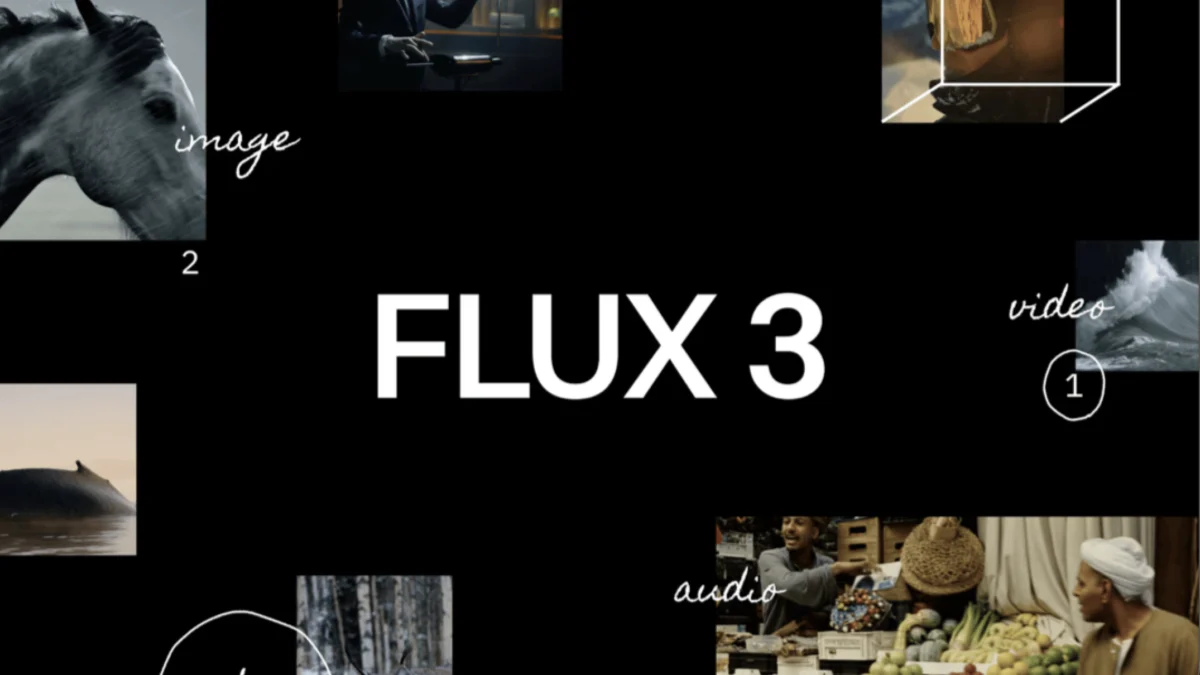
Black Forest Labs (BFL), the German artificial intelligence lab renowned for its innovative FLUX line of image generators, has announced the release of FLUX 3. This latest iteration represents a significant leap forward, moving beyond still image generation to natively produce video clips, complete with synchronized audio. Launched on Thursday, FLUX 3 embodies a true multimodal architecture, having been trained simultaneously on diverse data types including images, video, and audio within a single, unified system. This integrated approach stands in stark contrast to previous methods that often relied on separate models "bolted side by side," signifying a foundational shift in how AI understands and generates complex media.
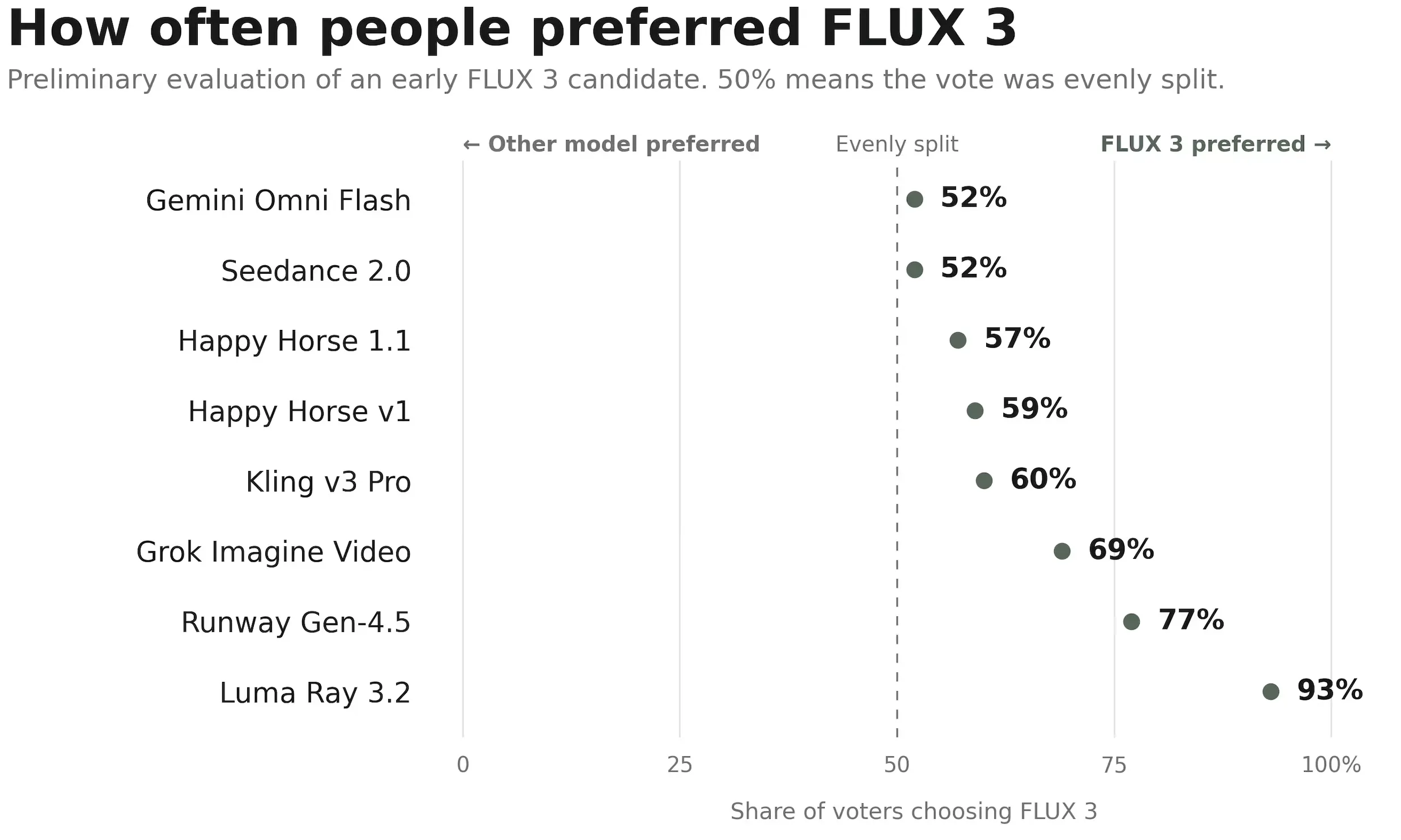
The headline feature of FLUX 3 is its robust video generation capability. The model can create video clips up to 20 seconds in length, meticulously generating audio alongside the visuals. This audio is not merely background noise; it is intricately synced to the on-screen action, encompassing dialogue, specific sound effects, and ambient noise, thereby creating a cohesive and immersive user experience. Early evaluations conducted by human reviewers underscore FLUX 3’s superior performance in this nascent field. In head-to-head comparisons, FLUX 3’s output was preferred over Runway Gen-4.5 in an impressive 77% of trials and outperformed Luma Ray 3.2 in a remarkable 93% of evaluations. While its edge was slightly narrower against established models like Gemini Omni and Seedance, FLUX 3 still emerged victorious in 52% of those comparisons, solidifying its position as a formidable contender in the rapidly evolving landscape of AI-powered video generation. These preference tests, a common method for qualitative assessment in AI, involve evaluators selecting the more convincing clip, with BFL meticulously tabulating FLUX 3’s win rate.
Beyond its groundbreaking video capabilities, FLUX 3 continues to uphold its legacy of excellence in still image generation. BFL has showcased a diverse portfolio of images generated by FLUX 3, demonstrating the model’s remarkable versatility and its capacity to render a broad spectrum of artistic styles that extend far beyond mere photorealism. This dual proficiency positions FLUX 3 as a comprehensive creative tool for artists, designers, and content creators.
The Strategic Significance of Multimodality
The shift to multimodality is not merely an incremental upgrade for Black Forest Labs; it is a strategic bet on the future of artificial intelligence. Robin Rombach, co-founder and CEO of Black Forest Labs, articulated this vision, stating, "A model that only learns images can only generate images." BFL’s core hypothesis is that an AI system capable of learning to predict video implicitly develops an understanding of the underlying physical principles that govern movement and interaction in the real world. This includes concepts such as weight, contact dynamics, and precise timing—elements crucial for any intelligent system tasked with navigating and manipulating objects within the physical environment.
This profound understanding of physical dynamics, gleaned from video prediction, forms the bedrock of a pioneering application: FLUX-mimic. Developed in collaboration with Zurich-based mimic robotics, FLUX-mimic leverages FLUX 3’s advanced video-prediction engine. It integrates a lightweight "decoder"—a compact add-on component—that effectively translates the model’s internal, learned sense of how objects move and interact into precise, actionable robot motions. This fusion of generative AI with real-world robotics holds immense promise for industrial automation and beyond.
Automotive giant Audi has already begun piloting FLUX-mimic in its manufacturing processes, specifically for intricate tasks such as fitting flexible door seals. This particular application highlights a persistent challenge for conventional automation systems, which have historically struggled with the nuanced manipulation of pliable, deformable materials. Stephan-Daniel Gravert, co-founder of mimic robotics, emphasized the synergy, remarking, "Audi represents the kind of manufacturing partner we built FLUX-mimic for." Christoph Schneider of Audi lauded the system’s impact, noting that the robots powered by FLUX-mimic can now "solve complex soft-body manipulation work" that was previously beyond the capabilities of older machinery. The efficiency of the FLUX-mimic system is underscored by its rapid reaction time, operating in approximately 101 milliseconds—a speed comparable to human visual reflexes, paving the way for more agile and adaptable robotic systems in manufacturing.
Black Forest Labs: A Brief History of Disruption
The ascendancy of FLUX models did not occur in a vacuum; it is the result of a deliberate strategy and a deep understanding of generative AI. Black Forest Labs was founded in August 2024 by a cadre of veteran researchers who had previously played pivotal roles in the development of the original Stable Diffusion models at Stability AI. This pedigree immediately positioned BFL as a formidable new player in the highly competitive AI landscape.
From its inception, BFL aimed to challenge the status quo. Their initial FLUX models, including the open-source Flux Dev and Flux Schnell, quickly gained traction. These models garnered significant attention for their ability to surpass the quality of outputs from established competitors like MidJourney and, notably, Stability AI’s own much-anticipated but ultimately underwhelming Stable Diffusion 3. The open-source community, particularly AI artists, had held high expectations for Stability AI’s subsequent release, Stable Diffusion 3.5, to reclaim the title of "best open-source image generator." However, this never materialized, allowing BFL’s Flux models to consolidate their lead.
The commercial tier, FLUX 1.1 Pro, further cemented BFL’s reputation. Released in October of the same year, it went on to claim the top spot in the rigorous evaluations conducted by the Artificial Analysis image arena, a respected benchmark for AI image generation quality. This model, unlike its open-source counterparts, was not made publicly available for local deployment, indicating BFL’s early exploration of different commercialization strategies.
The journey was not without its competitive challenges. BFL released FLUX 2 in November 2025, but this iteration did not achieve the same level of widespread popularity or critical acclaim as its predecessors. The open-source crown, initially worn by the original Flux, was eventually passed to Alibaba’s Z-Image Turbo in late 2025. Z-Image Turbo distinguished itself by matching FLUX’s quality while operating efficiently on lower-end consumer graphics cards, a significant advantage for broader accessibility. A user on CivitAI, a popular platform for AI art models, famously remarked at the time, "This is what SD3 was supposed to be," highlighting the community’s persistent disappointment with Stability AI’s offerings and the strong impression made by new challengers.
FLUX 3: A Comeback and a Strategic Rollout
FLUX 3 represents Black Forest Labs’ strategic comeback and a bold declaration of its ambitions in the multimodal AI space. The rollout of FLUX 3 is being conducted in a phased approach, reflecting the complexity and strategic importance of its new capabilities. The video generation and robotics action features are currently in early access, available through select APIs and to strategic partners, with mimic robotics being a prime example. The image generation capabilities, building on BFL’s foundational strengths, are slated for release in the "coming weeks," according to official statements from BFL.
In a move that acknowledges its roots and the importance of community engagement, Black Forest Labs also plans to release an open-weight Dev version of FLUX 3. This tier, which will be the only one available for local deployment by users, is anticipated later in 2026. This staggered release strategy allows BFL to refine its offerings, secure initial commercial partnerships for its advanced features, and eventually democratize access to a powerful version of its multimodal model.
Broader Implications for AI and Industry
The launch of FLUX 3 carries significant implications across several sectors. For the content creation industry, the ability to generate high-quality, synchronized video and audio from a single prompt represents a paradigm shift. It promises to democratize video production, enabling individuals and small teams to create sophisticated visual narratives with unprecedented ease and speed. This could disrupt traditional animation, filmmaking, and advertising workflows, fostering new forms of creative expression and efficiency.
In the realm of robotics and industrial automation, FLUX-mimic’s success with Audi points to a future where AI-driven robots can perform highly dexterous and adaptive tasks that were once exclusively within the domain of human workers or required prohibitively complex and rigid programming. The "internal sense of how things move" that FLUX 3 develops could be foundational for advancements in various fields, from logistics and manufacturing to healthcare and hazardous environment exploration. The convergence of generative AI for content and AI for physical world interaction suggests a future where intelligent systems are not just capable of understanding and generating digital information, but also of meaningfully interacting with and manipulating the physical world.
Furthermore, FLUX 3’s multimodal architecture reinforces the industry-wide trend towards more unified and holistic AI models. This approach reduces the complexity of integrating disparate AI tools and promises more coherent and contextually rich outputs. As AI models continue to evolve, the ability to process and generate multiple data types simultaneously will be critical for creating truly intelligent and versatile systems that can mimic human perception and interaction more closely.
Black Forest Labs, through FLUX 3, is not merely introducing a new product; it is helping to define the next generation of AI capabilities. By bridging the gap between digital content creation and real-world physical interaction, BFL is positioning itself at the forefront of a technological revolution that promises to reshape industries and redefine the very nature of human-computer interaction. The coming months will be crucial as FLUX 3’s capabilities become more widely accessible, offering a glimpse into a future powered by truly multimodal and physically intelligent AI.