
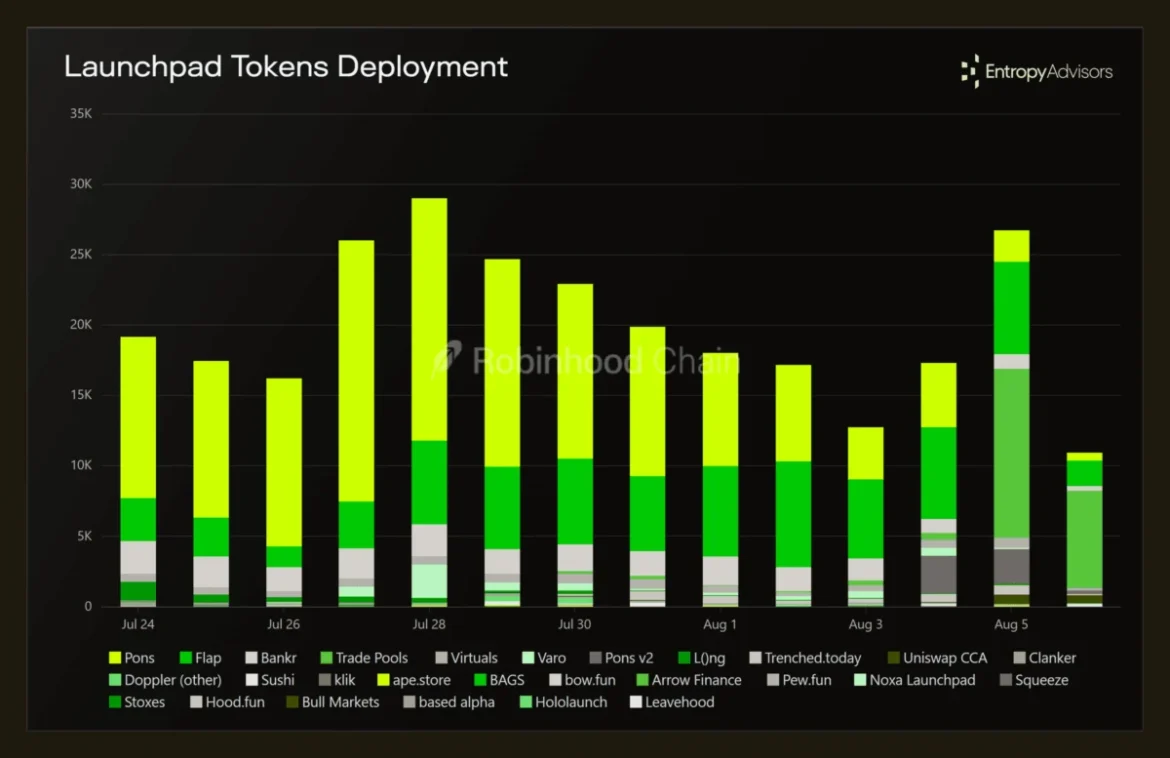
Uniswap has firmly pushed back against mounting criticism surrounding its newly introduced token launchpad, "Trade Pools," refuting allegations that the platform is engineered to extract predatory value from retail traders. The controversy emerged shortly after Uniswap rolled out the feature, which introduces a 0.25% trading fee—marking a significant discount compared to the industry standard 1% fee levied by several competing platforms.
While proponents welcomed the lower cost barrier as a win for everyday traders, skeptics quickly took to social media and industry forums to question the motives behind the product. Critics suggested that Trade Pools was an aggressive undercutting maneuver designed to muscle out rival memecoin launchpads operating within the Robinhood ecosystem, such as Pons, Flap, and Bankr. More pointedly, some market observers expressed concern that the platform could pave the way for extractive practices similar to those seen on high-activity venues like PumpFun, where heavy token creation pipelines have occasionally drawn regulatory and community backlash.
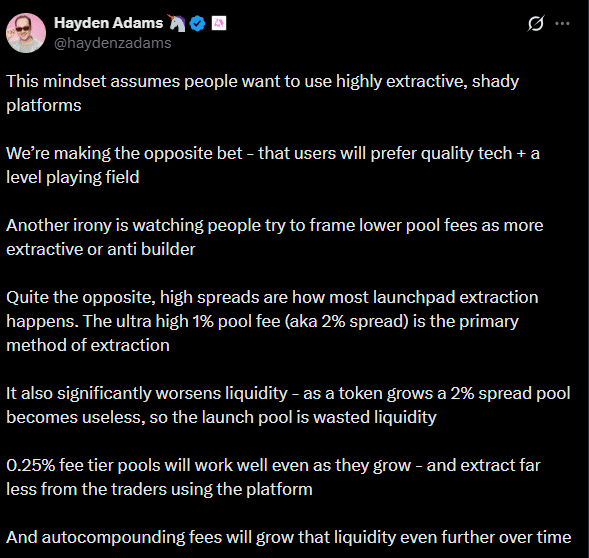
Addressing these concerns directly, Uniswap CEO Hayden Adams took to public channels to defend the platform’s economic design and overarching philosophy.
"This mindset assumes people want to use highly extractive, shady platforms," Adams stated. "We’re making the opposite bet—that users will prefer quality tech plus a level playing field."
Adams further emphasized that the 0.25% fee tier is structurally sustainable and designed to scale healthily as adoption grows, ensuring that traders retain a much higher percentage of their capital rather than losing it to platform extraction fees.
The Genesis of Uniswap Launches and the Robinhood Integration

The debut of Trade Pools represents a strategic evolution in Uniswap’s deployment strategy, following closely on the heels of "Uniswap Launches," an interface aggregator designed to bundle various token launchpads into a single, cohesive user experience. Initially, this aggregator rolled out exclusively on Robinhood’s newly launched Layer-2 (L2) network, capitalizing on a sharp surge in speculative retail interest and memecoin activity on the platform.
The initial rollout integrated several established third-party launchpads, allowing users to interact with multiple protocols without leaving the Uniswap interface. However, rather than remaining purely an aggregator, Uniswap made the decisive move to launch its own proprietary alternative: Trade Pools. By offering a launchpad that charges a fraction of the cost of its competitors, Uniswap directly entered the competitive arena of token generation engines.
Strategic Alignment with Uniswap V4
Industry analysts have been quick to dissect the underlying architecture and strategic implications of the Trade Pools rollout. Tom Wan, head of data at Entropy Advisors, provided key insights into why Uniswap chose to build a native launchpad rather than relying solely on aggregation.
"I read Trade Pools as a strategic push to drive usage of Uniswap v4," Wan noted. "Most launchpads today graduate tokens into v3, while Trade Pools routes directly into v4."
This structural integration is viewed as a masterclass in ecosystem synergy. By channeling newly launched tokens directly into Uniswap V4 liquidity pools, the protocol incentivizes adoption of its latest iteration, which offers advanced customizability, hooks, and capital efficiency features.
The market response to this architectural shift was almost immediate. According to data tracked by Entropy Advisors, Uniswap V4 trading volumes experienced a dramatic 2.4x expansion within just 48 hours of the Trade Pools launch, soaring from a baseline of $100 million to over $237 million. This rapid acceleration highlights the immense liquidity-generation capacity of token launchpads when paired with a deeply liquid decentralized exchange protocol.
Impact on Robinhood Chain and Cross-Chain Competition
The launch of Trade Pools has not only bolstered Uniswap’s internal metrics but has also profoundly influenced the competitive standing of the Robinhood Chain itself. Released just last month, the new Layer-2 network has quickly established itself as a formidable contender in the multi-chain landscape, capturing significant market share during a period of explosive memecoin and Real-World Asset (RWA) growth.
On-chain metrics compiled over the first week of August 2026 illustrate the rapid ascent of the Robinhood L2. The network recorded nearly $600 million in total launchpad volume, effectively outperforming established ecosystems such as the BNB Chain, which logged approximately $400 million over the same timeframe.
While Solana continues to dominate the broader memecoin launchpad sector—commanding roughly $3 billion in volume thanks to industry heavyweights like PumpFun and Bonkfun—the sudden emergence of Robinhood Chain and Uniswap’s Trade Pools signals a shifting competitive dynamic. Analysts note that low transaction fees, combined with the trusted brand recognition of Robinhood and the decentralized liquidity infrastructure of Uniswap, create a powerful value proposition for retail speculators.
Market Reaction and Price Action for UNI
The broader financial markets have closely monitored these developments, translating the protocol’s expanding market share into positive price momentum for the governance token, UNI. Following the announcement and subsequent volume surge of Trade Pools, the UNI token registered a 5% upward correction, trading near $4.19.
Despite this recent rally, market analysts point out that UNI remains in a period of consolidation as it cools off from a broader market recovery observed throughout July. That recovery was initially catalyzed by a combination of rising transactional activity on the Robinhood network and renewed community discussions surrounding the implementation of the Uniswap fee switch—a mechanism designed to distribute protocol revenues back to token holders.
Broader Implications for Decentralized Finance
The controversy and subsequent success surrounding Trade Pools underscore a broader philosophical debate within decentralized finance (DeFi): the tension between maximizing short-term extractive revenue and building sustainable, user-centric infrastructure.
While traditional launchpads have often relied on high fee structures to capture immediate value from the hyper-speculative memecoin cycle, Uniswap’s aggressive pricing model suggests a different playbook. By lowering fees to 0.25% and integrating directly with V4 architecture, Uniswap is betting that long-term volume dominance and sticky user retention will outweigh short-term margins.
As the L2 landscape matures and competition between chains like Solana, BNB, and Robinhood intensifies, the role of native infrastructure providers like Uniswap will remain pivotal. Whether Trade Pools can sustain its explosive early growth and weather regulatory and market scrutiny will depend heavily on the continued appetite for speculative assets and the execution of Uniswap’s long-term scaling strategy.
