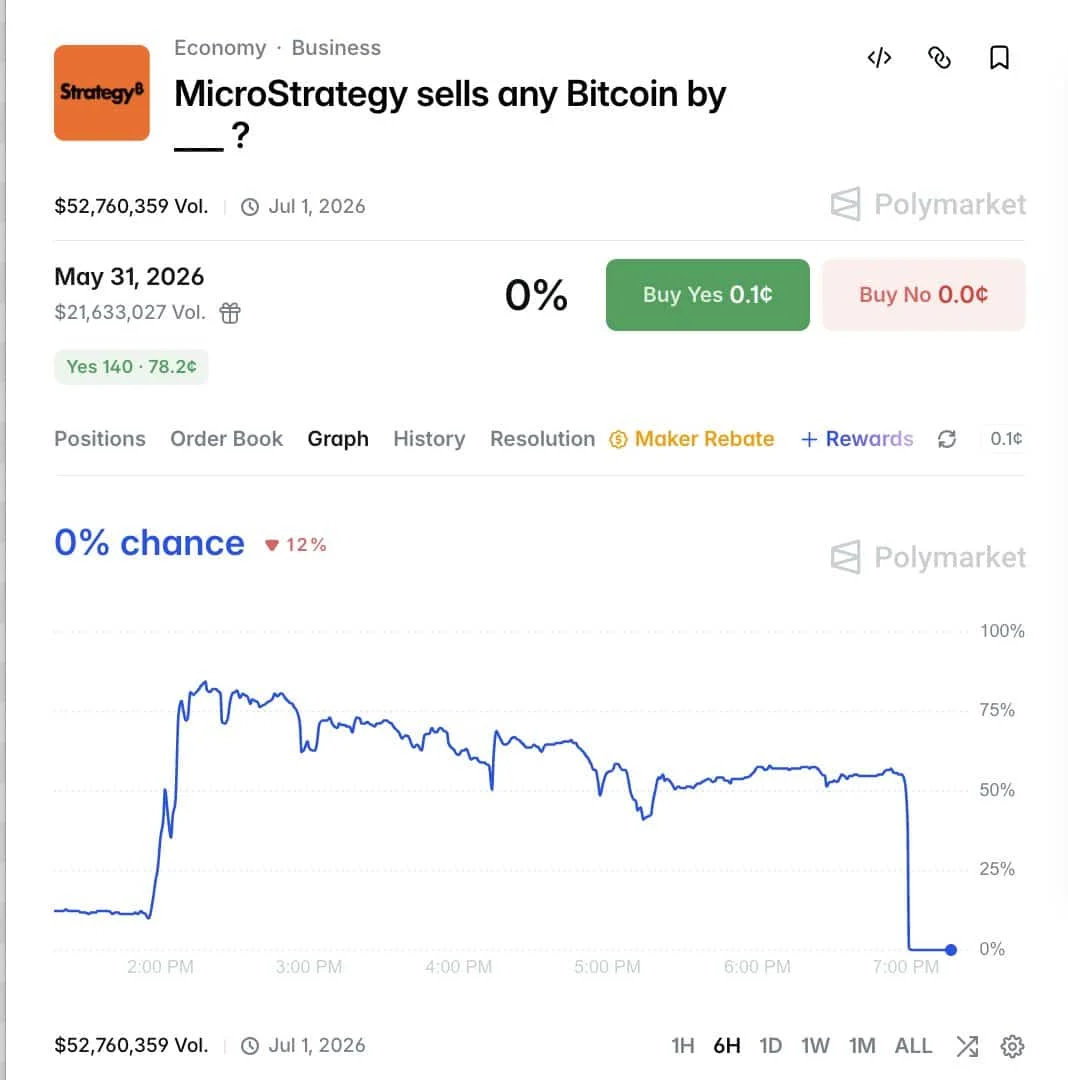
A high-stakes dispute involving a Polymarket prediction market with over $80 million in trading volume has reached its final arbitration stage, centered on the resolution of a bet concerning MicroStrategy’s Bitcoin sales. The platform’s proposed resolution of "No" has ignited significant controversy, as MicroStrategy did execute a substantial Bitcoin sale within the market’s stipulated timeframe, leading to a critical decision by UMA tokenholders, the decentralized oracle system powering Polymarket’s settlements.
The market in question posed a simple yet financially significant question: "Will MicroStrategy sell Bitcoin by May 31?" The underlying transaction involved MicroStrategy selling 32 Bitcoin, valued at approximately $2.5 million, between May 26 and May 31. However, the company officially disclosed this sale in a regulatory filing on June 1, a day after the market’s deadline. Polymarket’s decision to resolve the market as "No" hinges on the argument that no official confirmation of the sale existed before the May 31 deadline, thus rendering the transaction ineligible for a "Yes" resolution. This interpretation has placed the integrity of Polymarket’s resolution mechanisms and the precision of its market criteria under intense scrutiny, especially given the vast sums of capital involved.
The crux of the dispute lies not in whether traders are dissatisfied, but in the adequacy and clarity of the resolution criteria. The analytical question now before UMA tokenholders is whether the rules, as written and subsequently clarified, were sufficiently unambiguous to justify Polymarket’s interpretation of the event, impacting the capital of potentially millions of participants.
This is not the first time this particular market’s resolution has been formally challenged, marking it as one of Polymarket’s most persistently contested markets on record. For those holding "Yes" shares, the implications are immediate and financially tangible. For Polymarket and its governance infrastructure, the outcome carries broader implications for trust, predictability, and the future of decentralized prediction markets.
The Mechanics of the Dispute Resolution
Polymarket operates by utilizing UMA’s optimistic oracle system for market settlement. When a market is created, it includes a set of rules and a deadline. If the outcome of the event is uncertain or disputed, a proposed resolution is submitted. This proposed resolution stands unless it is challenged by "bonded disputers" within a specified timeframe. These disputers essentially stake capital to signal their disagreement and escalate the dispute.
When a challenge is successful in escalating a dispute, the ultimate decision-making power shifts to UMA tokenholders. These tokenholders then vote on the correct interpretation of the event, based on the evidence presented and the market’s rules. In the case of the MicroStrategy Bitcoin sale market, the dispute resolution process has been unusually complex. There have been two distinct challenges escalating the question before it reached the current final review stage. This frequency of escalation on a single market is structurally unusual and suggests that UMA’s governance design, while robust, may not have been specifically optimized to handle such a high volume of contentious arbitrations on one market.

MicroStrategy’s Bitcoin Transaction: A Timeline of Events
The sequence of events leading to this dispute is critical for understanding the differing interpretations:
- Prior to May 26, 2026: MicroStrategy holds a significant amount of Bitcoin as part of its corporate treasury strategy. The market "Will MicroStrategy sell Bitcoin by May 31?" is active on Polymarket, with considerable trading volume.
- May 26 – May 31, 2026: MicroStrategy executes the sale of 32 Bitcoin. The exact timing within this window is a key point of contention. The approximate value of this sale is $2.5 million.
- May 31, 2026 (11:59 PM UTC): The deadline for the Polymarket market. At this point, according to Polymarket’s interpretation, there is no publicly verifiable confirmation of the Bitcoin sale.
- June 1, 2026: MicroStrategy files a Form 8-K with the U.S. Securities and Exchange Commission (SEC) disclosing the sale of 32 BTC. This filing is tied to the company’s stock repurchase program and distributions related to its preferred stock. This is the first reported disposal of Bitcoin by MicroStrategy since December 2022.
- Post-June 1, 2026: Polymarket proposes to resolve the market as "No," citing the lack of confirmation before the May 31 deadline. This proposal triggers a dispute.
- Subsequent Dispute Escalations: The dispute is challenged, leading to multiple rounds of arbitration and review, culminating in the current final review by UMA tokenholders.
Polymarket’s stance is heavily reliant on a clarifying note added to the market page after the conflict began to surface. This note specifies that any confirmations released outside the market’s timeframe would not be considered valid for resolution purposes. Furthermore, Polymarket asserts that no on-chain data, official filing, or credible reporting confirmed the Bitcoin sale prior to the expiration of the May 31 deadline.
The "Moving the Goalposts" Accusation
Many participants in the Polymarket market have characterized the addition of this clarifying language as an instance of "moving the goalposts." They argue that the majority of the $80 million in trading volume occurred under the expectation that a sale executed within the timeframe, even if disclosed slightly later, would qualify for a "Yes" resolution. The subsequent addition of a strict disclosure-timing requirement is seen as an arbitrary change that disadvantages those who bet on the event’s occurrence rather than the speed of its public verification.
MicroStrategy’s June 1 SEC filing is significant because it represents the first disclosed Bitcoin sale by the company in over two years. This makes the interpretive weight placed on a single 24-hour disclosure gap particularly substantial. The company’s official statement in the filing linked the sale to its capital allocation strategy, specifically its share repurchase program and preferred stock distributions, providing a clear corporate rationale.
Truth vs. Technicalities: The Core of the Debate
Objectors to the "No" resolution frame their argument around a fundamental distinction between the occurrence of an event and its public verifiability. They contend that the actual sale of Bitcoin by MicroStrategy happened within the designated timeframe. Therefore, the market should reflect this reality, irrespective of the precise moment the news became officially public.
Comments on the market page reflect this sentiment, with one participant asserting that Polymarket should "trade truth, not technicalities." Other participants have expressed disbelief and concern, with some stating that this dispute has eroded their confidence in the platform’s ability to deliver fair and transparent resolutions. The subjective perception of fairness is a crucial element in decentralized systems, where trust in the protocol is paramount.
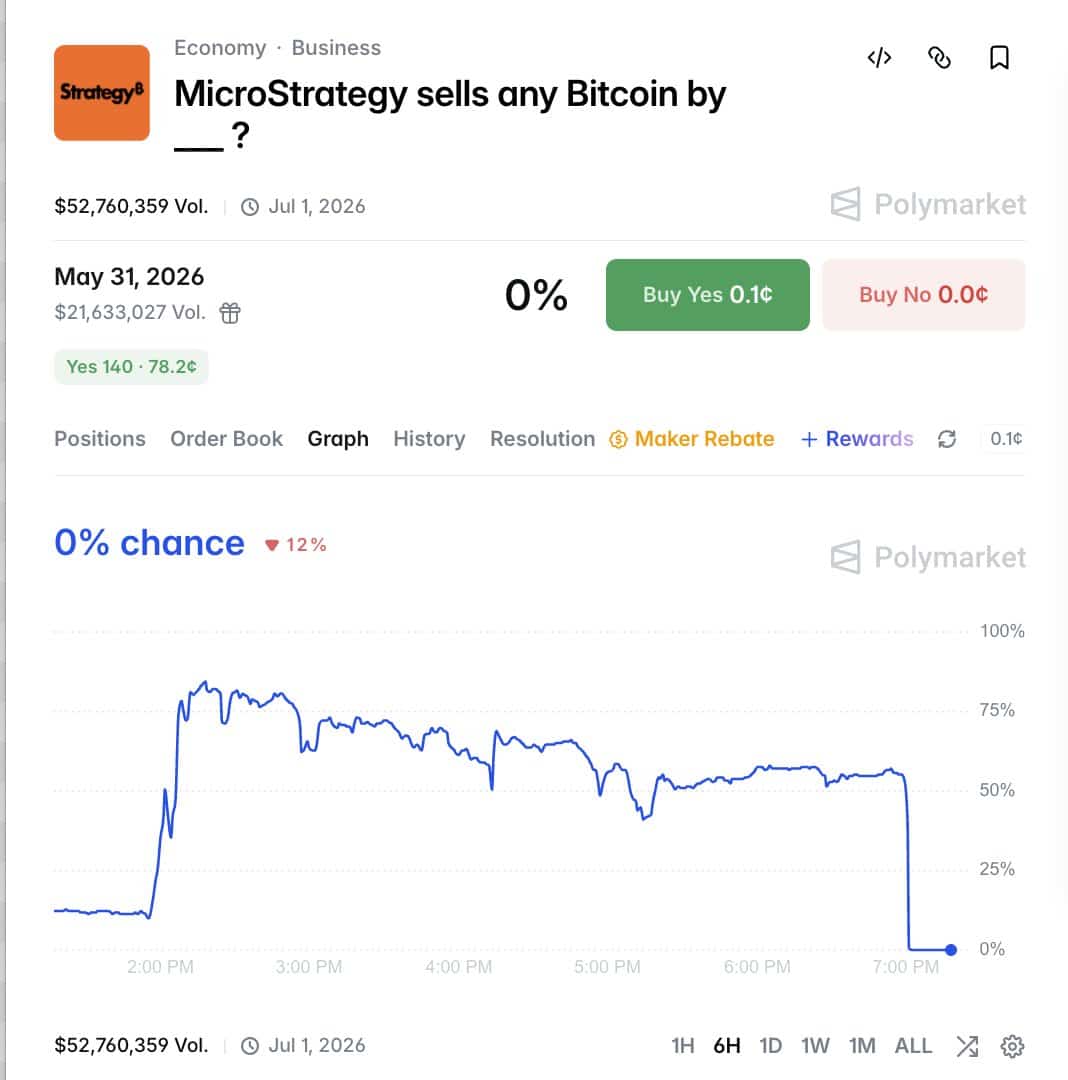
Despite the widespread objections and the perceived unfairness by a segment of the user base, the market pricing on Polymarket, as of the latest available data, overwhelmingly favors the "No" outcome. Approximately 99.9% of the odds are attached to "No." This figure, however, reflects the capital allocation under the current resolution trajectory and the perceived likelihood of a "No" ruling by UMA tokenholders, rather than necessarily representing the objective merits of the underlying dispute or the true will of the majority of traders.
The Stakes for Polymarket and Decentralized Oracles
The implications of this dispute extend far beyond the immediate financial outcomes for individual traders. For Polymarket, a platform aiming to be a leader in decentralized prediction markets, the resolution of this high-profile case is crucial for its reputation. A perceived unfair or arbitrary resolution could deter future participation and investment, undermining the platform’s growth and its ability to attract significant capital.
The case also serves as a critical test for the UMA optimistic oracle system. The design of such systems aims to create decentralized and trustless dispute resolution mechanisms. However, disputes like this highlight potential vulnerabilities or areas for improvement. The fact that the dispute has gone through multiple escalations suggests that the current dispute resolution process, while functional, might be susceptible to complexities that were not fully anticipated. The efficiency and fairness of these decentralized arbitration processes are vital for the broader adoption of Web3 technologies that rely on them.
The broader Web3 ecosystem is watching this dispute closely. Prediction markets are seen as a powerful tool for aggregating collective intelligence and hedging against uncertainty. If these markets are perceived as susceptible to manipulation or to resolutions based on overly strict or retroactive interpretations of rules, their utility and credibility could be significantly diminished. The success or failure of Polymarket in navigating this dispute will provide valuable insights into the robustness and maturity of decentralized oracle and dispute resolution mechanisms.
The UMA Tokenholder Vote: A Decisive Moment
The ultimate decision now rests with UMA tokenholders. They are tasked with reviewing the evidence, the market rules, Polymarket’s proposed resolution, and the arguments presented by the disputing parties. Their vote will determine whether the market is resolved as "Yes" or "No." The deadline for this final ruling is set for 12:00 a.m. UTC on Wednesday. Failure to reach a conclusive decision by this time would result in the order book being cleared, potentially leading to an arbitrary resolution or a stalemate that leaves the outcome uncertain.
This critical juncture underscores the challenges inherent in establishing objective and universally accepted resolution criteria in decentralized environments. As prediction markets mature, the need for crystal-clear, immutable, and precisely defined market parameters becomes increasingly evident. The MicroStrategy Bitcoin sale dispute on Polymarket is a stark reminder of the intricate interplay between event occurrence, public disclosure, and the precise wording of rules in the evolving landscape of decentralized finance and governance. The outcome will undoubtedly set a precedent for future disputes and inform the ongoing development of decentralized oracle and dispute resolution technologies.
Disclaimer: Coinspeaker is committed to providing unbiased and transparent reporting. This article aims to deliver accurate and timely information but should not be taken as financial or investment advice. Since market conditions can change rapidly, we encourage you to verify information on your own and consult with a professional before making any decisions based on this content.