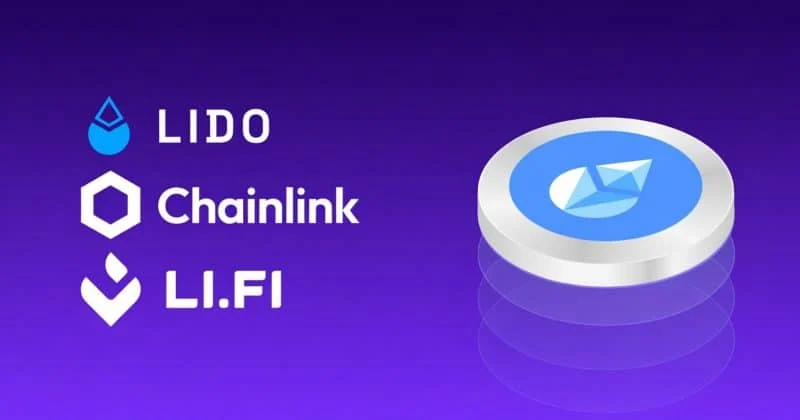
A significant advancement in decentralized finance (DeFi) infrastructure has emerged with the collaborative launch of a single-click, cross-chain staking solution by the prominent trio, Lido, Chainlink, and LI.FI. This innovative integration empowers users to stake Ethereum (ETH) on various layer 2 (L2) networks and instantaneously receive wrapped staked Ether (wstETH), thereby dramatically streamlining a process that previously entailed multiple complex, time-consuming, and often costly steps. The solution marks a pivotal moment in making liquid staking more accessible and efficient across the burgeoning multi-chain ecosystem, particularly for users seeking to leverage the scalability and lower transaction costs offered by L2s.
The newly unveiled mechanism is built upon a robust foundation, leveraging the distinct strengths of each participating entity. Chainlink’s industry-leading Cross-Chain Interoperability Protocol (CCIP) provides the bedrock for secure and reliable cross-chain bridging, mitigating the risks historically associated with asset transfers between disparate blockchain environments. LI.FI contributes its advanced order routing and pricing engine, ensuring optimal execution and efficiency for asset conversions. Meanwhile, Lido, the dominant force in liquid staking, underpins the entire operation with its established staking infrastructure, facilitating the creation and distribution of wstETH. This powerful synergy enables users to convert ETH held on L2 networks, such as Arbitrum, directly into wstETH on the same network within a single transaction, requiring only one digital signature.
The Genesis of the Collaboration: Addressing DeFi’s Multi-Chain Challenge
The evolution of decentralized finance has been characterized by rapid innovation, but also by persistent challenges, primarily concerning scalability and interoperability. Ethereum, the foundational blockchain for much of DeFi, grappled with high transaction fees and network congestion, particularly during periods of intense activity. This led to the proliferation of layer 2 scaling solutions, including optimistic rollups like Arbitrum and Optimism, and zero-knowledge rollups, which process transactions off the mainnet before batching them and submitting them back to Ethereum. While L2s dramatically improved transaction speed and reduced costs, they introduced a new layer of complexity: fragmentation. Assets and liquidity became siloed across various networks, making it cumbersome for users to move funds and participate in DeFi activities across different chains.
Liquid staking emerged as another critical innovation, allowing users to stake their ETH to secure the Ethereum network without locking up their capital. Instead, they receive a liquid staking derivative (LSD) like Lido’s stETH or wstETH, which can then be used in other DeFi protocols to earn additional yield. This concept significantly enhanced capital efficiency for stakers. However, the benefits of liquid staking often remained confined to the Ethereum mainnet or required arduous bridging processes to access L2s. The vision of a truly seamless, multi-chain DeFi ecosystem where users could effortlessly stake assets and utilize their derivatives across any network remained elusive until now.
This collaboration is a direct response to these intertwined challenges. Each participant brings a piece of the puzzle: Lido provides the core liquid staking primitive, Chainlink offers the secure conduit for cross-chain value transfer, and LI.FI acts as the intelligent aggregator and router, abstracting away the underlying complexities. The combined effort seeks to bridge the gap between L2 efficiency and liquid staking utility, fostering a more integrated and user-friendly DeFi experience.
Unpacking the Solution: A Technical Deep Dive
At its core, the new cross-chain staking solution orchestrates a series of sophisticated operations into a single, user-facing action. When a user initiates a stake of ETH on an L2 like Arbitrum, the LI.FI protocol immediately comes into play. LI.FI’s aggregation layer scans various routes and liquidity pools to identify the most efficient path for converting the user’s ETH into wstETH. This involves not just direct swaps but potentially bridging the ETH to another chain where a more favorable swap is available, or routing it through intermediate tokens, all executed seamlessly in the background.
Crucially, Chainlink’s CCIP is employed for any cross-chain messaging or value transfer required during this process. CCIP is designed to provide the highest level of security and reliability for cross-chain communication, utilizing a decentralized network of Chainlink oracle nodes to verify and transmit data and assets. Unlike many traditional bridges that have proven vulnerable to exploits, CCIP employs a multi-layered security approach, including active risk management networks and customizable security parameters, ensuring the integrity of the transaction across different chains. This robust security model is paramount, especially when dealing with substantial volumes of staked ETH.
Once the optimal route is identified and secured by CCIP (if a cross-chain component is needed), Lido’s liquid staking infrastructure is engaged. Lido processes the staking request, minting the corresponding amount of wstETH. Importantly, the solution is designed to deliver the wstETH directly back to the user’s wallet on the original L2 network where the transaction was initiated. This eliminates the need for manual bridging of the wstETH back to the L2, a common friction point in previous workflows. The entire sequence—from ETH on an L2 to wstETH on the same L2—is encapsulated within a single, atomic transaction requiring only one signature from the user. This level of abstraction significantly lowers the technical barrier for participation in liquid staking on L2s.
The Problem Solved: Overcoming Prior Hurdles
The introduction of this unified solution directly addresses several significant pain points that have long plagued DeFi users interacting with L2s and liquid staking protocols. Previously, a user with ETH on an L2 network like Arbitrum, wishing to obtain wstETH on that same network, faced a dilemma:
- Costly DEX Swaps: They could attempt to swap their ETH for wstETH on a decentralized exchange (DEX) operating on the L2. However, the liquidity for wstETH directly on L2s might be fragmented or insufficient, leading to high slippage and unfavorable exchange rates, effectively making the process expensive.
- Slow, Multi-Step Bridge, Staking, and Wrap Process: Alternatively, users could initiate a cumbersome multi-step procedure. This typically involved:
- Bridging their ETH from the L2 back to the Ethereum mainnet. This process often takes a significant amount of time, sometimes hours or even days, particularly for optimistic rollups with their challenge periods.
- Once on mainnet, staking their ETH with Lido to receive stETH.
- Wrapping their stETH into wstETH (a more composable, non-rebasing version of stETH).
- Finally, bridging the newly acquired wstETH back from the Ethereum mainnet to their desired L2 network, again incurring time delays and additional transaction fees.
This convoluted workflow was not only time-consuming and expensive due to multiple gas fees across different networks but also introduced considerable risk. Each manual step presented an opportunity for user error, such as sending funds to the wrong address or misconfiguring a bridge transaction, with no inherent protection against such mistakes. The "updated pipeline will handle everything in one seamless API call," according to statements from the collaborating teams, completely abstracting away these complexities.
The solution removes a significant layer of technical complexity for both end-users and developers. For users, it transforms a daunting multi-stage operation into a simple click. For developers, it means they can integrate this streamlined functionality into their applications via the LI.FI API, rather than having to build and maintain their own complex bridging and swapping logic. This capability is already live and accessible through platforms like Jumper Earn, providing immediate utility to a broad user base.
Industry Context: The Rise of Liquid Staking and Layer 2s
The significance of this integration can be fully appreciated within the broader context of DeFi’s rapid expansion. Ethereum staking has witnessed monumental growth since the Merge, with a substantial portion of the ETH supply now locked in staking contracts. Lido Finance has emerged as the unequivocal leader in the liquid staking sector, currently commanding roughly $19 billion in total value locked (TVL) across its protocols. Its dominance underscores the market’s demand for liquid staking solutions that allow users to earn staking rewards while retaining liquidity for their assets.
Concurrently, Layer 2 networks have experienced an explosive surge in adoption. Arbitrum, for instance, has consistently ranked among the top L2s by TVL, attracting billions of dollars in capital and hosting a vibrant ecosystem of decentralized applications. The appeal of L2s lies in their ability to offer transaction speeds often exceeding 1,000 transactions per second (TPS) and gas fees that are orders of magnitude lower than those on the Ethereum mainnet, making DeFi accessible to a wider audience.
However, the proliferation of L2s and the increasing volume of assets moving between them also highlighted the critical need for secure and efficient cross-chain interoperability. Traditional bridges have been a recurring point of vulnerability in the crypto space, with billions of dollars lost to hacks and exploits over the past few years. Chainlink’s CCIP, which already secures over $26 trillion in on-chain transactions across various services, represents a paradigm shift in cross-chain security, offering a more robust and decentralized alternative to single-point-of-failure bridge designs. LI.FI further enhances this multi-chain environment by connecting more than 60 blockchains and over 20 bridges, optimizing asset transfers and swaps across this fragmented landscape. The convergence of these powerful infrastructures provides a robust, secure, and efficient solution that was previously unavailable.
Statements and Perspectives from the Architects
While no direct quotes were provided in the initial announcement, the strategic implications allow for inferred statements reflecting the objectives of each participating entity.
A representative from Lido Finance would likely emphasize the commitment to expanding the utility and accessibility of liquid staking derivatives. "Our mission at Lido has always been to democratize access to Ethereum staking, providing users with the flexibility of liquid assets," a spokesperson might state. "This collaboration with Chainlink and LI.FI is a monumental step towards achieving that goal, allowing users to seamlessly engage with wstETH across the most popular Layer 2 networks. It removes friction, lowers costs, and ultimately brings the benefits of liquid staking to a much broader audience, enhancing capital efficiency throughout the DeFi ecosystem."
From Chainlink’s perspective, the focus would undoubtedly be on the foundational role of CCIP in securing complex cross-chain interactions. "The successful deployment of this single-click staking solution underscores the power and unparalleled security of Chainlink CCIP," a Chainlink executive could remark. "In a multi-chain future, secure interoperability is not merely a feature, but a necessity. CCIP is engineered to be the industry standard for cross-chain communication, enabling developers to build truly composable and secure applications that span multiple blockchains. This integration with Lido and LI.FI showcases CCIP’s ability to unlock entirely new classes of cross-chain DeFi primitives, setting a new benchmark for reliability and trust in the ecosystem."
LI.FI’s contribution would be highlighted for its role in enhancing user experience and optimizing liquidity routing. "Our core philosophy at LI.FI is to abstract away the complexity of the multi-chain world, making it feel like a single, unified experience," a LI.FI team member might explain. "This collaboration is a perfect embodiment of that vision. By combining our intelligent routing engine with Lido’s liquid staking and Chainlink’s secure bridging, we’ve created a product that not only saves users time and money but also protects them from common pitfalls. It’s about delivering unparalleled efficiency and simplicity, allowing users to focus on their strategies rather than navigating intricate blockchain mechanics."
Broader Implications: Reshaping the DeFi Landscape
The introduction of this single-click, cross-chain staking solution carries profound implications for the future trajectory of decentralized finance:
Enhanced User Experience and Accessibility: By simplifying the process of obtaining wstETH on L2s, the solution significantly lowers the barrier to entry for a vast number of users. This ease of use is crucial for mainstream adoption, as it moves DeFi closer to the intuitive user interfaces found in traditional financial applications. More users are likely to participate in staking, leading to a more robust and decentralized Ethereum network.
Increased Capital Efficiency and Composability on L2s: The immediate availability of wstETH on L2s unlocks a new wave of capital efficiency. Users can stake their ETH and immediately utilize their wstETH in other DeFi protocols native to those L2s, such as lending platforms, yield aggregators, or decentralized exchanges, without incurring significant delays or costs for bridging. This fosters deeper liquidity and more sophisticated financial primitives within L2 ecosystems, driving innovation and total value locked.
Impact on L2 Adoption and Growth: Making liquid staking on L2s more accessible will undoubtedly attract more capital and users to these scaling solutions. As more value flows into L2s, their ecosystems will mature, leading to more robust infrastructure, a wider array of dApps, and increased transaction volume, further cementing their role as critical components of the Ethereum scaling roadmap.
Setting New Standards for Cross-Chain Security: The reliance on Chainlink’s CCIP for secure bridging sets a new precedent for cross-chain interactions within DeFi. Given the history of bridge exploits, an enterprise-grade, highly secure interoperability protocol is essential for building trust and enabling the next generation of multi-chain applications. This collaboration demonstrates how best-in-class security can be integrated into core DeFi primitives.
The Path Towards a Truly Seamless Multi-Chain Future: This development represents a significant step towards a future where users no longer perceive blockchain boundaries. The ability to seamlessly move assets and engage with protocols across different chains with minimal friction brings the vision of a truly interconnected and efficient multi-chain DeFi ecosystem closer to reality. It lays the groundwork for more complex, cross-chain applications that were previously impractical or too risky to build.
Market Dynamics and Future Outlook
From a market dynamics perspective, this solution further solidifies Lido’s position as a dominant liquid staking provider by significantly expanding its reach and utility across L2s. It also strengthens Chainlink’s role as the indispensable security layer for cross-chain communication and LI.FI’s prominence as a key infrastructure provider for multi-chain routing.
Looking ahead, the potential for expansion is vast. While the initial focus highlights Arbitrum, the underlying infrastructure can be extended to other prominent L2 networks, such as Optimism, Polygon zkEVM, and zkSync Era, as their ecosystems mature and demand for liquid staking grows. Furthermore, similar single-click solutions could potentially be developed for other liquid staking derivatives or asset types, further simplifying cross-chain DeFi interactions.
The evolving regulatory landscape for DeFi also plays a role. As regulators scrutinize decentralized protocols, solutions that prioritize security, transparency, and user protection, like those built on Chainlink CCIP, may be viewed more favorably. Robust, well-audited infrastructure can contribute to the overall legitimacy and long-term sustainability of the DeFi space.
Conclusion
The collaborative effort between Lido, Chainlink, and LI.FI to launch a single-click, cross-chain ETH staking solution is a landmark achievement in decentralized finance. By seamlessly integrating liquid staking with Layer 2 networks through secure interoperability and intelligent routing, this innovation dramatically simplifies a previously arduous process. It not only enhances user experience and accessibility but also fosters greater capital efficiency and composability within the rapidly expanding multi-chain ecosystem. This development signifies a crucial step towards a more integrated, secure, and user-friendly future for DeFi, setting a new standard for how users interact with their assets across disparate blockchain environments.