A pilot project often serves as a crucial barometer, indicating the strategic direction and future trajectory envisioned by major industry players. In this context, the recent announcement from global banking behemoth HSBC carries profound significance, resonating across the financial technology landscape. The institution has successfully concluded a pivotal pilot project for its Tokenised Deposit Service (TDS) on the Canton Network. What distinguishes this development and amplifies its importance is the explicit clarification that these tokenised deposits are not stablecoins. Instead, they represent traditional fiat cash, digitally transformed and held as a liability on HSBC’s balance sheet, leveraging blockchain technology for enhanced functionality.
According to analysis from AMBCrypto, understanding this fundamental distinction is paramount to fully grasping the implications of HSBC’s innovative stride. This pilot project marks a historical first for the bank, signifying its inaugural deployment of the TDS on a blockchain network. This pioneering move establishes a significant benchmark, not only for HSBC but also for other leading financial institutions contemplating or actively exploring the integration of distributed ledger technology (DLT) into their core operations. The successful execution of this pilot underscores a growing confidence in blockchain’s ability to facilitate regulated financial activities, moving beyond speculative crypto use cases to practical, enterprise-grade applications.
The Genesis of Tokenised Deposits: A Nuanced Approach to Digital Cash
To appreciate the weight of HSBC’s achievement, it is essential to delve into the concept of tokenised deposits and differentiate them from other forms of digital currency. Tokenised deposits are essentially representations of commercial bank money held on a distributed ledger. Unlike stablecoins, which are typically issued by private entities and peg their value to a fiat currency (often through reserves), tokenised deposits are direct liabilities of a regulated commercial bank. This means they inherit the full regulatory oversight, depositor protection, and legal framework already applicable to traditional bank deposits. They are not new forms of money but rather a new, digital infrastructure for existing money.
This distinction is critical for institutional adoption. Financial institutions operate within stringent regulatory environments that demand clarity, stability, and legal certainty. Tokenised deposits offer a pathway to leverage the efficiencies of blockchain—such as instant settlement, programmability, and transparency—without introducing the regulatory ambiguities or perceived risks often associated with unbacked cryptocurrencies or less-regulated stablecoins. They maintain the existing trust framework of regulated banking while enhancing operational capabilities.
HSBC’s Strategic Embrace of Digital Assets and Blockchain
HSBC’s pilot on the Canton Network is not an isolated experiment but rather a testament to the bank’s broader, evolving digital asset strategy. The global bank has been an active participant in various DLT initiatives, signaling a long-term commitment to exploring the transformative potential of blockchain technology across its diverse business lines. For instance, HSBC has been involved in Project Guardian, a collaborative initiative led by the Monetary Authority of Singapore (MAS) to explore the tokenisation of financial assets and the development of institutional DeFi applications.
Furthermore, HSBC’s proactive stance in the digital asset space was highlighted when it became one of the first Hong Kong-based banks to secure regulatory approval related to stablecoin initiatives. While the recent pilot focuses on tokenised deposits rather than stablecoins, these parallel efforts demonstrate a consistent strategic push towards modernizing financial infrastructure through tokenisation. The bank’s leadership recognizes the potential for DLT to streamline processes, reduce costs, and unlock new business models in areas like cross-border payments, securities settlement, and asset management. The successful TDS pilot on Canton Network thus represents a significant step forward in operationalizing this strategic vision, moving from theoretical exploration to practical implementation.
The Canton Network: Building the Infrastructure for Institutional DeFi
The Canton Network, a private-by-design interoperable blockchain network, serves as the critical infrastructure underpinning HSBC’s pilot. Its co-founder, Yuval Rooz, notably shared the successful update on X (formerly Twitter), highlighting the milestone. This brings forth a larger question: what does this development truly signify for the Canton Network itself?

The distinction between tokenised deposits and stablecoins is particularly relevant here. HSBC’s pilot focuses on enabling these regulated, bank-backed digital cash representations to function directly on blockchain rails. At its core, this functionality empowers financial institutions to move money more seamlessly and efficiently, all while strictly adhering to established regulatory frameworks.
From a technical perspective, the implications for Canton are profound. The successful pilot strongly reinforces Canton Network’s positioning as a purpose-built infrastructure for institutional Decentralized Finance (DeFi). It unequivocally demonstrates that the network is capable of supporting complex, real-world financial workflows, rather than being confined to speculative crypto use cases. Canton is designed to facilitate atomic transactions across multiple applications, ensuring privacy, control, and interoperability—features crucial for regulated financial entities. The network leverages Daml, a smart contract language, to ensure strict access control and deterministic outcomes, vital for enterprise-grade applications. This successful deployment by a major global bank like HSBC provides a powerful validation of Canton’s architecture and its suitability for the demanding requirements of traditional finance.
A Broader Trend: The Inexorable March of Institutional Blockchain Adoption
HSBC’s confidence in the Canton Network, from both a fundamental and technical standpoint, could indeed mark a turning point in the broader narrative of institutional blockchain adoption. Canton has been steadily building momentum throughout the current year, attracting significant institutional participation. This trajectory gained considerable traction following JPMorgan’s decision to expand its payment infrastructure onto the network, integrating its own deposit token initiatives. This earlier endorsement by another banking titan set a precedent, establishing Canton as a viable and trusted platform for large-scale financial innovation.
In this light, HSBC’s pilot on Canton appears less as an isolated "standalone" experiment and more as an integral component of a wider, systemic shift within the financial sector. This shift is characterized by a collective move towards blockchain-powered financial rails, driven by the promise of enhanced efficiency, transparency, and resilience. Major financial institutions are increasingly recognizing that DLT offers solutions to long-standing challenges in areas such as cross-border payments, syndicated loans, collateral management, and interbank settlement. The adoption of tokenised assets, including tokenised deposits, is seen as a foundational step towards building a more integrated and efficient global financial system. This trend suggests a future where traditional assets are increasingly represented and managed on distributed ledgers, unlocking new levels of liquidity and programmability.
Navigating the Regulatory Landscape: Compliance as a Cornerstone
A critical aspect underpinning the institutional shift towards tokenised assets is the imperative of regulatory compliance. Unlike the largely unregulated early days of cryptocurrency, institutional adoption demands solutions that operate squarely within existing legal and regulatory frameworks. Tokenised deposits, by virtue of being direct liabilities of regulated banks, inherently meet these requirements. This characteristic makes them particularly attractive to financial institutions hesitant to engage with assets that fall into regulatory grey areas.
The design of the Canton Network itself reflects this focus on compliance. Its private-by-design architecture allows participants to maintain control over their data and transactions, ensuring that sensitive financial information remains confidential while still benefiting from the shared ledger’s integrity. This capability is vital for meeting privacy regulations and maintaining competitive advantages. The ability to embed regulatory rules directly into smart contracts further streamlines compliance, reducing manual oversight and potential for error. This blend of technological innovation and regulatory adherence positions tokenised deposits and networks like Canton as key enablers for the future of regulated DeFi.
Operational and Economic Implications: Reshaping Financial Workflows
The successful deployment of tokenised deposits on a blockchain network like Canton promises significant operational and economic implications for financial institutions. Operationally, it facilitates atomic settlement, meaning that the transfer of value and the corresponding asset can occur simultaneously and instantly, eliminating settlement risk (DvP – Delivery versus Payment). This capability drastically reduces the time and cost associated with traditional settlement processes, which can often take days.
For example, in cross-border payments, tokenised deposits could allow for near-instantaneous transfers across different jurisdictions, bypassing multiple intermediaries and reducing foreign exchange risks. In capital markets, the tokenisation of securities combined with tokenised deposits could enable real-time clearing and settlement of trades, improving market liquidity and efficiency. Furthermore, the programmability inherent in smart contracts allows for the automation of complex financial agreements, such as interest payments, collateral calls, or dividend distributions, reducing manual intervention and operational errors.

Economically, these efficiencies translate into significant cost savings, improved capital utilization, and the potential for new revenue streams. Banks can optimize their liquidity management by having real-time visibility and control over their digital cash. New financial products and services can be built on top of this programmable money, fostering innovation in areas like supply chain finance, trade finance, and customized investment vehicles. The ability to fractionalize assets and automate processes could also broaden access to financial markets for a wider range of participants.
Industry Reactions and Future Outlook
While official statements from HSBC executives beyond the initial pilot announcement are pending, the market reaction from industry observers is one of cautious optimism and recognition of a significant milestone. The successful completion of this pilot is likely to prompt other major banks to accelerate their own DLT initiatives, particularly those focused on tokenised commercial bank money. Yuval Rooz’s public announcement underscores the Canton Network’s strategic importance in this evolving landscape, positioning it as a leading platform for institutional-grade DLT applications.
Analysts anticipate that this development will catalyze further institutional engagement with blockchain technology, fostering a more interconnected and efficient global financial ecosystem. The emphasis on "real workflows" and "regulatory frameworks" distinguishes this trend from the earlier, more speculative phases of crypto adoption. The future of finance appears increasingly intertwined with DLT, and tokenised deposits are emerging as a foundational element of this transformation. This move by HSBC signals a clear intent to be at the forefront of this evolution, leveraging technology to deliver more efficient, resilient, and innovative financial services.
Market Dynamics and Canton’s Valuation: A Long-Term Play
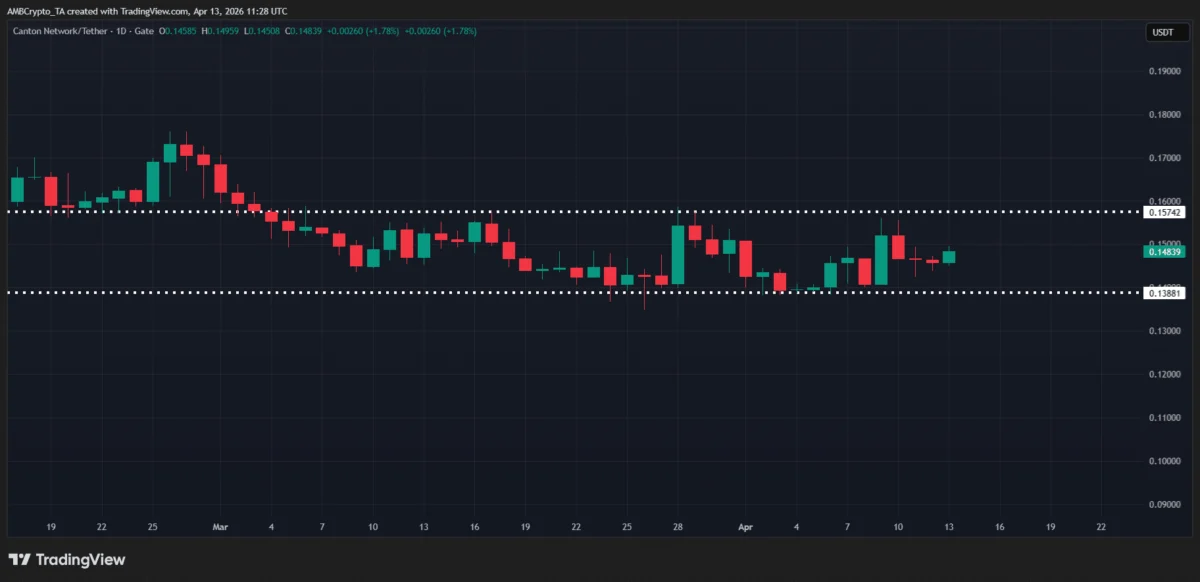
Despite the strong fundamental and technical confidence expressed by institutions like HSBC and JPMorgan, this momentum has not yet fully translated into a dramatic repricing of the Canton Network’s native token (CC) in the public market. As illustrated by recent market data, Canton Network’s last two quarterly cycles have delivered relatively modest upside moves. However, when viewed against broader market flows and the inherent nature of institutional adoption, the overall setup for CC appears to lean bullish.
Specifically, CC demonstrated resilience by closing Q4 up 1.7%, diverging slightly from the wider market "FUD" (fear, uncertainty, and doubt) observed during the same period. This suggests a degree of decoupling from general cryptocurrency market volatility, indicative of an asset whose value is increasingly tied to its utility within enterprise ecosystems rather than speculative retail interest.
In this context, asserting that the momentum has not reflected in the price at all might be an oversimplification. Instead, with institutional capital gradually flowing into and validating the underlying technology, the Canton Network appears to be constructing a robust consolidation base. Institutional investment typically involves longer time horizons and less speculative trading than retail participation. These players often accumulate positions steadily, focusing on the long-term utility and adoption of the technology rather than short-term price fluctuations.
Furthermore, with HSBC’s recent move and the anticipated increase in institutional inflows, this accumulation phase is expected to strengthen further. This gradual build-up of institutional confidence and participation is likely to precede a more significant market repricing, as the network’s real-world utility and adoption mature. The current market behavior might reflect a period of quiet accumulation by informed investors who recognize the foundational importance of Canton in the emerging institutional DeFi landscape. This suggests that while immediate price spikes may not be evident, the long-term value proposition of Canton is steadily being reinforced by these landmark institutional partnerships.
The successful pilot of HSBC’s Tokenised Deposit Service on the Canton Network marks a pivotal moment in the convergence of traditional finance and blockchain technology. By demonstrating the viability of regulated, bank-backed digital cash on a private-by-design DLT, HSBC has not only set a new industry benchmark but also provided compelling validation for the Canton Network’s role as a foundational infrastructure for institutional DeFi. This move, alongside earlier endorsements from JPMorgan, underscores a broader, strategic shift within the financial sector towards leveraging blockchain for enhanced efficiency, compliance, and innovation. While public market valuation for Canton’s native token may still be in an accumulation phase, the increasing institutional adoption signals a robust long-term outlook, promising a future where tokenised assets redefine how financial institutions operate and interact within the global economy.