Global financial markets faced a turbulent conclusion to the trading week, as traditional macroeconomic headwinds collided with severe weakness in the digital asset ecosystem. Traditional stock exchanges bore the brunt of an initial sell-off driven by waning confidence in artificial intelligence and semiconductor equities, which subsequently triggered a cascading liquidity drain across broader risk-on assets. As Wall Street indexes suffered substantial corrections, the cryptocurrency market experienced its own acute trauma, led primarily by a deepening crisis within the altcoin sector.
According to comprehensive on-chain data and market analysis shared by seasoned CryptoQuant analyst Darkfost, alternative cryptocurrencies—commonly referred to as altcoins—remain trapped in a precarious and deteriorating market position. This prolonged underperformance highlights a fundamental divergence in this market cycle, wherein capital increasingly concentrates in flagship assets like Bitcoin while abandoning the broader ecosystem of smaller tokens. With billions of dollars evaporating from valuations in a matter of weeks, industry participants are forced to re-evaluate the structural health of the altcoin market as it struggles to regain a foothold above crucial technical thresholds.
Macroeconomic Triggers and Traditional Market Spillover
The genesis of the most recent cryptocurrency contraction can be traced directly to traditional financial markets. On Friday, investor sentiment soured dramatically following disappointing earnings projections and valuation concerns within the technology sector, particularly concerning AI infrastructure and semiconductor manufacturers. This sentiment shift catalyzed a massive flight to safety, wiping out over $1 trillion from United States financial markets in a single trading session.
The resulting bloodbath spared few asset classes. The benchmark S&P 500 index tumbled by 2.6%, while the technology-heavy Nasdaq Composite suffered a severe contraction of 4.7%. As institutional capital scrambled to cover leveraged positions and de-risk portfolios, the shockwaves quickly reached the 24/7 cryptocurrency markets. Bitcoin, often viewed as a high-beta risk asset closely correlated with tech stocks during periods of macroeconomic stress, dropped 4% in tandem.

However, while Bitcoin’s correction was relatively contained within the context of its historical volatility, the damage inflicted upon the altcoin market was disproportionately severe. Analysts note that unlike previous market cycles where capital flowed organically from Bitcoin into large-cap and mid-cap altcoins during bull runs, the current environment has exhibited a pronounced "de-coupling" to the downside. Altcoins have consistently struggled to generate sustainable upward momentum since December 2024, leaving portfolios heavily exposed as macroeconomic pressures mount.
Technical Indicators Signal Structural Weakness: 83% Below the 200DMA
To understand the depth of the current altcoin malaise, market analysts frequently turn to long-term technical indicators that gauge overarching market health. Among the most reliable barometers is the 200-day moving average (200DMA), which calculates an asset’s average closing price over the preceding 200 trading sessions. In technical analysis, the 200DMA acts as a vital demarcation line between bull and bear market regimes, frequently functioning as dynamic support during corrections or formidable resistance during recoveries.
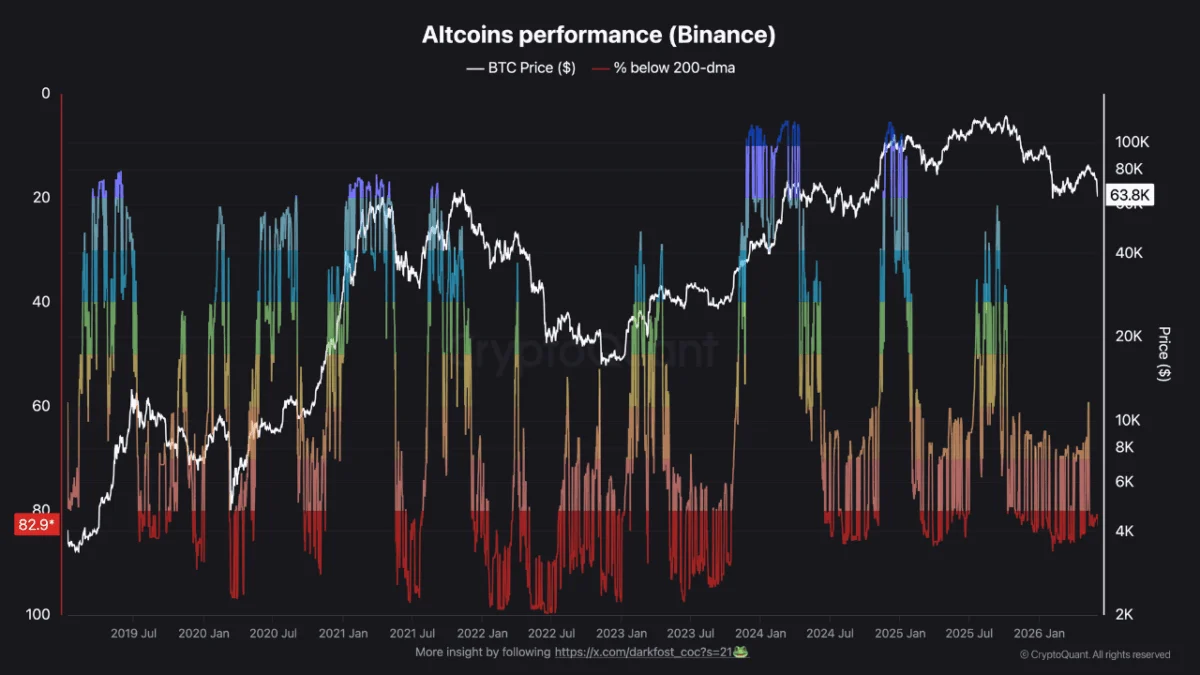
Darkfost’s latest metrics reveal a grim reality for alternative cryptocurrency holders: approximately 83% of all tracked altcoins are currently trading below their respective 200-day moving averages. This staggering statistic underscores a pervasive, systemic bearish sentiment dominating the sector. Historical data compiled since 2002 indicates that the percentage of altcoins trading beneath this threshold typically fluctuates within a wide band of 60% to 90% during routine market cycles. However, the current reading sits perilously close to the upper bound of this historical range, signaling severe, structural market weakness and widespread underperformance.
Market participants interpret this high concentration of assets below the 200DMA as a symptom of chronic capital starvation. Rather than participating in broad-based rallies, liquidity has been tightly funneled into Bitcoin and select stablecoins, leaving the vast majority of altcoins devoid of the buying pressure necessary to reverse multi-month downtrends. Consequently, investors holding altcoin-heavy portfolios have endured sustained drawdowns, with many tokens erasing all the gains accumulated during previous relief rallies.
A $520 Billion Erasure: Analyzing the TOTAL3 Contraction

The statistical deterioration observed on technical charts has translated into massive tangible losses in market capitalization. Market data tracked via the TOTAL3 chart on TradingView—which measures the combined market valuation of all cryptocurrencies excluding Bitcoin and Ethereum—provides a stark visualization of the capital flight.
Following a cyclical peak in October 2025, the TOTAL3 index has suffered a catastrophic contraction, shedding nearly $520 billion in total market value. From its highs, the index plummeted to approximately $670 billion, effectively wiping out months of cumulative gains across the broader altcoin landscape. This steep decline has dragged total altcoin valuations back to baseline levels last recorded in November 2024, neutralizing an entire phase of market expansion.
The rapid evaporation of over half a trillion dollars highlights the unforgiving nature of liquidity cycles in digital assets. When macroeconomic uncertainty rises and institutional investors retreat to cash or blue-chip digital assets like Bitcoin, altcoins—which inherently carry a higher risk profile due to lower liquidity and fragmented developer ecosystems—suffer disproportionate outflows. Market makers and institutional desks often reduce their exposure to high-beta altcoins first, creating a self-fulfilling downward spiral of falling prices and evaporating order book depth.
Contrasting Market Cycles: From Euphoria to Extreme Pessimism
To place the current downturn into a proper historical perspective, analysts often compare today’s landscape with periods of peak market exuberance. The contrast between late 2024 and early 2025 offers a clear lesson in cryptocurrency market cyclicality.
During periods of intense market optimism—such as those recorded in March and December 2024—nearly 90% of altcoins traded comfortably above their 200-day moving averages. Those intervals were characterized by broad market participation, where capital flowed freely down the risk curve into mid-cap and small-cap tokens. Analysts note that the breadth expansion witnessed during those phases was the most robust observed since the landmark bull run of 2017, reflecting widespread retail and institutional engagement across virtually every sector of the decentralized finance (DeFi) and layer-1 ecosystem.

However, historical precedent also suggests that such periods of elevated optimism frequently coincide with reduced forward-looking upside potential, as markets become overextended and heavily saturated with leveraged long positions. Conversely, periods characterized by deep pessimism, widespread capital flight, and technical distress are often viewed by contrarian investors as incubators for future opportunity.
Implications for Long-Term Investors and Strategic Outlook
While the prevailing mood across the altcoin sector is undeniably bleak, experienced market observers argue that extreme contractions frequently lay the groundwork for subsequent accumulation phases. Historical market cycles demonstrate that generational wealth in the digital asset space is rarely forged during periods of euphoria, but rather in the depths of despair when assets are heavily undervalued and disregarded by the mainstream public.
Nevertheless, navigating the current environment requires a high degree of caution and selectivity. Not all altcoins possess the fundamental utility, treasury runway, or developer retention required to survive a prolonged bear market or macroeconomic contraction. Projects lacking genuine economic activity or real-world use cases face an uphill battle to reclaim their 200-day moving averages, particularly as risk-averse investors demand proven utility and sustainable tokenomics.
Looking forward, the trajectory of the altcoin market will likely remain tethered to broader macroeconomic conditions and the price action of Bitcoin. Until macroeconomic stability returns to traditional financial markets and institutional risk appetite recovers, altcoins are expected to consolidate within these depressed ranges. For long-term investors, the current environment presents a complex landscape of risk and reward: a market defined by deep structural distress, yet historically echoing the exact conditions that precede major cyclical trend reversals.