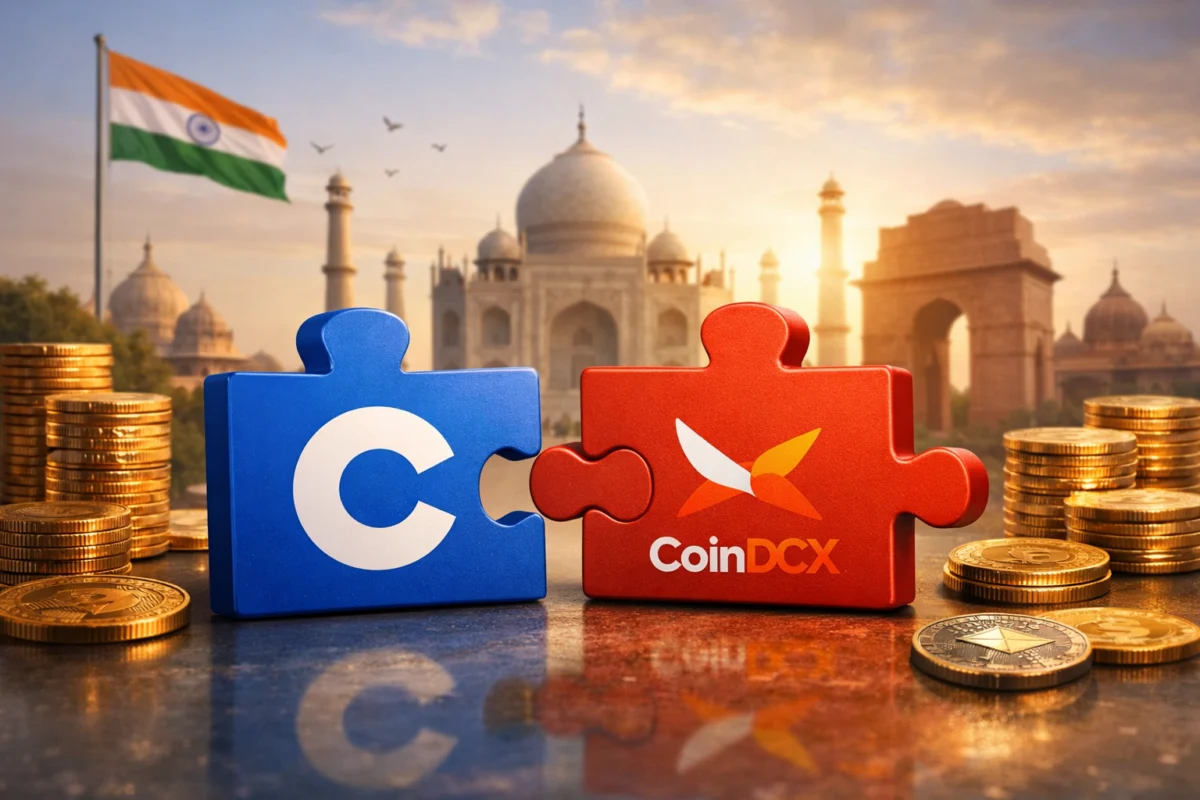
The Competition Commission of India (CCI) has formally granted approval for Coinbase Global Inc. to increase its strategic footprint in the Indian digital asset ecosystem through a minority stake acquisition in DCX Global Limited, the parent entity of the prominent local exchange CoinDCX. This regulatory milestone, announced on Wednesday, represents a pivotal shift in the relationship between the United States’ largest cryptocurrency exchange and the world’s most populous nation. The approval comes at a critical juncture for the Indian crypto industry, which has been characterized by a complex interplay of high retail adoption, stringent taxation, and evolving oversight.
By greenlighting the transaction, the CCI has effectively cleared the path for Coinbase to deepen its institutional ties with one of India’s few crypto "unicorns." For Coinbase, the move is less about immediate operational control and more about securing a long-term foothold in a market that consistently ranks at the top of global adoption indices. For the Indian market, the regulator’s decision signals a willingness to integrate global capital into the domestic fintech framework, provided such investments undergo rigorous official scrutiny.
The Evolution of a Strategic Partnership
The relationship between Coinbase and CoinDCX is not a new development but rather the continuation of a multi-year engagement. Coinbase first participated in CoinDCX’s funding rounds as early as 2022, during a period of aggressive global expansion for the San Francisco-based firm. However, the path has been anything but linear. In mid-October 2024, Coinbase disclosed plans for an additional capital infusion into DCX Global Limited, a move that required the specific clearance of the CCI to ensure it did not violate anti-competitive or monopolistic practices within the Indian financial technology sector.
The CCI’s disclosure, shared via official social media channels, confirmed that the "proposed combination" involving the acquisition of minority shareholding had been reviewed and approved. This formalization allows Coinbase to act as a significant strategic partner, providing CoinDCX with access to global best practices, liquidity insights, and technological standards, while Coinbase gains indirect exposure to India’s massive user base without the immediate burden of navigating the full spectrum of local retail operational challenges.
Chronology of Coinbase’s Indian Market Engagement
To understand the significance of this approval, one must look at the turbulent timeline of Coinbase’s history in India.
In April 2022, Coinbase CEO Brian Armstrong traveled to India to announce a major hiring push and the integration of the Unified Payments Interface (UPI) for its trading platform. However, within days of the launch, the National Payments Corporation of India (NPCI) issued a statement saying it was "not aware of any crypto exchange using UPI." Under immense pressure from the Reserve Bank of India (RBI), Coinbase was forced to disable UPI payments, effectively crippling its ability to offer a seamless fiat-to-crypto "on-ramp."
Following this setback, Coinbase entered a period of relative dormancy in the Indian market, eventually pausing new user registrations entirely. During this time, the exchange shifted its focus toward "Go Broad, Go Deep" international strategies, targeting jurisdictions with clearer regulatory frameworks like the European Union, Singapore, and Brazil.
The tide began to turn in late 2024. Just one week prior to the CCI approval, Coinbase officially reopened user registrations for Indian residents. While the current service is restricted to crypto-to-crypto trading and token swaps, the exchange has mapped out a clear recovery trajectory. According to internal roadmaps, Coinbase intends to re-introduce a rupee (INR) on-ramp by 2026, a move that would require extensive coordination with local banking partners and compliance with the ever-shifting directives of the RBI.
The Indian Regulatory Landscape: A Barrier and an Opportunity
India presents a unique paradox for global crypto firms. On one hand, the Chainalysis 2023 and 2024 Global Crypto Adoption Indexes ranked India at the top, driven by a massive population of tech-savvy youth and a burgeoning developer community. On the other hand, the fiscal environment is among the most punitive in the world.
In 2022, the Indian government introduced a flat 30% tax on all "Virtual Digital Asset" (VDA) gains, with no provision to offset losses against profits. Furthermore, a 1% Tax Deducted at Source (TDS) was implemented on every transaction exceeding a certain threshold. These measures led to a precipitous drop in trading volumes on domestic exchanges—including CoinDCX, WazirX, and CoinSwitch—as high-frequency traders migrated to offshore platforms or decentralized exchanges.
However, the regulatory environment has recently entered a phase of "formalization." The Financial Intelligence Unit (FIU-IND) has begun registering both domestic and international exchanges, requiring them to comply with Anti-Money Laundering (AML) and Counter-Terrorism Financing (CFT) protocols. Binance and KuCoin have already successfully registered with the FIU after paying substantial fines for past non-compliance. Coinbase’s investment in CoinDCX serves as a strategic hedge; by backing a compliant, FIU-registered local leader, Coinbase ensures it remains part of the conversation as India moves toward a comprehensive crypto bill, which is rumored to be in the drafting stages.
CoinDCX: Resilience Amidst Market Volatility
For CoinDCX, the Coinbase investment provides a vital vote of confidence following a challenging year. In July 2024, the exchange faced a security scare when it disclosed a $44.2 million breach involving one of its wallets. While the company was quick to reassure users that customer funds remained secure and the loss was absorbed by the firm’s own treasury, the incident highlighted the ongoing risks associated with digital asset custody in the region.
Despite these hurdles, CoinDCX has remained aggressive in its growth strategy. The firm recently acquired BitOasis, a leading crypto platform in the Middle East and North Africa (MENA) region, signaling its intention to become a multinational player. Additionally, CoinDCX has leaned heavily into decentralized finance (DeFi) through its "Okto" wallet, an app designed to give users access to thousands of tokens across multiple chains while maintaining self-custody. The capital and technical backing from Coinbase are expected to accelerate these diversified product lines.
Analysis of Implications for the Global Crypto Market
The CCI’s approval of the Coinbase-CoinDCX deal carries implications that extend beyond the borders of the Indian subcontinent.
-
The Partnership Model as a Blueprint: Global exchanges are increasingly finding that direct entry into highly regulated markets is fraught with political and legal risk. The "minority stake" model allows a global giant like Coinbase to provide the "engine" (liquidity and tech) while a local partner provides the "body" (regulatory licenses and local banking relationships). This could become the standard operating procedure for Western firms entering emerging markets.
-
Institutional Validation of India: The fact that Coinbase is willing to commit capital to India despite the 30% tax and 1% TDS suggests that the long-term potential of the Indian market outweighs current fiscal headwinds. Institutional investors are betting on an eventual softening of these taxes as the government realizes that the current regime may be stifling innovation.
-
Competitive Pressure: Coinbase’s renewed interest will likely force other global players to reconsider their Indian strategies. With Binance now officially back in the good graces of the FIU, the competition for the Indian retail and institutional user will intensify. This competition is likely to drive down fees and improve the user experience for Indian investors.
Future Outlook: The Path to 2026
As Coinbase integrates more deeply with CoinDCX, the focus will shift toward the 2026 goal of a rupee on-ramp. This will be the ultimate test of the partnership. Re-establishing a connection to the Indian banking system requires more than just a CCI approval; it requires a thaw in the historically frosty relationship between the crypto industry and the Reserve Bank of India.
In the interim, the Indian crypto community views the CCI’s decision as a rare piece of positive regulatory news. It confirms that digital asset businesses are being treated as legitimate corporate entities capable of attracting foreign direct investment (FDI).
While the road to full regulatory clarity in India remains long and likely filled with further legislative debates, the alliance between Coinbase and CoinDCX creates a formidable bloc. By combining Coinbase’s global scale with CoinDCX’s local expertise, the two entities are positioned to lead the next wave of digital asset adoption in one of the world’s most vital economies. For now, the message from the Indian regulators is clear: foreign investment in crypto is welcome, provided it happens within the boundaries of the law and under the watchful eye of the state.