The highly anticipated promise of enhanced capital efficiency within decentralized finance (DeFi) is facing a critical examination, as a recent comprehensive report by Dune Analytics reveals that a substantial portion of liquidity provided to decentralized exchanges (DEXs) remains underutilized. This inefficiency, particularly prevalent within concentrated liquidity models, represents a significant drain on potential earnings for liquidity providers (LPs) and a drag on the overall performance of the DeFi ecosystem. The findings highlight a complex challenge: while concentrated liquidity was designed to optimize capital usage, its practical implementation often falls short, leading to hundreds of millions in idle assets and foregone trading fees.
The Genesis of Concentrated Liquidity and its Promise
To fully appreciate the implications of Dune’s findings, it’s essential to understand the evolution and theoretical advantages of concentrated liquidity. Traditional automated market makers (AMMs), epitomized by early versions like Uniswap v2, distributed liquidity uniformly across all possible price ranges. This "full range" approach, while simple to implement, often resulted in poor capital efficiency. A large percentage of the pooled assets would sit far from the current trading price, rarely being utilized to facilitate swaps and thus generating minimal fees for LPs.
The advent of concentrated liquidity, most famously introduced with Uniswap v3 in 2021, aimed to revolutionize this model. The core innovation allows liquidity providers to allocate their capital within specific, user-defined price ranges. The idea was straightforward: LPs could concentrate their funds around the current market price, where the vast majority of trading activity occurs. By doing so, they could earn significantly higher fees on their deployed capital compared to the full-range approach, as their assets would be actively facilitating trades more frequently. This mechanism was hailed as a breakthrough, promising deeper liquidity, tighter spreads for traders, and superior returns for LPs, thereby increasing the overall efficiency and attractiveness of DEXs. The move towards concentrated liquidity was a pivotal moment in DeFi, signaling a shift towards more sophisticated and capital-conscious market-making strategies.
Dune’s Revealing Report: A Snapshot of Underutilization
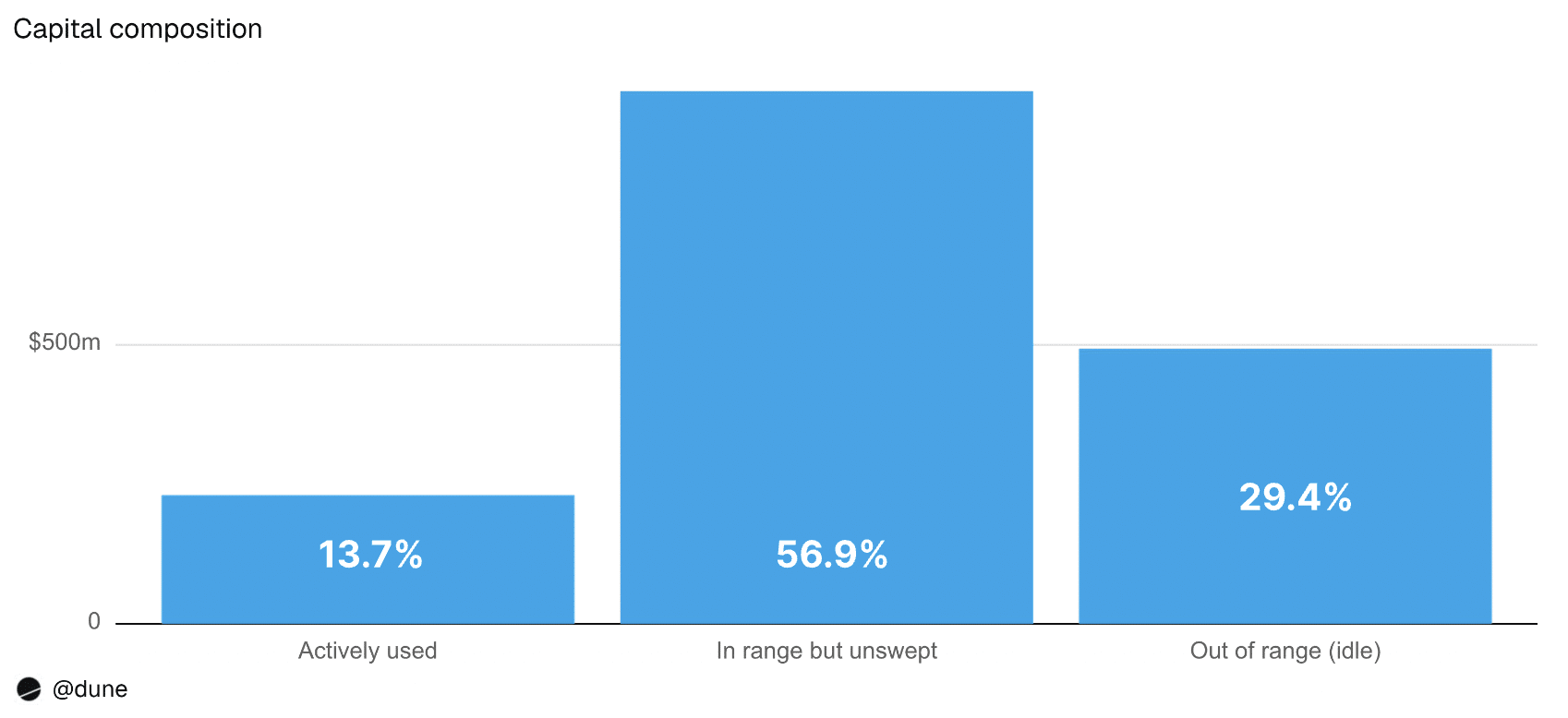
Dune’s report, which analyzed data from the first half of 2026, painted a less optimistic picture of concentrated liquidity’s real-world performance. The study focused on four prominent protocols utilizing concentrated liquidity: Uniswap v3, Uniswap v4, PancakeSwap v3, and Aerodrome Slipstream. Across these platforms, a critical finding emerged: an average of 29.4% of the total provided liquidity was found to be outside the range of active trading. This "out-of-range" liquidity is effectively idle capital, unable to facilitate swaps and, consequently, unable to generate any trading fees for the LPs who supplied it.

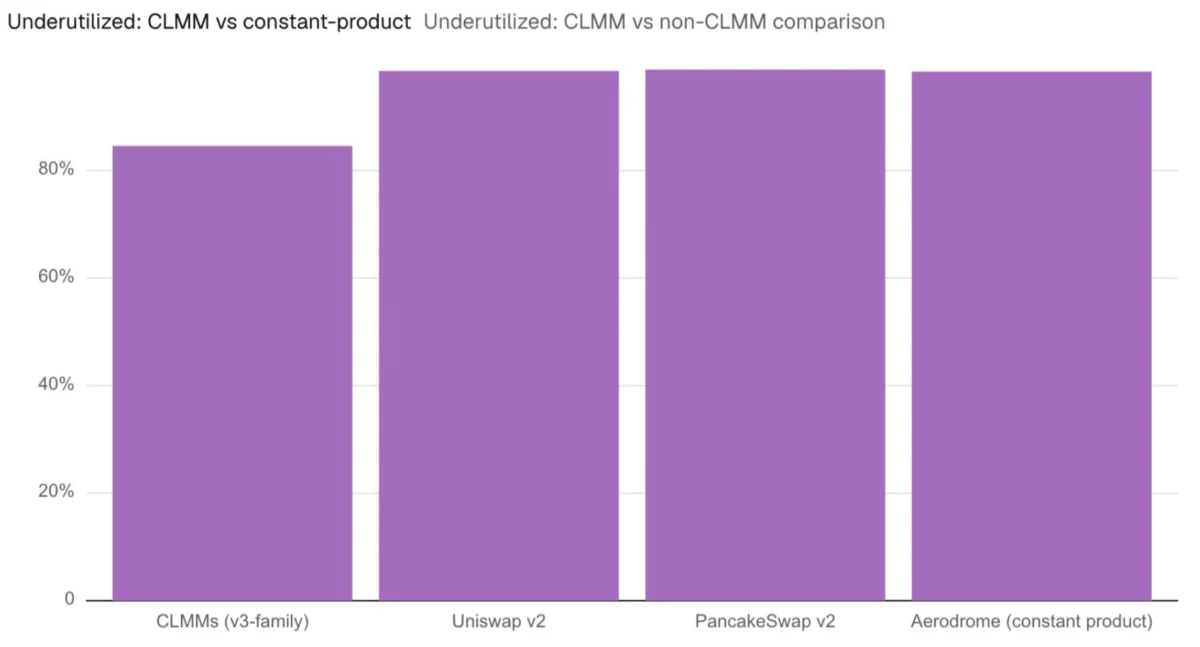
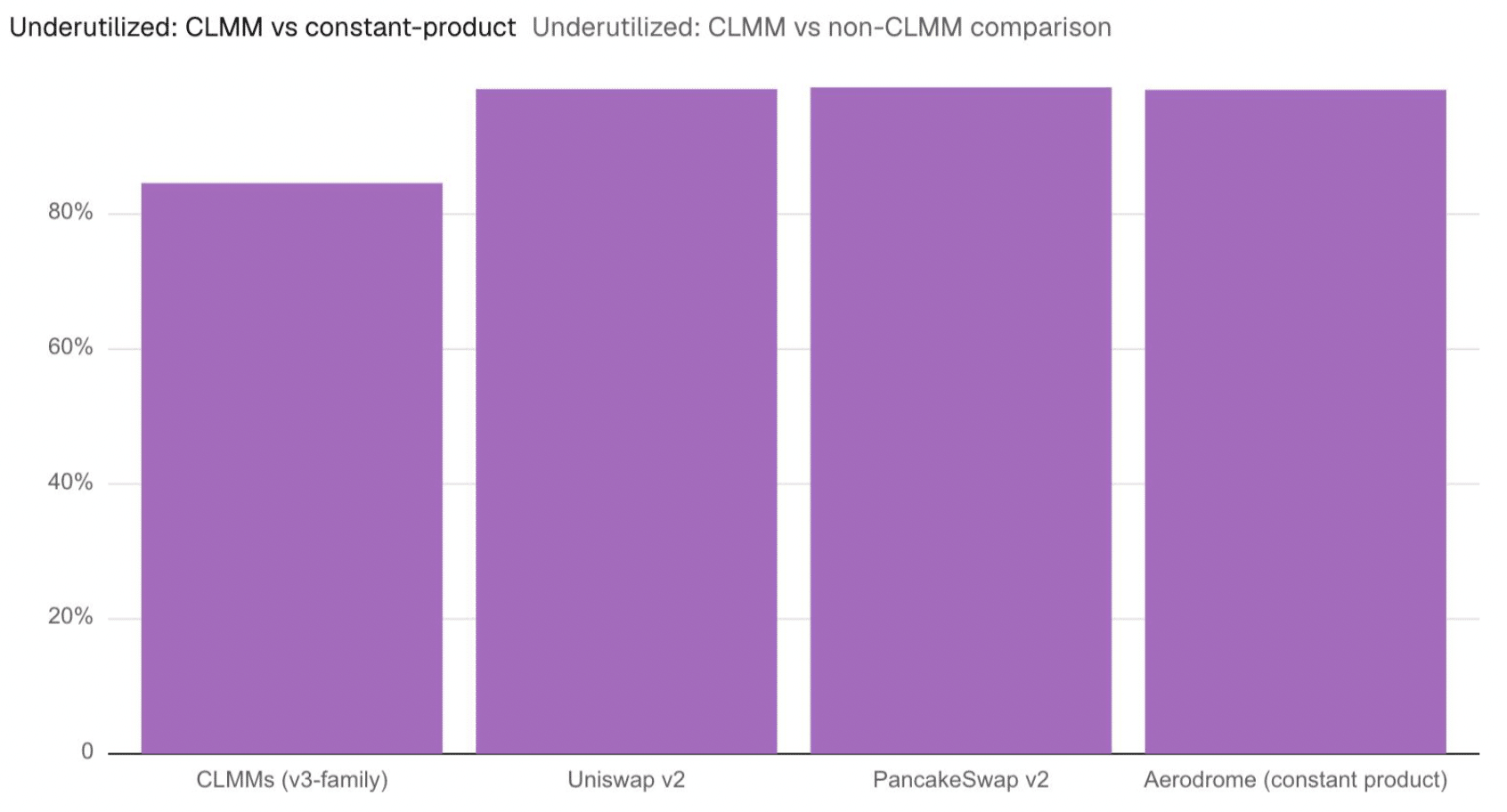
Putting these percentages into tangible financial terms reveals the scale of the problem. The report estimated that this amounted to approximately $542 million in idle capital per week across the four analyzed protocols. Over the course of a year, this inefficiency translates to an estimated $150 million in lost annual fee income for liquidity providers. This figure represents direct revenue that LPs could have earned if their capital had been actively deployed within optimal trading ranges. The impact extends beyond just out-of-range positions; the report further indicated that if considering all technically available but never used liquidity, approximately 85% of capital was underutilized. This broader metric points to a deeper issue of capital dormancy, where even within designated ranges, some liquidity pools see minimal activity, or LPs simply fail to capture trades within their chosen bounds.
A particularly concerning detail highlighted by the report was the passive nature of many LP positions. It noted that more than $200 million in idle liquidity had not been repositioned in over 90 days. This extended period of inactivity strongly suggests that many LPs are not actively managing their holdings, a critical requirement for maximizing returns in a concentrated liquidity model. The very design of concentrated liquidity, while offering efficiency, demands vigilance and timely adjustments to market price fluctuations. The data indicates that a significant segment of LPs struggles with, or opts out of, this active management, inadvertently sacrificing potential earnings.
The Burden on Individual Investors
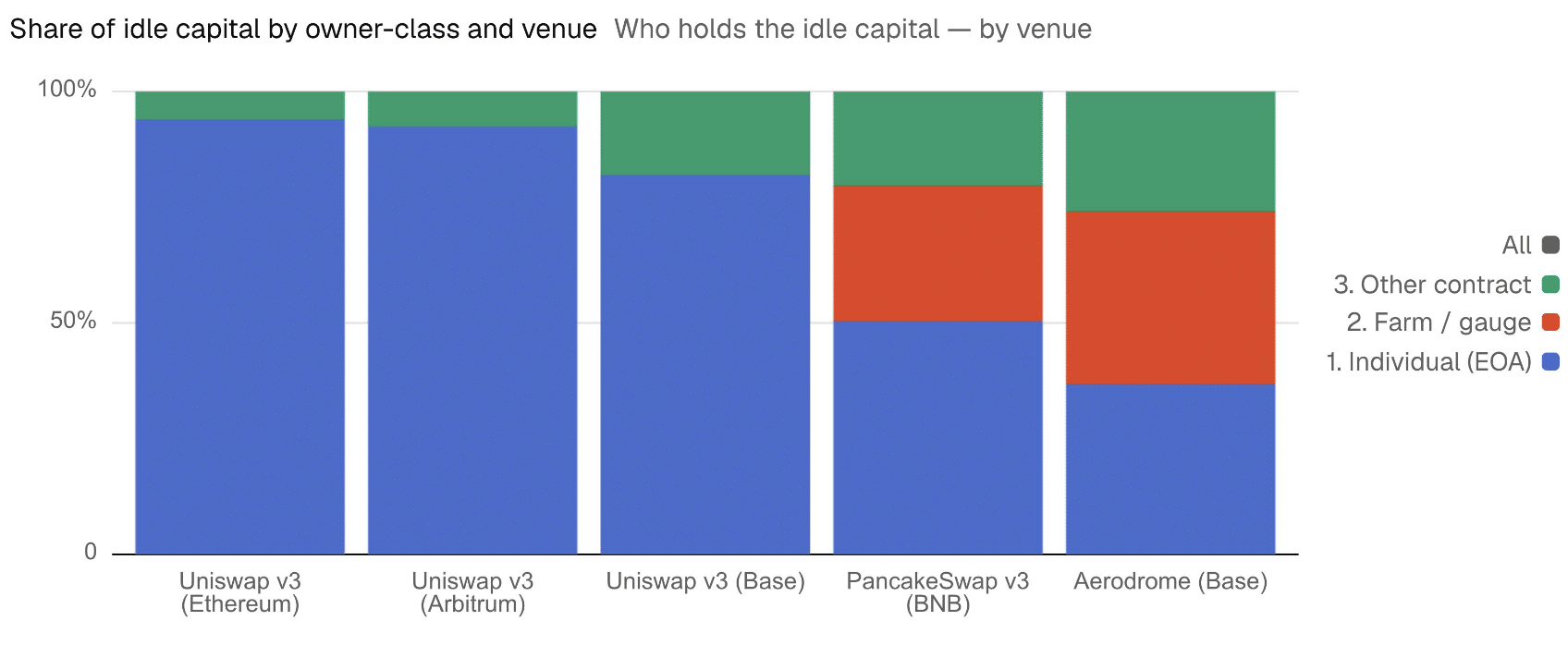
One of the most striking revelations from the Dune report concerns the disproportionate impact of idle liquidity on individual investors compared to automated management solutions. The study explicitly found that automated managers maintained a higher level of capital activity, while individual investors owned the vast majority of idle liquidity. This disparity underscores a fundamental challenge for retail participants in the DeFi landscape.
The report provided specific, stark figures across different blockchain networks:
- On Ethereum, individual wallets accounted for a staggering 94% of idle capital, despite holding 91% of the total Uniswap v3 liquidity. This suggests that while retail users are major contributors of capital, they are significantly less effective at deploying it profitably.
- On Arbitrum, individual users controlled 92% of idle liquidity and 78% of the total liquidity, again showing a pronounced imbalance in efficiency.
- Even on Base, where smart contracts held roughly 50% of the liquidity, individual users still oversaw 82% of the idle capital.
In stark contrast, automated liquidity managers, which typically employ sophisticated algorithms and strategies to dynamically adjust price ranges, exhibited far superior performance. Their positions were found to be out of range only 6.5% of the time, a stark difference compared to the roughly 30% observed for individual wallets. This demonstrates that automated strategies have been considerably more successful than individual LPs at maintaining their liquidity within active trading ranges.
This finding has significant implications. It suggests that the complexity and time commitment required for effective concentrated liquidity management often exceed the capabilities or willingness of average retail investors. While the promise of higher yields is attractive, the operational demands—constant monitoring, rebalancing, and understanding market dynamics—present a substantial barrier. Automated solutions, ranging from sophisticated institutional strategies to user-friendly third-party protocols, appear to be better equipped to navigate the volatile and dynamic nature of DeFi markets, leaving individual LPs at a disadvantage without similar tools or expertise. This widens the performance gap between professional and retail participants in the decentralized exchange space.
Uniswap v4 and the Unresolved Efficiency Puzzle
The report also cast a critical eye on Uniswap v4, the latest iteration of the pioneering DEX, which was designed with new features intended to enhance flexibility and capital efficiency. A key innovation in Uniswap v4 is the introduction of "hooks" – custom code snippets that allow developers to execute logic at various points within a swap’s lifecycle. These hooks were envisioned as a powerful tool that could, among other things, enable idle capital to be deployed into external yield strategies, thereby addressing the very issue of underutilization.
However, Dune’s analysis indicates that Uniswap v4, in its current state, has not yet resolved the idle liquidity problem. The study found that, much like its predecessor Uniswap v3, approximately 30.5% of Uniswap v4’s liquidity is still out of range. This figure is remarkably similar to the average across other protocols, suggesting that the fundamental challenge of keeping liquidity active persists even with advanced architectural changes.
Furthermore, the report highlighted a critical gap in the adoption and utilization of v4’s new features. It noted that just 10% of Uniswap v4’s Total Value Locked (TVL) actually uses hooks, and, more importantly, none of these hooks are currently producing yield from idle liquidity. This suggests that while the technical infrastructure for enhanced capital efficiency might be in place, its practical application and widespread adoption are still nascent. The lack of active yield generation from idle capital via hooks indicates that either developers are still experimenting with effective strategies, or the complexity of implementing such solutions is a significant hurdle. The vision of hooks transforming idle capital into productive assets remains largely unrealized in the current environment.
Broader Implications and Future Trajectories
The findings from Dune’s report carry significant implications for the entire decentralized finance ecosystem. The persistent underutilization of capital in concentrated liquidity pools affects not only individual LPs but also the overall health, competitiveness, and innovation trajectory of DEXs.
Impact on DEX Competitiveness: Inefficiencies in capital deployment can hinder DEXs from competing effectively with centralized exchanges (CEXs) that often boast deeper liquidity and tighter spreads. While DeFi offers decentralization and censorship resistance, a significant gap in capital efficiency could deter institutional players and large traders seeking optimal execution.
LP Profitability and Participation: The consistent loss of potential fee income, amounting to hundreds of millions annually, directly impacts LP profitability. If LPs find that their capital is frequently idle or difficult to manage for optimal returns, it could lead to reduced participation, capital flight, or a preference for simpler, albeit less efficient, full-range liquidity protocols. This could stifle the growth of advanced AMM models.
The Imperative for Automation and Tooling: The clear performance disparity between individual LPs and automated managers underscores the urgent need for more robust, user-friendly, and intelligent liquidity management tools. This could spur innovation in several areas:
- Automated Liquidity Management Protocols: Protocols that abstract away the complexity of active range management, dynamically adjusting positions based on market conditions, could see increased adoption.
- AI/ML-Driven Strategies: The integration of artificial intelligence and machine learning to predict optimal price ranges and rebalancing points could become standard.
- User-Friendly Interfaces: Simplifying the process of setting and adjusting liquidity ranges, perhaps through pre-set strategies or risk profiles, could empower individual investors.
- Enhanced Analytics: Better on-chain analytics and dashboards that provide LPs with clear, actionable insights into their positions’ performance and optimal rebalancing times.
Evolution of Protocol Design: The Uniswap v4 findings, in particular, suggest that while groundbreaking technical features like hooks offer immense potential, their practical utility hinges on ease of implementation and adoption. Future DEX designs might need to prioritize not just theoretical efficiency but also the accessibility and ease of use for a broad range of LPs. This could mean more integrated solutions for yield generation from idle capital directly within the protocol or through standardized hook implementations.
Market Efficiency and Innovation: Ultimately, the underutilization of capital represents a drag on the overall efficiency of the DeFi market. Capital that is locked but not working is capital that is not contributing to market depth, price discovery, or transaction facilitation. Addressing this challenge is crucial for the continued maturation and mainstream adoption of decentralized finance. It will likely drive a new wave of innovation focused on optimizing capital allocation, reducing management overhead for LPs, and unlocking the full economic potential of assets within the DeFi ecosystem.
Conclusion
The Dune Analytics report serves as a critical reality check for the concentrated liquidity model, revealing a significant gap between its theoretical promise and its practical execution. While a powerful innovation designed to boost capital efficiency, the model’s inherent demand for active management has created a substantial hurdle, particularly for individual investors. With nearly a third of liquidity routinely sitting idle, translating into hundreds of millions in lost earnings and underutilized capital, the DeFi ecosystem faces a clear imperative. The path forward demands a concerted effort to develop more intelligent, automated, and user-friendly solutions for liquidity management. Only by bridging this gap between sophisticated protocol design and accessible, efficient capital deployment can decentralized exchanges truly realize their full potential and offer a genuinely superior alternative for global financial markets.