
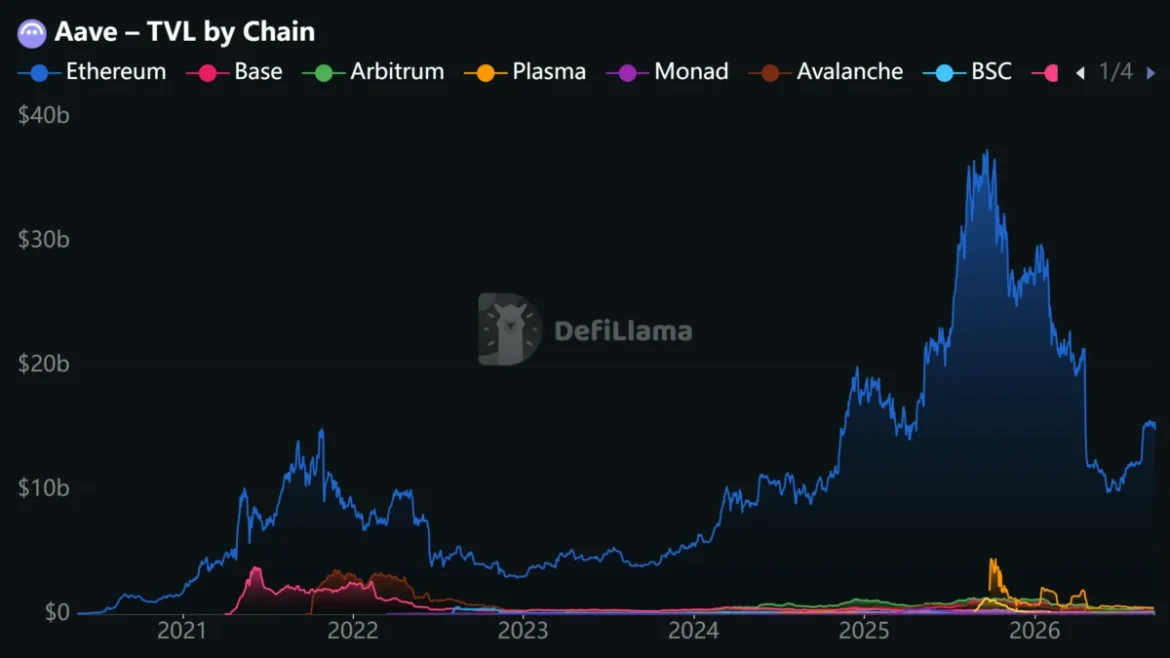
DeFi lending giant Aave is advancing a strategic initiative designed to bridge the structural divide between traditional institutional finance and decentralized finance (DeFi). The protocol has formally introduced a governance proposal centered on custodied collateral lending, a mechanism tailored to allow institutional entities to borrow stablecoins directly on Aave V4 using underlying assets securely housed within regulated third-party custodians.
By targeting institutional borrowers who are legally or operationally restricted from engaging in self-custody, Aave aims to unlock a vast pool of idle capital that has historically remained inaccessible to on-chain liquidity markets. The proposal outlines a framework utilizing Anchorage as the primary regulated custodian and Chainlink’s infrastructure to establish a secure, auditable communication channel between off-chain asset storage and on-chain borrowing activity.
The Mechanics of Custodied Collateral Lending
For years, institutional participation in DeFi has faced significant friction due to the rigid separation between regulated custody solutions and permissionless blockchain protocols. Financial institutions such as hedge funds, asset managers, and corporate treasuries are bound by strict regulatory mandates that require their digital assets to be stored with qualified, compliant custodians like Anchorage, rather than maintained in personal software or hardware wallets.
Under current market conditions, institutions wishing to leverage their crypto holdings—such as Bitcoin (BTC)—for liquidity must typically convert those assets into wrapped alternatives, such as Wrapped Bitcoin (WBTC), before interacting with DeFi platforms. However, this workaround introduces layers of operational complexity, counterparty risks, compliance hurdles, and smart contract vulnerabilities that many institutional risk committees refuse to accept.
Aave’s newly proposed framework seeks to eliminate this workaround by introducing a natively integrated bridge. In this architecture, an institutional player deposits its primary assets, such as Bitcoin, directly into a regulated account with Anchorage. The actual underlying asset remains securely within Anchorage’s custody infrastructure and never leaves its segregated storage environment.
To reflect these holdings on-chain, Aave leverages Chainlink’s advanced technology stack, specifically utilizing CustodySync and Custodied Collateral Tokens (CoCTs). These CoCTs serve as cryptographic receipts or representations of the assets held in custody by Anchorage. Once the CoCTs are minted and deposited onto the Aave V4 protocol, the institutional borrower can utilize them as collateral to draw down stablecoin liquidity, predominantly USD Coin (USDC).
The repayment cycle mirrors standard lending mechanics with an on-chain twist: upon final repayment of the borrowed stablecoins plus accrued interest, the corresponding CoCTs are burned on-chain. This action triggers a verified signal to Anchorage, unlocking the original Bitcoin in the institutional custodian account and returning full control to the borrower.
Background and Evolution of the Aave Protocol
The introduction of custodied collateral lending arrives during a pivotal evolutionary phase for Aave, which commands a dominant share of the decentralized lending market. Founded by Stani Kulechov, the protocol has continuously adapted its architecture to accommodate shifting market demands, progressing through successive iterations from ETHLend to its current roadmap leading toward Aave V4.
Over the past year, Aave has experienced a robust financial resurgence. The platform’s Total Value Locked (TVL) rebounded sharply from a local low of approximately $12.5 billion in June to reach $19 billion, marking a significant 52% recovery. This growth underscores an expanding appetite for on-chain borrowing and yield generation, particularly among sophisticated market participants seeking capital efficiency. Despite this immense liquidity, billions of dollars frequently sit idle within the ecosystem due to the mismatch between traditional institutional compliance frameworks and decentralized infrastructure.
Aave V4 is designed specifically to address scalability, cross-chain liquidity fragmentation, and modular risk management through an isolated hub-and-spoke architecture. The custodied collateral lending proposal is positioned as a cornerstone feature within this upcoming version, intending to establish a secure gateway for institutional capital to enter Aave markets without compromising regulatory compliance or institutional security standards.

Leadership Perspectives and Industry Reception
Industry leaders have characterized the proposal as a watershed moment for institutional adoption of blockchain technology. Aave founder Stani Kulechov described the initiative as a first-of-its-kind development for the sector.
"This is a first-of-its-kind proposal to enable institutions to borrow stablecoins on Aave V4 against collateral held with a qualified custodian, accessing liquidity directly from Aave V4 markets," Kulechov noted in governance discussions. By establishing a direct pipeline from Anchorage to Aave, the protocol is effectively targeting what developers have categorized as currently unreachable collateral assets.
Institutional borrowers who are bound by fiduciary duties and regulatory oversight can now maintain institutional-grade custody while simultaneously participating in permissionless financial markets. This duality is expected to appeal heavily to traditional financial institutions that have previously monitored the DeFi space from the sidelines due to regulatory uncertainty.
Furthermore, the integration of Chainlink’s CustodySync serves as a critical trust anchor. Chainlink’s decentralized oracle networks provide verifiable proof of reserve and secure messaging between the off-chain custodian and the on-chain smart contracts, mitigating the risk of double-spending or unbacked token minting.
Timeline and Governance Process
The path from conceptual proposal to full protocol implementation follows a rigorous decentralized governance lifecycle within the Aave DAO.
- Forum Discussion and ARFC Phase: The initiative was formally submitted to the Aave governance forum as an Aave Request for Comments (ARFC) under the title "Custodied Collateral Lending: Aave V4 Isolated Hub Spoke." Community members, risk contributors, and technical delegates have spent weeks analyzing the security assumptions, counterparty risks associated with Anchorage, and the technical implementation of Chainlink’s CoCTs.
- Sentiment Check (Snapshot): Following community refinement and preliminary risk assessments, the proposal advances to a Snapshot vote. This off-chain signaling vote gauges the broader token holder sentiment and determines whether the community officially supports dedicating development and integration resources to the feature.
- On-Chain Governance and Execution: If the Snapshot vote achieves quorum and passes with a favorable majority, the proposal will proceed to a formal on-chain governance vote. Upon successful execution of this final governance vote, smart contract parameters will be updated, and the integration between Anchorage, Chainlink, and Aave V4 will move toward a mainnet launch.
Implications for the Broader DeFi Ecosystem
The potential deployment of custodied collateral lending on Aave carries profound implications for the broader decentralized finance landscape. For years, the competition among lending protocols—including competitors such as Morpho, Kamino, and others—has centered on capital efficiency, interest rate optimization, and user interface enhancements.
Should Aave successfully capture institutional market share via regulated custody bridges, competing protocols may be forced to accelerate their own institutional integration strategies. This dynamic could spark a broader industry trend toward hybrid compliance models, where decentralized liquidity layers are increasingly intertwined with traditional institutional infrastructure.
Additionally, the macroeconomic impact of unlocking institutional Bitcoin and other Tier-1 digital assets could significantly expand the depth of DeFi stablecoin markets. As more institutional capital enters the ecosystem as collateral, the demand for stablecoin liquidity will scale correspondingly, potentially driving higher yields for retail and institutional lenders alike who supply assets to Aave liquidity pools.
However, financial analysts also point to potential risks that warrant close monitoring. The reliance on centralized custodians like Anchorage introduces a degree of counterparty risk that contrasts with the trustless ethos of native DeFi. If a regulated custodian experiences regulatory freezes, legal disputes, or operational disruptions, the corresponding on-chain CoCTs could face redemption bottlenecks. Risk management frameworks implemented within Aave V4 will need to price these operational risks accurately through dynamic parameters and isolated market designs.
As the governance process for custodied collateral lending progresses toward its final voting stages, the crypto community remains focused on whether traditional finance will embrace this on-chain bridge. If successful, Aave’s initiative could redefine the operational standards for institutional engagement with decentralized liquidity markets for years to come.
