The cryptocurrency landscape in 2026 continues to demonstrate robust financial performance across decentralized finance protocols and application-specific chains, with on-chain revenue acting as a primary metric for protocol health and sustainability. According to a comprehensive market report published recently by data aggregator CoinGecko, memecoin launchpad Pump.fun [PUMP] has firmly established itself as a financial powerhouse, securing the second position among the top 15 revenue-generating crypto projects for the year to date.
Generating a staggering $322 million in revenue, Pump.fun trails only Hyperliquid [HYPE], which captured the top spot with $429 million. Combined, these two dominant platforms account for a significant 22.10 percent of the total $3.40 billion in on-chain revenue tracked across the entire cryptocurrency sector throughout 2026. This high concentration of earnings underscores a shifting market dynamic wherein specialized, high-velocity trading platforms and retail-facing applications capture an unprecedented share of user fees and economic activity.
A Deep Dive into Pump.fun’s Revenue Generation Model
The economic foundation of Pump.fun rests almost entirely on its core utility as a frictionless memecoin launchpad. The platform’s revenue stream is derived directly from token creation fees and automated trading commissions generated as users deploy, buy, and sell speculative digital assets.
While memecoin platforms have historically faced skepticism regarding their long-term viability and intrinsic value, Pump.fun has continuously iterated on its product offering to sustain user engagement and transaction volume. The protocol’s ability to pull in $322 million in a relatively short timeframe highlights the enduring retail appetite for speculative on-chain assets, even amidst evolving macroeconomic conditions and shifting regulatory landscapes throughout 2026.
Beyond raw top-line revenue generation, the protocol has instituted aggressive tokenomics strategies designed to reward long-term holders and stabilize native token value. Most notably, a sweeping 240 million PUMP token buyback initiative has successfully reduced the asset’s circulating supply. In economic terms, this deliberate contraction of supply, coupled with sustained protocol usage, has introduced a deflationary pressure mechanism that has helped insulate the token against broader market corrections and enhanced its overall market valuation through scarcity.
Chronology of the 2026 Rally and Market Context
The trajectory of the PUMP token throughout 2026 has been characterized by aggressive bullish impulses followed by healthy, structurally sound consolidations. The broader uptrend gained substantial momentum in early July, catalyzed by rising protocol usage, the aforementioned supply-reduction strategies, and a general resurgence in altcoin market capitalization.
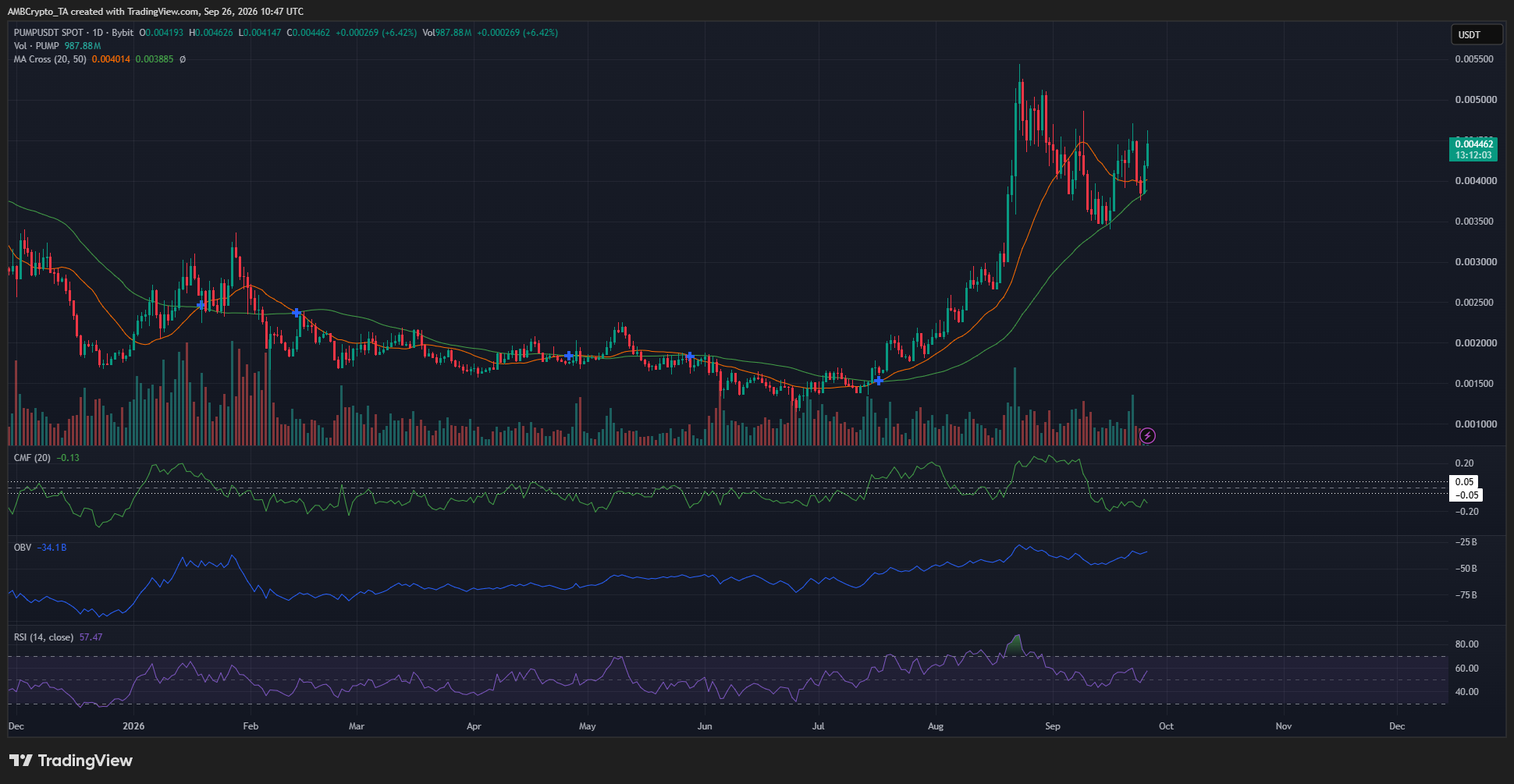
During the initial phase of the summer rally, PUMP established a local high of $0.0054 before experiencing a measured retracement down to $0.0034. Rather than collapsing into a prolonged bearish reversal, the token found robust buying interest, triggering a strong bullish reaction that has persisted over subsequent weeks. This resilience allowed PUMP to comfortably breach its previous May swing high of $0.00225, lifting token prices to levels not observed since October 2025 and validating the strength of the underlying macro trend.
Technical Analysis: Bulls Defend the 50-Day Moving Average
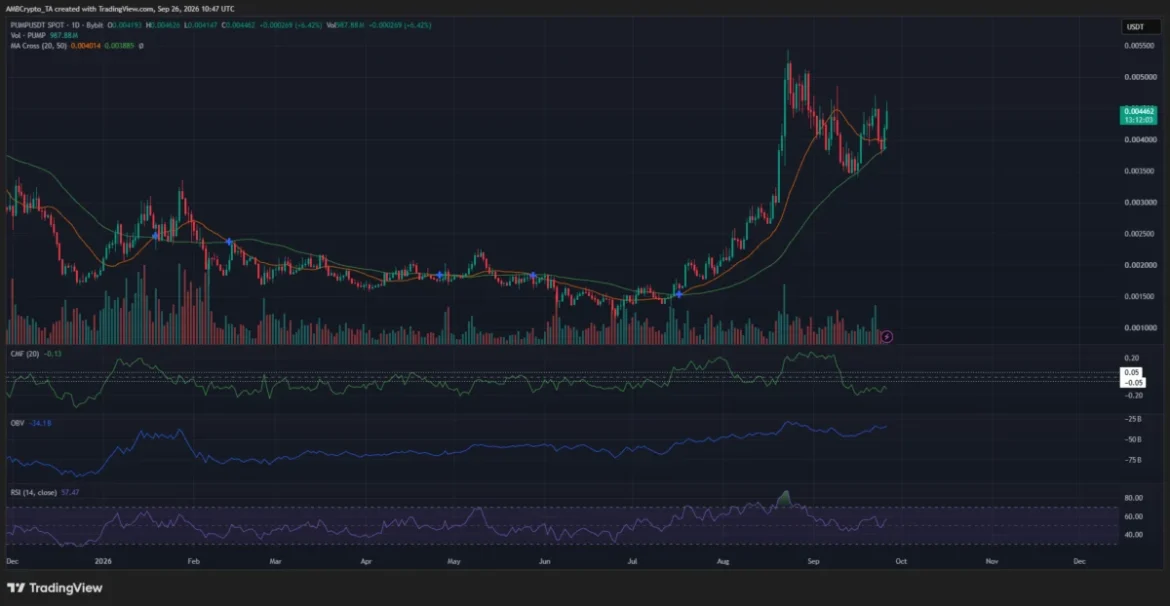
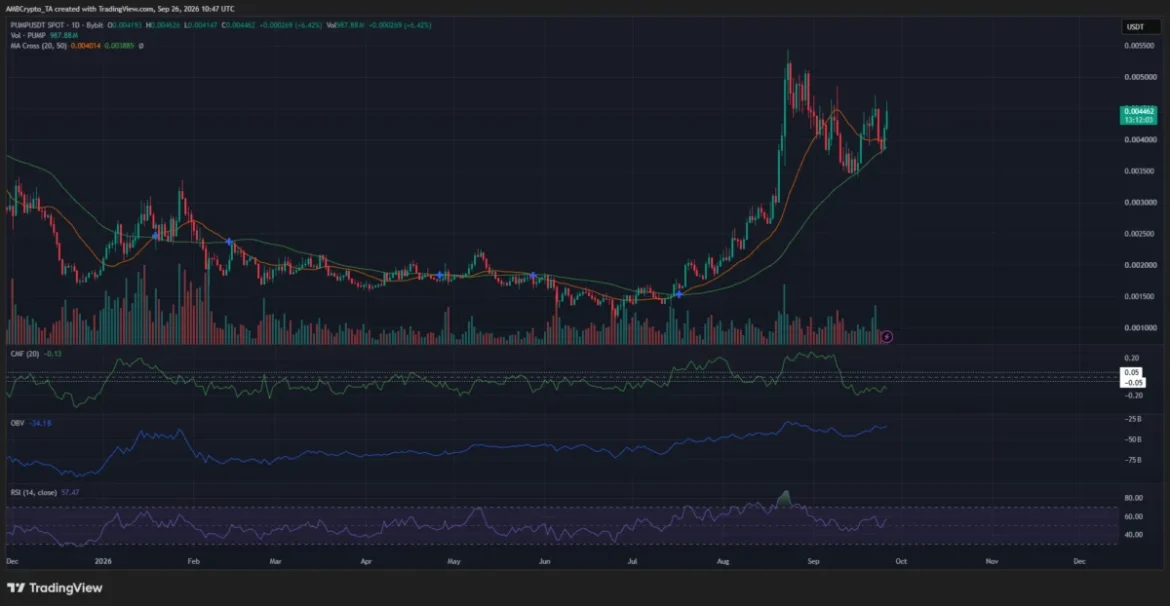
Market technicians monitoring the PUMP/USDT daily chart have pointed to the critical defense of the 50-day Moving Average (MA) as a primary indicator of continued bullish conviction. As the token price pulled back from its local highs, it directly tested the 50-day MA sitting at $0.00384. True to the broader uptrend established in July, the asset successfully rebounded from this technical floor.
The alignment of the 20-day and 50-day moving averages continues to project a bullish market structure on the daily timeframe. However, deeper scrutiny of underlying momentum indicators reveals a nuanced picture of intraday market conditions. While the On-Balance-Volume (OBV) indicator has been steadily climbing toward its previous August highs—signaling that volume is backing the upward moves—the Chaikin Money Flow (CMF) presented a contrasting narrative.
At the time of reporting, the CMF hovered in negative territory with a reading of -0.13. Market analysts interpret this divergence as evidence of heightened intraday volatility. While macro buyers are successfully defending key moving averages and maintaining the daily uptrend, current buying pressure lacks the relentless, steady accumulation seen during the peak of last month’s rally. Consequently, short-term price action has transitioned into a consolidated range formation rather than a straight-line vertical ascent.
Range Formations and Fibonacci Retracement Levels on the 4-Hour Chart
Zooming into the 4-hour timeframe provides clearer tactical insights for short-term swing traders and market participants navigating the current price action. Analysts examining the most recent bullish impulse from the previous month have mapped out a series of Fibonacci retracement levels to identify high-probability entry and exit zones.
Two weeks ago, PUMP successfully tested and defended the $0.00325 to $0.00371 "golden pocket" retracement zone. While bulls successfully used this area as a launching pad, subsequent upward momentum was capped by a local range high situated around $0.00464, marked clearly by horizontal resistance.
Given this established channel, trading strategists suggest a dual approach. Swing traders may look to systematically take profits near the upper boundary of the range resistance ($0.00464) while exercising patience for a potential dip back into the golden pocket support zone before establishing new long positions. Alternatively, a decisive volume-backed breakout past the established range high could present a secondary, high-momentum buying opportunity for breakout traders.
Broader Implications for the Decentralized Finance and Memecoin Sectors
The financial success of Pump.fun, as highlighted by the CoinGecko report, carries profound implications for the broader cryptocurrency industry. Recording $322 million in revenue places the protocol in an elite tier of profitability, rivaling foundational layer-1 blockchains and advanced derivatives exchanges like Hyperliquid. This challenges the traditional narrative that only core infrastructure projects—such as decentralized exchanges, lending markets, and execution layers—can capture meaningful, sustained economic value.
Furthermore, the protocol’s reliance on aggressive token buybacks to reduce supply points to a maturing operational strategy within the memecoin sector. By actively tying protocol revenues to token scarcity and holder value, platforms like Pump.fun are attempting to bridge the gap between purely speculative assets and utility-driven tokens.
However, regulatory bodies and institutional observers continue to monitor the explosive growth of memecoin infrastructure platforms closely. The heavy concentration of on-chain revenue derived from token creation and speculative trading underscores the retail market’s insatiable appetite for high-risk assets, a trend that invites ongoing discussions regarding investor protection, platform decentralization, and sustainable protocol economics.
As 2026 progresses into its final quarters, the ability of Pump.fun to maintain its revenue momentum—and for PUMP token holders to defend crucial technical supports like the 50-day moving average—will serve as a bellwether for the retail-driven segment of the digital asset economy. Whether the protocol can convert its current transactional velocity into long-term systemic durability remains one of the most compelling narratives in the decentralized finance space.