The cryptocurrency landscape is experiencing a significant shift toward regulated, institutional-grade investment vehicles, with privacy-focused digital asset ZCash (ZEC) taking center stage. On September 29, Nasdaq-listed financial technology firm DeFi Technologies Inc.—widely recognized for its mission to bridge traditional financial markets with decentralized finance (DeFi)—announced that its specialized investment product subsidiary, Valour, has officially launched a new ZCash exchange-traded product (ETP). This strategic rollout underscores a broader institutional trend aimed at giving traditional investors seamless exposure to digital assets without the operational complexities of self-custody or direct token management.
The newly introduced Valour ZCash SEK ETP commenced trading on Sweden’s Spotlight Stock Market, carrying a structured 1.9% management fee. This launch represents a critical expansion of Valour’s suite of digital asset ETPs across European jurisdictions, providing institutional and retail investors within the Nordic region a regulated gateway to the privacy-centric cryptocurrency. The timing of this product introduction coincides with a wave of similar financial instruments entering the European and North American markets, signaling a maturing regulatory environment and a growing appetite for diverse crypto assets beyond Bitcoin and Ethereum.
Background and Context of Institutional Inflows
The introduction of Valour’s SEK ETP is part of a broader wave of institutionalization that has swept across the ZCash ecosystem throughout the year. Just prior to the Valour announcement, rival digital asset product provider 21Shares made headlines by launching Europe’s first physically backed ZCash ETP, listed concurrently on major European exchanges including Euronext Paris and Amsterdam. These structured products are designed to track the underlying performance of ZEC by holding physical tokens in secure, institutional-grade custody, thereby eliminating tracking error and offering a secure bridge for traditional asset managers.
Simultaneously, North American markets have seen robust capital allocation into ZCash-linked vehicles. On September 24, market data revealed that the Grayscale ZCash ETF (ZCSH) officially crossed the monumental threshold of $1 billion in assets under management (AUM). While the milestone highlights massive capital retention and early institutional positioning, fresh inflows into the Grayscale product have shown varying dynamics, suggesting a transition from speculative retail momentum to more calculated, long-term institutional accumulation.
The convergence of European ETP launches and multi-billion-dollar AUM milestones in the United States points to a structural shift. Financial institutions, wealth managers, and corporate treasuries are increasingly seeking regulatory-compliant exposure to privacy coins, viewing them as essential portfolio diversifiers despite ongoing regulatory debates surrounding transactional privacy.
Chronology of Recent Market Developments

The acceleration of ZCash’s market presence did not happen overnight; it is the culmination of months of regulatory approvals, product developments, and shifting macroeconomic tides.
During the summer months, ZEC experienced a quiet accumulation phase, trading in the lower hundreds before sparking a massive rally in mid-August. As macroeconomic uncertainties persisted globally, institutional interest in alternative stores of value and decentralized financial infrastructure intensified.
By mid-September, asset managers finalized their preparations for new product offerings. On September 24, reports confirmed that Grayscale’s ZCash vehicle had secured $1 billion in AUM, setting an optimistic tone for the market. Days later, 21Shares debuted its physically backed ETP on Euronext Paris and Amsterdam, establishing deep liquidity channels across Western Europe. Finally, on September 29, DeFi Technologies finalized its Nordic strategy through Valour, bringing the Valour ZCash SEK ETP to Sweden’s Spotlight Stock Market. This rapid succession of product rollouts within a single fortnight created a synchronized wave of publicity and institutional validation that directly influenced trading behavior across global exchanges.
Technical Market Analysis and Price Action
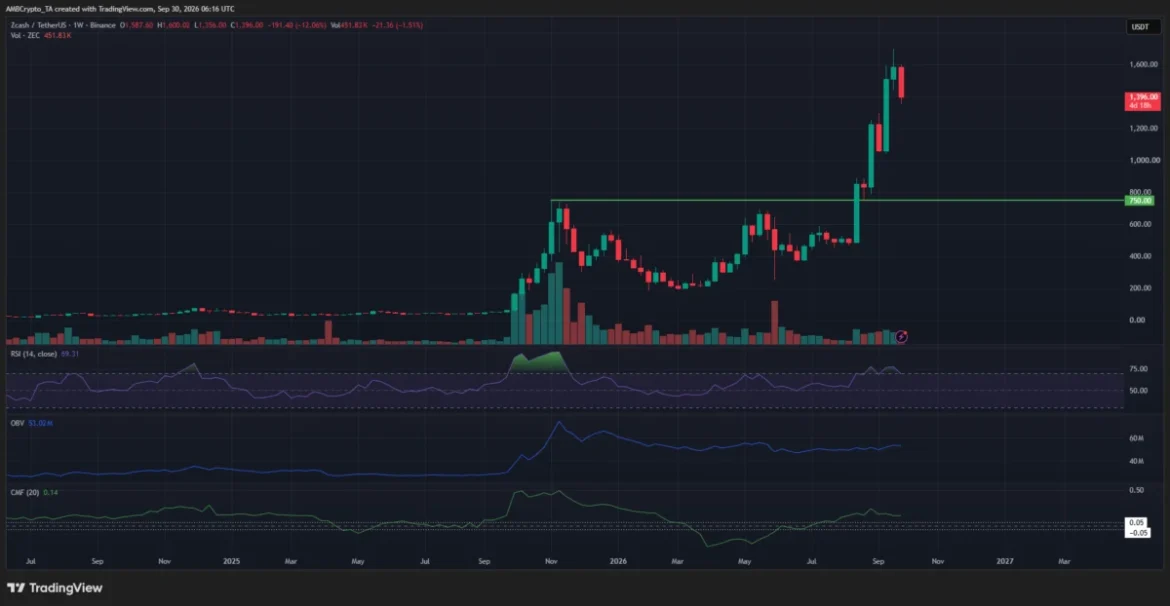
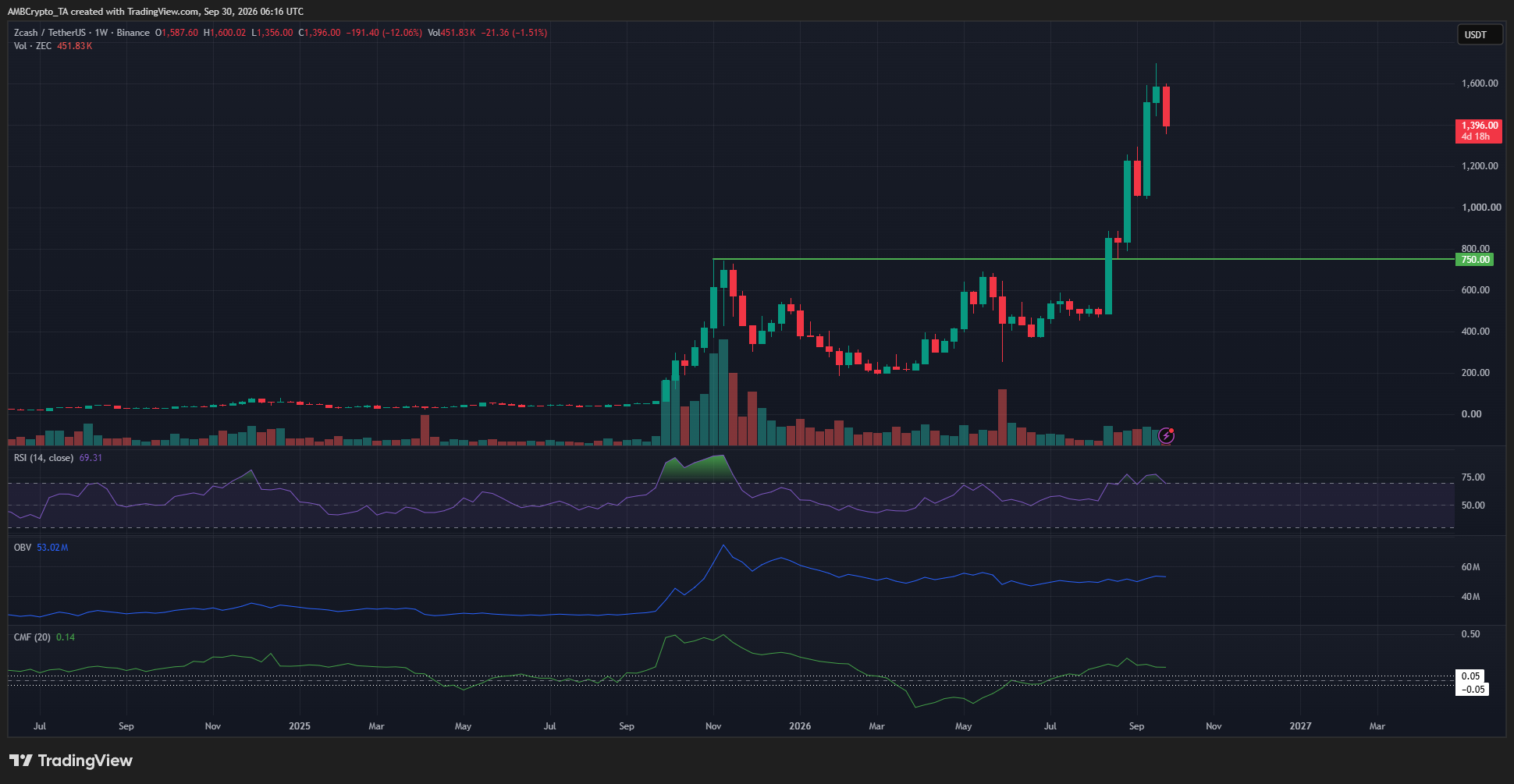
The fundamental catalysts driving ZCash have translated into aggressive, albeit volatile, price movements on technical charts. Since mid-August, ZEC has established itself as one of the best-performing large-cap digital assets in the broader cryptocurrency market. The token rallied nearly 200%, surging from a local base of $480 to a peak near $1,400, with intraday spikes briefly testing the $1,600 psychological and technical resistance zone.
On the weekly timeframe, ZEC maintains a firmly bullish structural bias, trading at price levels not observed in over six years. Market analysts, however, maintain a level of historical context regarding the asset’s all-time high of $5,941—as reported by CoinMarketCap—noting that the previous peak occurred during an era of significantly lower overall trading volume and vastly different market liquidity conditions.
Momentum indicators provide a nuanced picture of the asset’s current health. The Relative Strength Index (RSI) on the weekly chart has remained elevated above the neutral 50 line for consecutive weeks, spending significant time over the 70 threshold. While this indicates strong buying pressure, it stops short of the extreme overextended levels witnessed during the aggressive market cycles of late 2025.
Furthermore, the Chaikin Money Flow (CMF) indicator registered at +0.14 during the recent trading sessions. This reading sits comfortably above the +0.05 threshold, which traditionally demarcates robust, sustained capital inflows from institutional and high-net-worth participants. Conversely, the On-Balance Volume (OBV) presents a less convincing narrative; while it has traced a steady uptrend since the summer months, it has yet to challenge or surpass the heavy volume peaks recorded during the previous year’s trading sessions, suggesting that current price appreciation is being driven more by concentrated capital inflows than broad-based retail volume.
Correction Risks and Key Price Levels
Despite the powerful multi-month rally, ZEC has encountered notable resistance near the $1,600 threshold, leading to a cooling-off period and a subsequent price retracement. In recent sessions, the digital asset slipped below a critical 4-hour timeframe higher low at $1,427—a structural level that had previously preserved the short-term bullish market configuration.
With this former support zone now flipping into a tested overhead resistance level, market analysts and swing traders are preparing for the possibility of a deeper corrective phase. Fibonacci retracement levels highlight the $1,292 and $1,182 zones as primary areas of interest where buyers might step in to defend the trend and facilitate a potential bullish recovery.
A failure to hold these intermediary supports could introduce severe downside risk. Market participants are monitoring the $1,041 level as a structural tipping point; a decisive breakdown below this threshold would effectively flip the lower-timeframe market structure into a definitive bearish configuration. Furthermore, market makers note that a loss of the psychological $1,000 threshold could trigger automated stop-loss orders and cascading liquidations, potentially inviting accelerated selling pressure in the short term.
Implications of the Institutional Pivot
The simultaneous expansion of European ETPs, the maturation of multi-million-dollar American trusts, and the robust technical performance of ZEC highlight a fascinating intersection between traditional finance and decentralized technology. Financial technology firms like DeFi Technologies and investment issuers like 21Shares are effectively lowering the barrier to entry, allowing conservative capital pools to access high-beta, privacy-oriented assets through familiar brokerage accounts.
However, this institutionalization introduces a complex dynamic. While regulated ETPs provide legitimacy, price stability, and deep liquidity, they also integrate decentralized assets deeper into the traditional regulatory apparatus. As regulatory bodies in Europe and North America continue to scrutinize privacy-preserving technologies, the success of these ETPs will largely depend on their ability to comply with evolving Anti-Money Laundering (AML) and Know Your Customer (KYC) standards without compromising the core utility of the underlying protocols.
For now, the market is signaling a strong vote of confidence. The successful listing of the Valour ZCash SEK ETP in Sweden, alongside established counterparts in Paris, Amsterdam, and the United States, proves that demand for structured cryptocurrency exposure extends far beyond the traditional frontrunners of the asset class. As ZEC navigates its current technical consolidation phase, the structural backing of institutional investment products will likely serve as a crucial stabilizing force against macroeconomic volatility and short-term speculative pullbacks.