Foundry, the powerhouse operator behind the world’s largest Bitcoin mining pool by computing power, has officially announced its strategic expansion into the privacy-centric cryptocurrency sector. The company will launch a dedicated, institutional-grade Zcash (ZEC) mining pool slated for deployment in April 2026. This move represents a major milestone for the Zcash ecosystem, which has experienced a substantial resurgence in network participation and computing power over recent months.
Designed specifically to meet the rigorous compliance, security, and operational standards of public companies and institutional entities, the upcoming infrastructure aims to bridge a critical gap in the privacy coin market. As institutional adoption of digital assets matures, large-scale miners and corporate stakeholders have increasingly demanded robust, enterprise-ready tools that align with regulatory frameworks while offering high-performance capabilities.
The Announcement and Core Objectives
According to official corporate communications released in March 2026, the new venture will mirror the US-based operational model that has made Foundry USA the dominant force in the Bitcoin mining landscape. Foundry operates as a wholly-owned subsidiary of Digital Currency Group (DCG) and has built its reputation on providing dependable, transparent, and scalable mining infrastructure.
By channeling this expertise into the Zcash ecosystem, Foundry seeks to professionalize ZEC mining. Mike Colyer, Chief Executive Officer of Foundry, emphasized the strategic timing of the expansion. In a statement addressing the current market dynamics, Colyer noted that while Zcash has successfully evolved into an institutional-grade asset class over the years, the underlying mining infrastructure supporting its network security has simply not kept pace. The new pool is engineered to resolve this disparity, offering institutional miners a reliable ecosystem to contribute to the blockchain’s consensus mechanism.
Understanding Zcash: Privacy Meets Compliance

To contextualize Foundry’s expansion, it is essential to examine the unique architectural and economic design of Zcash. Launched in October 2016, Zcash emerged as an experimental offshoot of the Bitcoin codebase, utilizing zero-knowledge succinct non-interactive arguments of knowledge (zk-SNARKs)—a cryptographic breakthrough allowing transactions to be verified without revealing sender, receiver, or transaction amounts.
While pioneering cryptocurrencies like Bitcoin and Ethereum rely on public ledgers where transaction history is transparently tracked via pseudonymous addresses, privacy coins like ZEC offer fully shielded transactions by default. However, Zcash stands out in the privacy sector by offering a dual-nature ledger featuring both transparent and shielded addresses. This flexibility allows users to choose how much financial data they wish to disclose, demonstrating that strict cryptographic privacy and regulatory compliance can coexist within modern digital financial infrastructure.
From an economic perspective, Zcash shares foundational mechanics with Bitcoin. It operates on a Proof-of-Work (PoW) consensus algorithm, features a hard cap supply limit of 21 million ZEC, and enforces a programmed halving cycle every four years where block rewards are cut in half, steadily reducing the rate of new token issuance.
Chronology of the Zcash Hashrate Boom
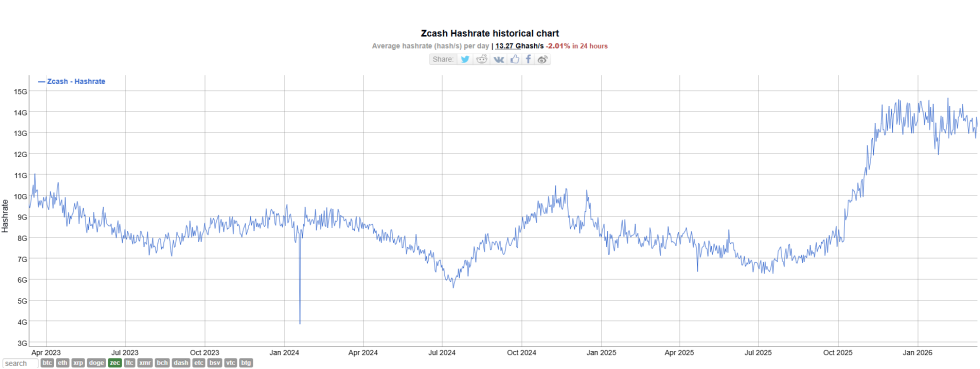
Foundry’s strategic pivot into Zcash does not occur in a vacuum; it follows a dramatic and sustained surge in the network’s computational security. Network hashrate—a metric representing the total computational power dedicated to mining and processing transactions on a Proof-of-Work blockchain—serves as a primary indicator of network health, security, and miner confidence.
Over the trailing six months leading up to the announcement, the Zcash network experienced a remarkable expansion in its underlying hash power:
- Late 2024 to Mid-2025: Zcash network metrics hovered within steady bounds, maintaining baseline participation from legacy mining operations and community hobbyists.
- October 2025: On-chain data compiled by BitInfoCharts indicated that the aggregate ZEC hashrate sat below 8 Ghash/s, reflecting moderate network activity.
- Early 2026: A sharp upward trajectory materialized as institutional interest and specialized hardware operators turned their attention back to privacy-preserving assets.
- March 2026: The network hashrate effectively surged by over 60%, stabilizing at more than 13 Ghash/s. This dramatic influx of computing power necessitated sophisticated, enterprise-grade pool coordination to optimize reward distribution and maintain network decentralization.
Industry Reactions and Official Responses

The announcement has garnered widespread acclaim from key figures within the privacy coin community and decentralized governance organizations.
Zooko Wilcox, founder of Zcash and Chief Product Officer at Shielded Labs—an independent Swiss-based non-profit organization dedicated to supporting the Zcash protocol—expressed immense enthusiasm regarding Foundry’s upcoming infrastructure. Wilcox noted that having North America’s largest and most prominent Bitcoin mining pool validate the network through an enterprise-grade ZEC offering marks a transformative validation for the protocol.
"We at Shielded Labs are delighted that Foundry—the largest Bitcoin mining pool, and one based in North America—is launching an enterprise-grade Zcash mining pool," Wilcox stated following the press release. Industry analysts view this endorsement as a vital bridge connecting traditional corporate mining operations with decentralized, privacy-centric blockchain networks.
Market Performance and Asset Valuation
The announcement of institutional-grade infrastructure arrives during a period of notable market volatility for the broader digital asset sector. At the time of the press release, Zcash (ZEC) was trading at approximately $209 per token, reflecting a retracement of more than 11% over the preceding seven-day trading window.
Despite short-term price fluctuations—which are historically common across both major cryptocurrencies and altcoin sectors—long-term infrastructure builders continue to focus on fundamental network metrics. Analysts point out that price corrections often contrast sharply with underlying structural developments, such as the growth in network hashrate and the onboarding of Tier-1 institutional service providers.
Implications and Broader Market Impact
The decision by Foundry to establish a dedicated Zcash mining pool carries several profound implications for the cryptocurrency mining industry and the future of privacy coins:
-
Institutional Validation of Privacy Coins: For years, privacy-focused digital assets faced regulatory headwinds and hesitancy from institutional investors due to compliance concerns surrounding anti-money laundering (AML) and know-your-customer (KYC) protocols. By stepping into the Zcash ecosystem, Foundry—a regulated entity operating heavily within Western jurisdictions—signals a growing institutional comfort with compliant privacy technology.
-
Decentralization and Network Security: As the ZEC hashrate scales past 13 Ghash/s, the need for professionalized pool management becomes acute. Mining pools prevent centralization of rewards by smoothing out the variance in finding blocks for individual miners. Foundry’s entry provides a stable, highly secure environment for large-scale hardware operators to deploy capital efficiently.
-
Geographic Diversification of Mining Operations: With operations firmly rooted in the United States, Foundry’s initiative reinforces North America’s position as a dominant hub for professionalized cryptocurrency mining infrastructure, extending its capabilities beyond Bitcoin into alternative Proof-of-Work networks.
Conclusion and Outlook
As the April 2026 launch date approaches, attention will remain focused on how enterprise miners integrate into the Zcash network. By merging institutional compliance with advanced cryptographic privacy, Foundry’s upcoming mining pool could establish a new blueprint for how alternative Layer-1 networks scale to meet the demands of institutional capital.