
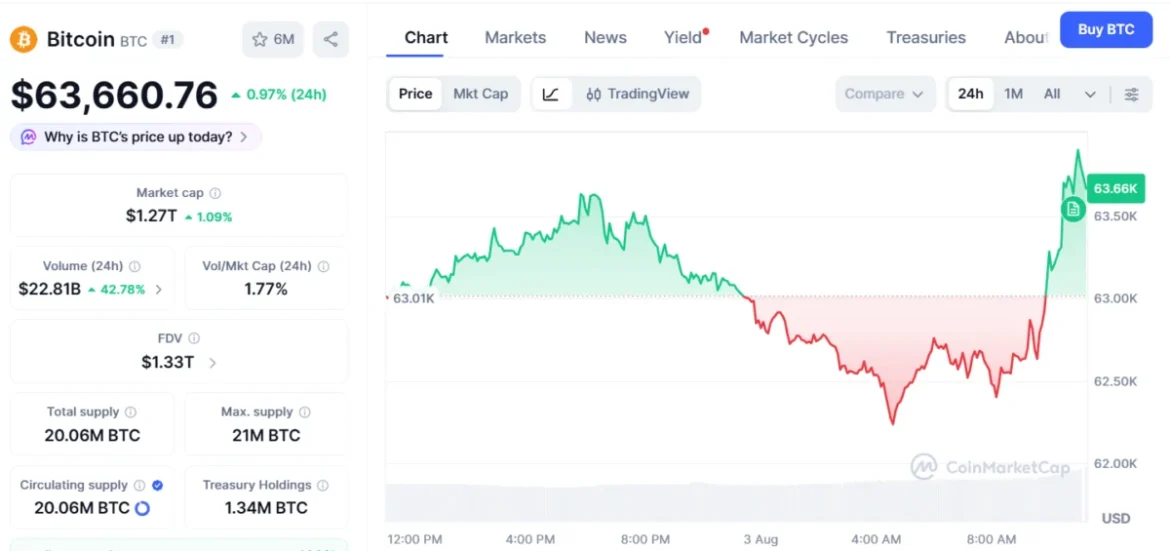
In a striking reversal of historical market norms, the global financial landscape is witnessing a profound decoupling between the volatility profiles of traditional government debt and the cryptocurrency market. While Bitcoin—an asset class historically defined by its dramatic price fluctuations—has entered a period of relative tranquility, the U.S. Treasury market is experiencing its most volatile stretch in months. This divergence has caught the attention of institutional analysts, as the MOVE index, which measures expected volatility in U.S. Treasuries, has climbed sharply, reflecting deep-seated anxiety regarding fiscal policy and interest rate trajectories.
The MOVE index, often referred to as the "VIX for bonds," surged from approximately 80 earlier this week to hit levels around 104. This represents the highest reading for Treasury volatility since March, a period marked by significant regional banking instability and frantic shifts in Federal Reserve policy expectations. Conversely, the Bitcoin Volatility Index (BVIV), which tracks 30-day implied volatility for the premier cryptocurrency, has been hovering near 37. This figure sits perilously close to the 2026 yearly low of 35, signaling that options traders are currently pricing in a remarkably muted outlook for Bitcoin price action.
A Chronology of Diverging Market Sentiments
The current market environment is the culmination of several weeks of intensifying pressure on the U.S. fixed-income market. Throughout early 2025, bond traders have been forced to recalibrate their expectations as economic data consistently pointed toward persistent inflationary pressures and a resilient, albeit complex, labor market.
In mid-January, the U.S. 10-year Treasury yield began a steady climb, reflecting the market’s growing skepticism that the Federal Reserve would be able to maintain its current trajectory of interest rate adjustments. By the first week of February, yields briefly breached the 5.2% threshold, a level that historically triggers a broad risk-off sentiment across equities and alternative assets.
As bond yields climbed, the correlation between the MOVE index and risk-on assets began to fracture. Typically, a rise in the MOVE index—indicating uncertainty in the "risk-free" rate—would coincide with an increase in crypto volatility. However, the first two weeks of February have seen this relationship dissolve. While bond markets reacted with volatility to energy price spikes and fiscal deficit concerns, Bitcoin’s price action remained range-bound, and the cost of hedging against extreme Bitcoin price swings in the options market fell to multi-year lows.
Quantitative Analysis of the Volatility Gap
The statistical evidence of this decoupling is found in the comparative analysis of implied volatility indices. The Cboe Volatility Index (VIX), which tracks the expected movement of the S&P 500, currently sits near 14, mirroring the subdued state of the crypto markets. This suggests that the broader equity market is also largely ignoring the tremors occurring in the bond market, or perhaps that investors are currently viewing Treasuries as the primary source of systemic risk.
The divergence is particularly notable when analyzing the spread between Treasury-backed instruments and Bitcoin derivatives. When the MOVE index rises, it reflects a premium placed on uncertainty regarding government debt. Historically, this has acted as a catalyst for Bitcoin volatility, as investors pivot between fiat-denominated assets and digital assets. Yet, current data from platforms like Volmex shows that the 30-day implied volatility for Bitcoin is remarkably suppressed.
Analysts point to several potential reasons for this:
- Institutional Maturation: The increased presence of spot Bitcoin exchange-traded funds (ETFs) has arguably brought a new cohort of long-term holders into the market, shifting the composition of the asset’s investor base away from hyper-active day traders.
- Capital Allocation Shifts: Institutional capital appears to be focused on the immediate risks of the bond market, treating the current Treasury yield fluctuations as a more pressing concern than the speculative potential of crypto assets.
- Liquidity Dynamics: The sheer volume of liquidity currently locked within Treasury-linked derivatives may be creating a localized volatility trap that does not necessarily transmit to the decentralized, globalized nature of the Bitcoin market.
The Macroeconomic Landscape and Rising Yields
The bond market’s current agitation is rooted in a "perfect storm" of macroeconomic factors. Energy prices have remained stubbornly elevated, fueling concerns about a second wave of inflation that could force the Federal Reserve to maintain higher-for-longer interest rates. Furthermore, the sheer volume of Treasury issuance required to fund government spending has placed structural pressure on the yield curve.
When the 10-year yield touched 5.2%, it signaled that the market was no longer confident in a "soft landing" scenario. In a conventional economic environment, this would act as a powerful headwind for Bitcoin. Higher yields provide an attractive "risk-free" return, which typically reduces the appeal of non-yielding assets like Bitcoin. While Bitcoin’s price rally did stall in response to the yield spikes, the lack of ensuing volatility in the options market suggests that the market does not view this yield-driven pressure as an existential threat to the digital asset’s valuation.
The weakening correlation between the MOVE index and Bitcoin volatility—which has effectively turned negative or near-zero—highlights a fundamental shift in how market participants perceive risk. In this new paradigm, Treasury bonds are being treated as the "active" risk, while Bitcoin is being treated as a "passive" asset waiting for the next secular trend to emerge.
Implications for Investors and Future Market Stability
It is crucial to emphasize that a period of low volatility in Bitcoin does not equate to a period of safety. Markets often consolidate in low-volatility environments before making massive, sudden moves. Traders are currently pricing in a stable outlook, but the underlying macro factors remain precarious. If the volatility in the bond market continues to bleed into the broader financial system, it is possible that the "calm" in the crypto space will be short-lived.
If the MOVE index continues to rise, it could eventually force a deleveraging event in other asset classes. Should the cost of capital remain high, the speculative premium that often drives Bitcoin prices could evaporate, leading to a delayed but violent volatility spike. Conversely, if the bond market stabilizes, the current "quiet" in Bitcoin could serve as the foundation for a more sustainable, institutional-led price discovery phase.
For the moment, the contrast remains stark: the "risk-free" asset is behaving like a high-risk derivative, and the "high-risk" asset is behaving like a defensive store of value. This inversion is perhaps the most significant indicator of the current uncertainty permeating global finance. As central banks and fiscal authorities navigate the complexities of 2025, the relationship between these two markets will remain a critical focal point for institutional risk managers.
While Bitcoin has spent years being the primary "volatility trade" in the eyes of global investors, the current data suggests that the spotlight has shifted. For the time being, the nervous energy of the global financial system is firmly lodged in the halls of the Treasury bond market, leaving Bitcoin to occupy an unusual, quiet space in the periphery. Whether this is a temporary phenomenon or a structural shift in the asset’s role within the global portfolio remains the central question for the coming fiscal quarter.
As the situation develops, market observers will be watching the correlation coefficients closely. If the MOVE index begins to descend, it will signal a return to normalcy. If it remains elevated, the divergence may force a deeper, more painful reconciliation between the crypto and fixed-income markets. For now, traders are left to navigate a landscape where the expected turbulence has migrated from the digital frontier to the very heart of the traditional financial system.
