
The decentralized finance (DeFi) sector finds itself at a critical juncture, as prominent investors move to temper growing security fears, even as major artificial intelligence (AI) firms unveil models with potentially offensive cybersecurity capabilities. This evolving narrative pits the optimistic outlook of industry insiders against a backdrop of persistent exploits and a nascent, yet powerful, AI-driven threat landscape. The core argument from some venture capitalists is that despite high-profile incidents, the systemic risk within DeFi is actually showing signs of consolidation and mitigation, particularly within larger protocols.
Haseeb Qureshi, managing partner at the prominent VC firm Dragonfly, has been a leading voice in this discussion, asserting that the reported value of DeFi hacks in 2026 was "declining in size" to a degree that does not warrant what he terms "overblown security fears." Qureshi’s analysis, widely disseminated within the crypto community, posits a nuanced perspective on the sector’s security posture. He emphasizes that while the sheer number of incidents might appear alarming, the financial impact per incident is shrinking, indicating a shift in the nature of vulnerabilities being exploited. "Median hack size by year is also declining, showing that we’re moving more toward smaller hacks of smaller protocols," Qureshi stated, underscoring a trend where less mature or less audited projects bear the brunt of attacks, rather than the core, heavily capitalized platforms.
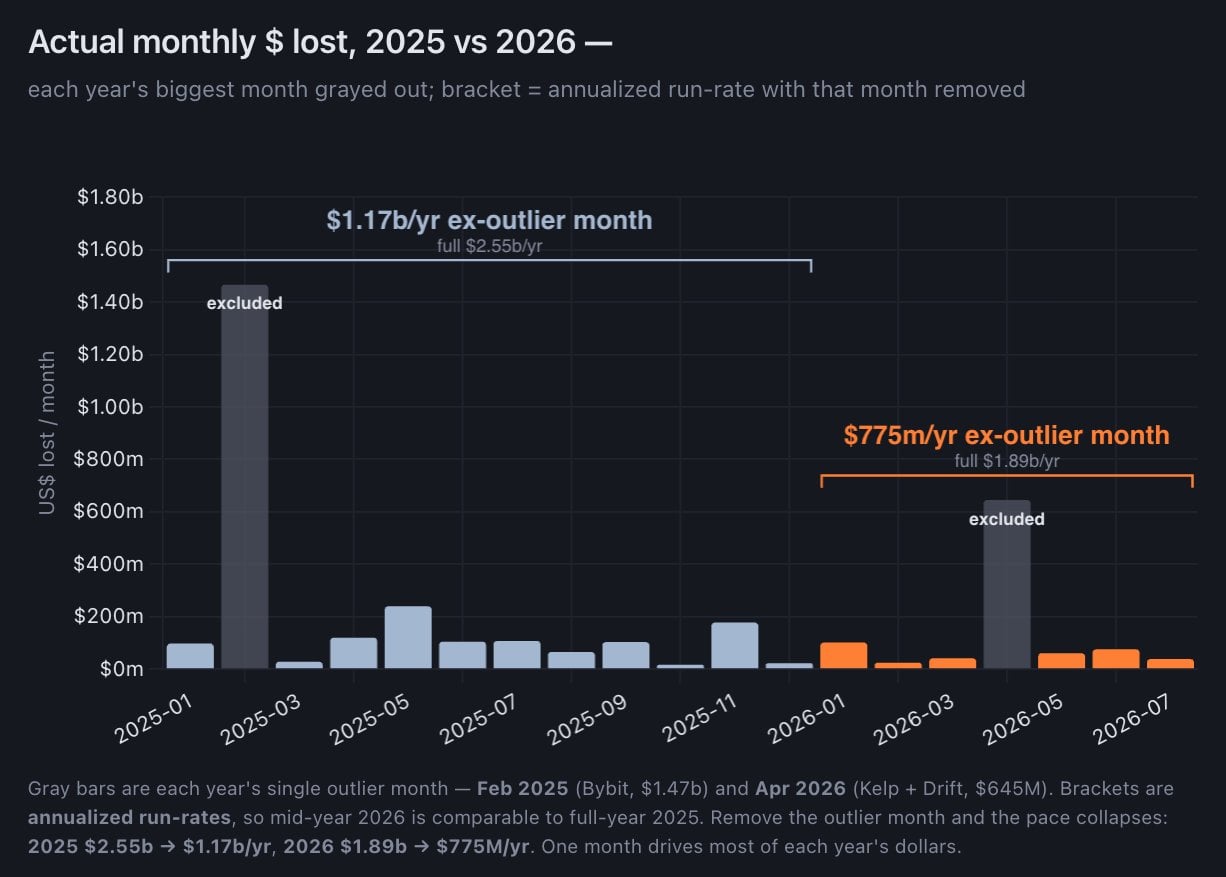
Qureshi’s interpretation of the 2026 data strategically excludes exceptionally large, specific incidents like the alleged Bybit ($1.4 billion) and KelpDAO ($292 million) stolen funds from his specific "DeFi hack" calculations. This methodological choice aims to differentiate between direct protocol exploits and broader operational or custodial failures, which, while impactful, might not reflect the underlying smart contract security of the decentralized ecosystem as a whole. While such exclusions can be debated for their comprehensive representation of total losses, they serve to refine the focus on the robustness of the core DeFi protocol layer. His data, after these adjustments, suggests a significant improvement: in 2025, an estimated $2.55 billion was lost to exploits (averaging $1.17 billion per year), a figure that decreased to $1.89 billion in 2026 (or $775 million per year). More strikingly, the median hack size per year has plummeted from over $8 million in 2021 to below $1 million in 2026, signaling a potential maturation in security practices among the larger, more established DeFi projects.
This trend underpins Qureshi’s broader assertion: "The average dollar in DeFi is as safe as it was a year ago. If you keep your money in large protocols that can afford to harden themselves, you’ll likely be fine." This statement serves as both an endorsement of the progress made by leading DeFi platforms and a cautious warning to users to exercise due diligence, particularly when engaging with nascent or less-vetted projects. The "hardening" of larger protocols typically involves substantial investments in security audits, bug bounty programs, formal verification of smart contracts, and the implementation of multi-signature security mechanisms for critical operations.
The Dual-Edged Sword of AI in Cybersecurity
The backdrop to these security discussions is further complicated by the rapid advancements in artificial intelligence. Major AI firms are increasingly releasing powerful language models and specialized AI tools that possess sophisticated cybersecurity offensive capabilities. These tools, while often developed for defensive purposes like identifying vulnerabilities or simulating attacks, can be weaponized by malicious actors. AI can drastically accelerate the process of discovering zero-day vulnerabilities, generating highly convincing phishing campaigns, and automating exploit development, thereby lowering the barrier to entry for cybercriminals. The ability of AI to analyze vast amounts of code for subtle flaws, predict human behavior for social engineering, and even orchestrate complex multi-stage attacks represents a significant escalation in the cyber arms race.
Conversely, AI is also being deployed to bolster defensive measures within DeFi. AI-powered analytics can detect anomalous transactions, identify suspicious contract interactions, and predict potential attack vectors by learning from historical data. Decentralized autonomous organizations (DAOs) and security firms within the DeFi space are exploring AI for real-time threat detection, automated incident response, and continuous monitoring of smart contract integrity. This creates a dynamic and uncertain environment where the offensive and defensive capabilities of AI are locked in a perpetual struggle, making the future security landscape of DeFi inherently unpredictable.
Will DeFi Security Concerns Derail Adoption? A Closer Look at Market Dynamics
Despite Qureshi’s optimistic data regarding the declining median hack size, other metrics paint a more complex picture. The number of hack incidents, for instance, skyrocketed to record highs in the first half of 2026. This suggests that while individual attacks might be smaller in financial value, the overall attack surface has widened, or attackers are finding more frequent, albeit less lucrative, opportunities. This rise in incident frequency could erode user trust and deter new entrants, regardless of the individual hack size.
One of Qureshi’s more striking insights, however, points to a decline in "operational security failures" or exploits related to admin keys or signing infrastructure. Historically, these types of attacks, often involving compromised private keys or poorly managed multi-signature wallets, have accounted for a significant portion of stolen funds. For perspective, 75% of the nearly $1 billion stolen in 2026 was initially linked to operational failures. Yet, Qureshi noted that this trend was also dropping, challenging the notion that attackers are merely shifting tactics to easier targets. "Some have claimed this is because hacks are moving into admin key hacks; admin key/multisig hacks are already included in this dataset. Those are going down in dollar terms as well," he clarified, suggesting a systemic improvement in how critical administrative functions are secured within DeFi.
However, the fragility of even major players in the DeFi ecosystem was starkly underscored by the "bank run" on the leading DeFi lending platform Aave following the KelpDAO hack. For the unfamiliar, KelpDAO, a liquid restaking protocol, suffered a significant exploit, triggering a wave of fear and uncertainty across the interconnected DeFi landscape. The KelpDAO incident, while potentially distinct from Qureshi’s specific "DeFi protocol hack" definition, sent shockwaves through the market due to the perceived interconnectedness of protocols. Investors, fearing contagion and systemic risk, began withdrawing funds from Aave, a cornerstone of DeFi lending, illustrating how even a major platform can be susceptible to broader market sentiment shifts stemming from exploits elsewhere. This event served as a potent reminder that trust in DeFi remains fragile and highly reactive to security breaches, regardless of where they occur.
Amidst these elevated security risks, the attractiveness of DeFi yields has also come under scrutiny. With average yields ranging from 2.7% to 3.8%, DeFi became relatively riskier and less lucrative compared to traditional, low-risk investments like U.S. Treasury bills. In an environment where the risk-free rate offered by government bonds is competitive, the additional risk premium required for DeFi participation increases significantly. This dynamic can deter institutional investors and risk-averse retail participants who prioritize capital preservation over speculative returns.
DeFi vaults, which are automated yield strategies leveraging smart contracts built on top of underlying protocols like Aave, were particularly hard hit during this period of heightened insecurity. These vaults, designed to optimize returns through complex strategies, are inherently exposed to the vulnerabilities of the underlying protocols they interact with. An exploit in one layer can cascade through the entire vault structure, leading to significant losses. The overall Total Value Locked (TVL) in DeFi vaults, a key metric of capital deployed, consequently dropped sharply from $113 billion to $61 billion, before slightly recovering to $65 billion as of writing. This substantial contraction reflects a significant withdrawal of capital, indicating a loss of confidence or a re-evaluation of risk by investors in these complex, automated strategies.
Institutional Integration and the Future of Tokenization
Despite the immediate challenges, the long-term vision for DeFi, particularly its role in the tokenization of real-world assets (RWAs), remains robust. Interestingly, S&P Global Ratings, a leading credit rating agency, views DeFi vaults as conceptually equivalent to traditional managed funds. This perspective is critical, as it bridges the conceptual gap between decentralized finance and traditional financial structures. The rating firm projects that vaults could become a "core infrastructure" for the burgeoning ecosystem of tokenized real-world assets and a conduit for institutional capital flows into the blockchain space.
Tokenized RWAs represent a significant paradigm shift, allowing tangible and intangible assets—from real estate and commodities to intellectual property and equities—to be represented as digital tokens on a blockchain. This process promises increased liquidity, fractional ownership, transparency, and reduced transaction costs. As this tokenization momentum grows, traditional managed funds are envisioned to evolve, integrating with or directly transforming into DeFi vaults to access and manage these new digital asset classes. This evolution would mark a monumental step in the convergence of traditional finance (TradFi) and decentralized finance.
However, a critical question looms: will the ongoing DeFi security fears, despite Qureshi’s assurances about declining median hack sizes, derail this major adoption unlock? Institutional capital, characterized by its conservative nature and stringent regulatory requirements, demands an exceptionally high standard of security and reliability. Frequent incidents, even if smaller in individual impact, can create a perception of systemic instability that is incompatible with institutional mandates. The potential for AI-powered offensive capabilities further amplifies these concerns, necessitating robust, AI-resistant security frameworks.
The future trajectory of DeFi and its role in the global financial system hinges on its ability to demonstrably address and mitigate these security challenges. This requires not only continuous technological innovation in smart contract auditing, formal verification, and decentralized insurance but also a concerted effort to enhance operational security practices across the ecosystem. Moreover, clear regulatory frameworks that acknowledge the unique characteristics of DeFi while ensuring investor protection will be crucial. The interplay between technological advancement, market confidence, and regulatory clarity will ultimately determine whether DeFi vaults can indeed become the "core infrastructure" for a new era of tokenized finance, or if persistent security concerns will impede this transformative potential. The current debate reflects a critical period of self-assessment and adaptation for the decentralized finance sector as it navigates the path from nascent innovation to mainstream adoption.
