
The decentralized finance and Layer 1 blockchain sectors have experienced a notable resurgence of capital inflows, with Sui (SUI) emerging as one of the standout performers in the digital asset market. Over a recent 24-hour trading window, the native token of the Sui network rallied by nearly 14%, accompanied by a substantial 26% surge in daily trading volume. This aggressive upward movement has been mirrored in derivatives markets, where Open Interest (OI)—a key metric tracking the total number of outstanding derivative contracts—climbed by approximately 21%. Market analysts interpret this spike in OI as a strong indicator that the prevailing bullish momentum is backed by fresh capital deployment rather than merely short-covering, suggesting that the current rally may have room to develop further.
Zooming out to a broader timeframe, SUI’s performance underscores a resilient recovery. The altcoin has registered a commendable 30.2% price appreciation over the course of a single week. Industry observers attribute this broad-based strength to a wider market rotation favoring Layer 1 tokens, a sector that has recently attracted considerable institutional and retail attention due to robust network metrics and expanding decentralized application (dApp) ecosystems. As SUI approaches the pivotal $1 psychological threshold, market participants are increasingly focused on whether technical indicators and network fundamentals can sustain the breakout or if a retracement is imminent.
A Chronological Overview of SUI’s Price Action
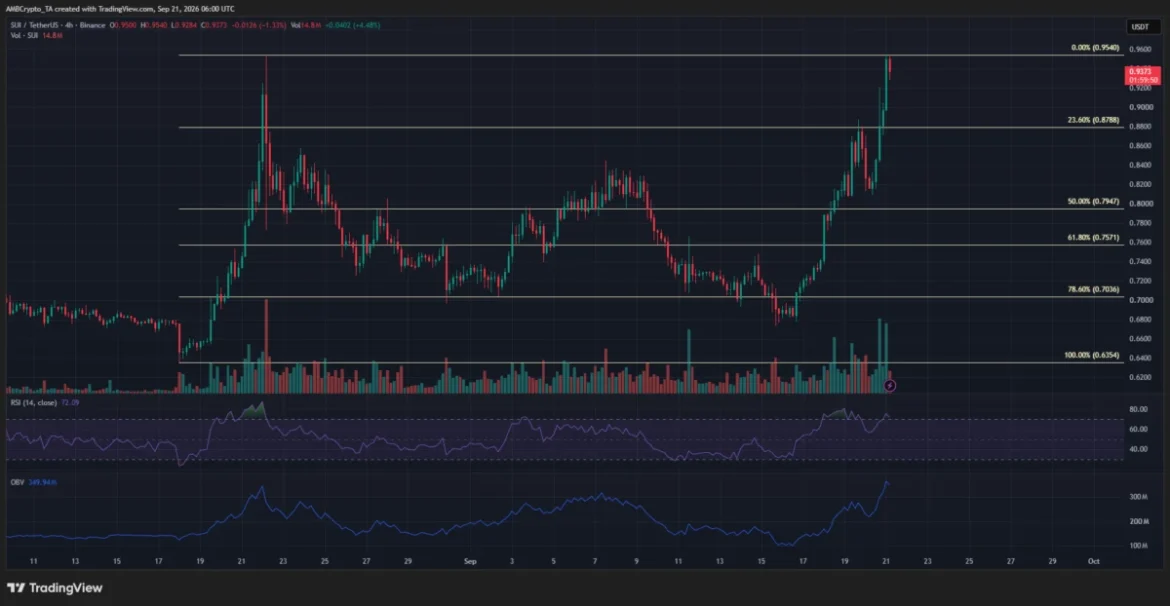
To understand the mechanics driving the current market sentiment, it is necessary to examine SUI’s trajectory over the preceding months. Following a prolonged period of consolidation that began in June—during which the asset traded largely sideways in a range anchored near the $0.70 mark—SUI broke out aggressively in August. Within a span of less than five days, the token surged from $0.635 to a local swing high of $0.954, representing an impressive 50.14% rally.
However, this rapid ascent was followed by an equally swift correction. As profit-taking ensued and broader macroeconomic pressures weighed on the cryptocurrency market, SUI retraced a significant portion of its August gains. The downward correction eventually found a floor at $0.673, dipping just below the 78.6% Fibonacci retracement level. Rather than validating a deeper bearish trend, this severe dip served as a springboard for accumulation. Buyers stepped in aggressively at lower levels, propelling the asset out of its corrective phase and steering it once again toward the $0.954 swing high, setting the stage for the current assault on the $1 barrier.

Market Data and Derivatives Insights
The quantitative metrics underpinning SUI’s latest price action provide vital context for professional traders and institutional investors alike. The 14% intraday price increase combined with a 26% expansion in trading volume indicates high market participation and strong liquidity supporting the move. Furthermore, the 21% jump in Open Interest signals that new market participants are actively opening leveraged positions, heightening both potential upside velocity and the risk of heightened volatility.
Technical configurations on the charts reveal that the $0.85 supply zone, which historically acted as a localized ceiling, was breached with minimal resistance during the latest push. On the 4-hour timeframe, technical indicators have turned firmly bullish in the wake of the recovery from the 78.6% Fibonacci level. Nevertheless, oscillators such as the Relative Strength Index (RSI) have drifted into overbought territory. In traditional technical analysis, an overbought RSI serves as a cautionary yellow flag, suggesting that the market may be temporarily overextended and susceptible to a localized cooling-off period before attempting a sustained break above higher resistance levels.
Strategic Price Levels and Critical Thresholds
From a structural standpoint, the price zone between $0.95 and $1.05 constitutes a critical liquidity and resistance cluster. Technical price targets calculated from previous consolidation ranges point toward $1.03 and $1.15 as the next logical milestones should the bulls successfully breach the $1 psychological barrier.
Despite the prevailing optimism, market veterans caution against unbridled euphoria. Historical precedent dictates caution: in May, SUI experienced a false breakout past the $1.05 supply zone before an unexpected wave of market-wide selling triggered a sharp reversal. Swing traders are therefore advised to monitor price action closely rather than chasing momentum blindly.
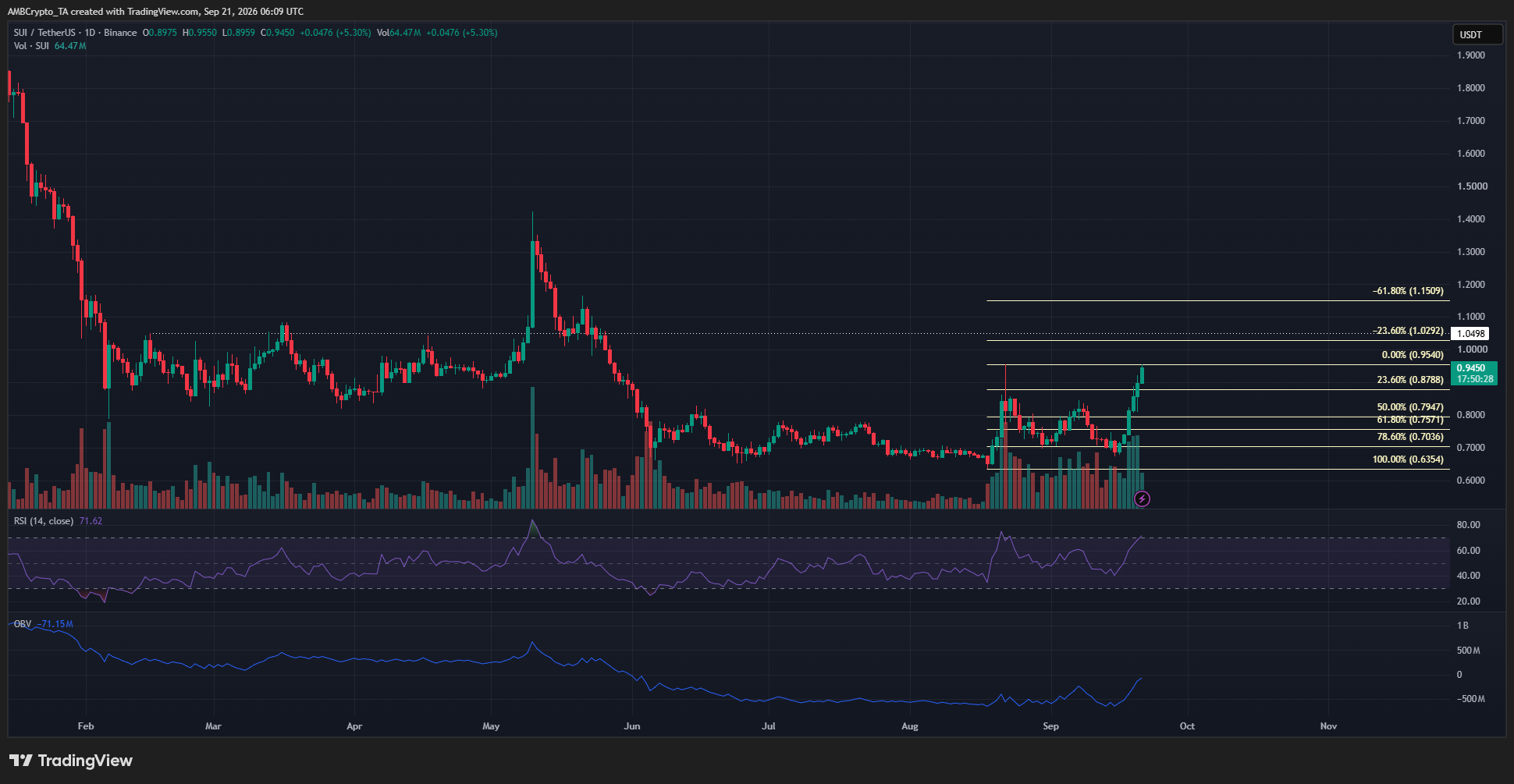
A preferred strategy among risk-conscious market participants involves waiting for a decisive daily close above the $1.05 resistance level, followed by a successful retest of the $0.95–$1.05 zone acting as newfound support. Such a market structure would validate the area as a launchpad, offering a more secure risk-to-reward ratio for re-entering long positions or establishing swing trades.
Broader Industry Implications and Outlook
The resurgence of SUI is not an isolated event but rather part of a broader narrative involving Layer 1 blockchain adoption and capital rotation. As alternative layer-1 networks continue to scale, improve transaction finality, and attract developers away from congested legacy networks, native tokens frequently capture speculative and fundamental interest.
For Sui, the ability to maintain transaction volume, expand its total value locked (TVL), and hold critical support levels during market pullbacks will be vital in determining whether the token can permanently graduate past the $1 mark. While the immediate outlook remains heavily influenced by derivatives market positioning and short-term technical indicators, the broader macroeconomic environment and overall appetite for risk assets across the cryptocurrency ecosystem will ultimately dictate the sustainability of the current rally. Traders and investors are encouraged to manage leverage carefully, maintain defined risk parameters, and watch for volume confirmation as SUI navigates this crucial technical juncture.
