The architecture of global high-finance is undergoing a profound structural evolution, with open-source distributed ledger technology emerging as the preferred backbone for international monetary institutions, central banks, and systemically important commercial banks. According to a comprehensive research report published by Ledger Insights and commissioned by the Linux Foundation Decentralized Trust (LFDT), nearly 30 percent of all institutional-grade blockchain platforms globally rely directly on core technologies developed and maintained under the LFDT umbrella.
Prominent enterprise protocols such as Hyperledger Fabric and Hyperledger Besu have secured positions within the top three most widely deployed enterprise blockchain technologies in the marketplace. However, a deeper examination of the report reveals that this headline metric significantly understates the true extent of LFDT’s footprint across the financial sector. The widespread integration of these open-source frameworks highlights a major shift in how major economic players approach digital asset infrastructure, favoring transparent, collaboratively governed codebases over siloed proprietary systems.
The Scale of Institutional Adoption: From Central Banks to Global Depositories
The true significance of LFDT’s market penetration lies not merely in numerical adoption rates, but in the institutional weight and systemic importance of the projects utilizing its technology. Central bank digital currency (CBDC) initiatives and wholesale cross-border payment experiments of unprecedented global scale are currently anchored by LFDT software.
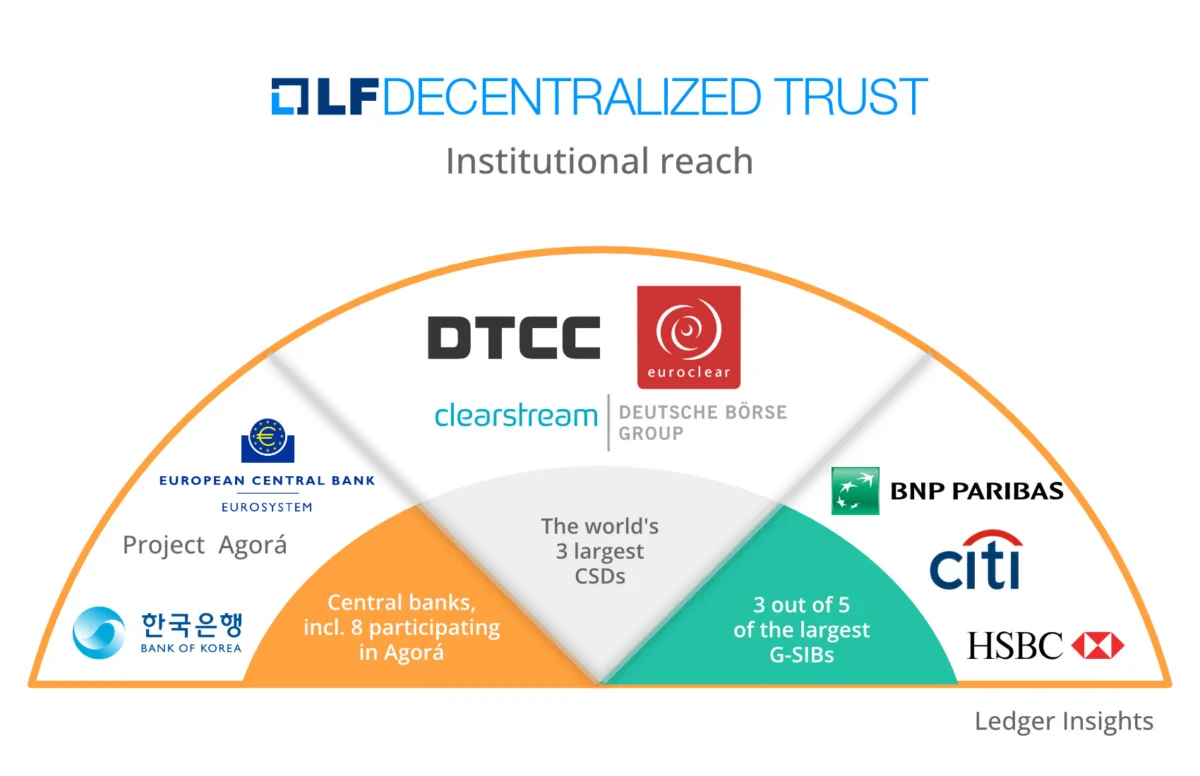
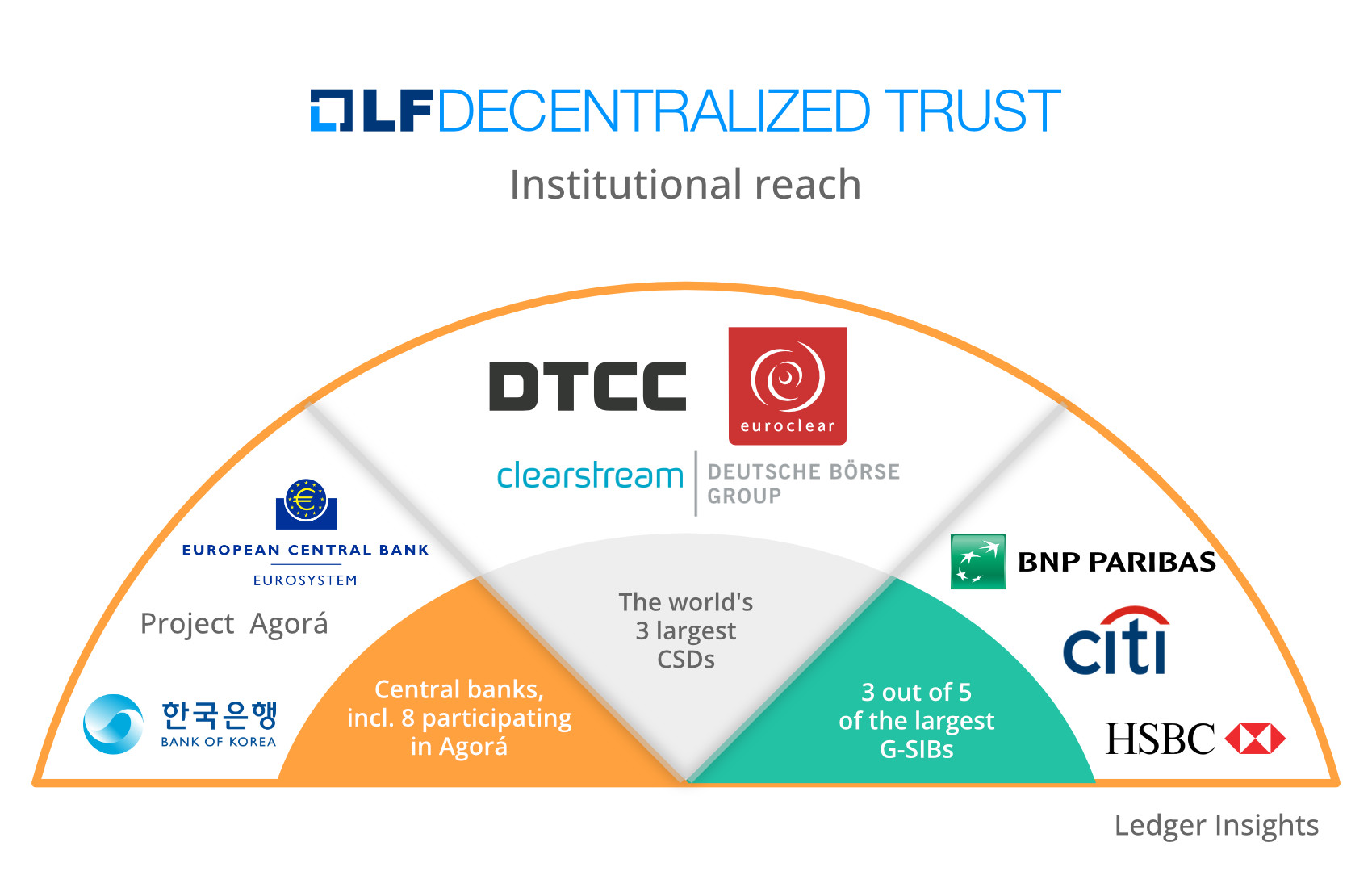
Among these is Project Agorá, a collaborative research initiative uniting seven major G7 economies alongside the Bank for International Settlements to explore the integration of tokenized wholesale central bank money and commercial bank deposits on a unified programmable core. Similarly, Project Pontes, spearheaded by the Eurosystem, relies on the same technological foundations.
The footprint extends directly into the heart of global financial market infrastructures. The world’s three largest central securities depositories—Clearstream, the Depository Trust & Clearing Corporation (DTCC), and Euroclear—have integrated LFDT technologies into their core operational pathways for tokenized issuance, settlement, custody, and collateral management. Furthermore, three of the world’s top five global systemically important banks (G-SIBs), namely BNP Paribas, Citi, and HSBC, utilize these open-source networks. When factoring in foundational messaging and market infrastructure networks like Swift, the collective reliance on Linux Foundation-backed frameworks becomes a cornerstone of modern financial architecture.
Daniela Barbosa, General Manager of Decentralized Technologies at the Linux Foundation and Executive Director of LFDT, emphasized the gravity of these technological choices. The engineering decisions made today by central banks, market infrastructure operators, and commercial banking institutions carry long-term implications for the interoperability, connectivity, and evolution of the global monetary system. These implementations impose long-term stewardship obligations on the developer communities maintaining the underlying source code, prompting the commissioning of the empirical study to better understand and inform those responsibilities.
Dissecting the Data: Why the Headline Figures Understate Market Dominance
While the reported 29.4 percent market share for LFDT frameworks is substantial, methodical analysis of the survey data indicates that the real-world utilization rate is meaningfully higher. Several critical variables account for this statistical discrepancy.
First, approximately 29 percent of surveyed institutional blockchain projects declined to publicly disclose their underlying technology stacks, meaning the baseline percentage exclusively represents transparent implementations. Hyperledger Fabric, having established an early-mover advantage as one of the earliest enterprise-grade permissioned ledger technologies, maintains a massive legacy installation base that continues to power active production environments. However, the sheer volume of newly initiated, large-scale deployments indicates that LFDT’s market share is being actively driven by ongoing adoption rather than resting solely on legacy inertia.
Second, the market share breakdown highlights two ambiguous categories: "EVM compatible" and "proprietary" solutions, which jointly account for roughly 25 percent of the tracked market. Industry analysis, factoring in developer skill sets and deployment profiles, strongly suggests that a significant portion of EVM-compatible institutional projects utilize Hyperledger Besu under the hood. However, lacking formal public confirmation from the institutions, these instances were categorized separately.
Finally, the proprietary software category introduces further underreporting. While certain global institutions openly acknowledge that their proprietary applications are built upon adapted LFDT codebases—such as Citi and India’s National Payments Corporation of India (NPCI), which administers the country’s massive Unified Payments Corporation (UPI) infrastructure—many other financial institutions brand custom-built systems as proprietary. In reality, very few modern enterprise platforms are built entirely from scratch. Given these factors, industry analysts conclude that LFDT’s effective market share substantially surpasses the conservative 29.4 percent headline figure.
The Strategic Appeal of Open-Source Infrastructure
The widespread convergence of financial institutions toward open-source decentralized trust frameworks is driven by several economic and operational imperatives. Chief among these is the mitigation of vendor lock-in. Historically, proprietary software models left financial institutions at the mercy of single-vendor licensing terms, pricing models, and product lifecycles. Open-source ecosystems grant organizations the autonomy to inspect, modify, and optimize source code tailored to their exact compliance and operational requirements.
Moreover, open-source adoption provides access to deep, global developer pools, accelerating time-to-market for complex tokenization and settlement platforms. When multiple competing institutions adopt a unified open-source foundation, it generates a powerful network effect. This shared technological baseline dramatically lowers the friction required to establish common industry standards and interoperability protocols—an advantage explicitly highlighted by market operators like Clearstream within the Ledger Insights findings.
Governance represents another decisive differentiator. Traditional blockchain ecosystems frequently suffer from structural conflicts of interest. While commercial software vendors drive rapid innovation, their profit motives can sometimes dictate infrastructure roadmaps in directions that diverge from the long-term risk management and operational stability needs of regulated financial institutions. A neutral, open-source foundation governed by a diverse consortium offers a trusted counterweight, providing an institutional-grade governance model that commercial software vendors cannot easily replicate.
Blurring Lines: The Convergence of Public and Private Networks
A notable evolutionary trend highlighted in the research is the gradual convergence between permissioned enterprise infrastructure and public blockchain networks. Traditionally, institutional finance maintained a strict aversion to public, permissionless chains due to regulatory, privacy, and finality concerns, favoring isolated private networks instead.
However, the survey data revealed that three platforms with public blockchain origins have broken into the top ten institutional rankings, with the Ethereum mainnet securing the fifth position overall. While public chain adoption within the institutional sector remains largely concentrated in specific use cases such as regulated fund tokenization, its presence alongside established permissioned stalwarts like Hyperledger Fabric and Besu marks a major shift in market dynamics.
This trend underscores the rising importance of hybrid architectures. Technologies like Hyperledger Besu, which natively support both permissioned enterprise environments and permissionless public deployments, are uniquely positioned for a future financial landscape where institutions must seamlessly bridge private liquidity pools and public tokenized asset markets.
Chronology and Evolution of Enterprise Blockchain
The maturation of enterprise decentralized trust technology has unfolded across distinct developmental phases over the past decade:
- 2015–2016 (Inception and Exploration): The Linux Foundation launches the Hyperledger project, uniting major financial and technology institutions to build open-source enterprise blockchain frameworks. Hyperledger Fabric is introduced as a modular, permissioned ledger architecture tailored for business logic.
- 2017–2019 (Proof of Concept Era): Global banks and financial market infrastructures conduct hundreds of localized proofs of concept, testing permissioned ledgers for trade finance, syndicated lending, and post-trade clearing.
- 2020–2022 (Production and Scalability): Enterprise blockchains transition from experimental sandboxes to production-grade core infrastructure. Hyperledger Besu joins the ecosystem, introducing Enterprise Ethereum capabilities that bridge the EVM developer community with permissioned corporate requirements.
- 2023–Present (Systemic Integration and CBDCs): Central banks and tier-one financial institutions deploy LFDT technologies for cross-border wholesale CBDC experiments (such as Projects Agorá and Pontes) and large-scale asset tokenization platforms operated by central securities depositories like DTCC, Euroclear, and Clearstream.
Implications for the Future of Financial Systems
The dominant market position of Linux Foundation Decentralized Trust technologies underscores a broader reality: open-source software has graduated from an experimental alternative to the foundational bedrock of global financial market plumbing.
As central banks move closer to issuing digital currencies and commercial institutions accelerate the tokenization of traditional assets—including bonds, equities, and real-world assets—the demand for secure, interoperable, and neutrally governed infrastructure will only intensify. The collaborative development model championed by the Linux Foundation ensures that no single commercial entity dictates the trajectory of the digital economy, safeguarding systemic resilience as finance enters its next technological era.