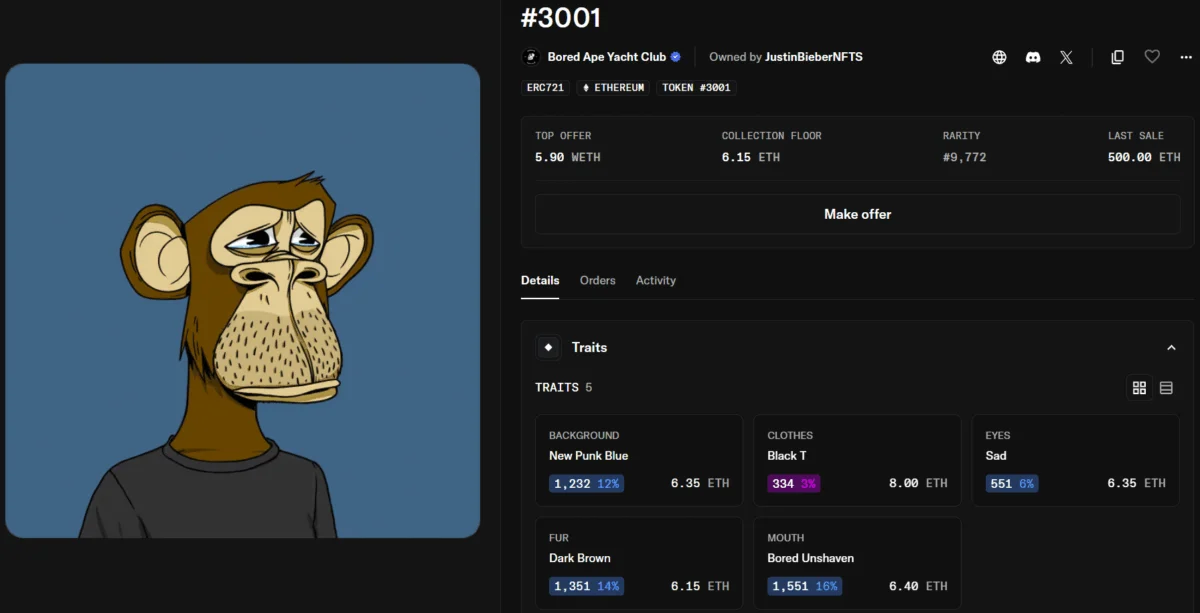
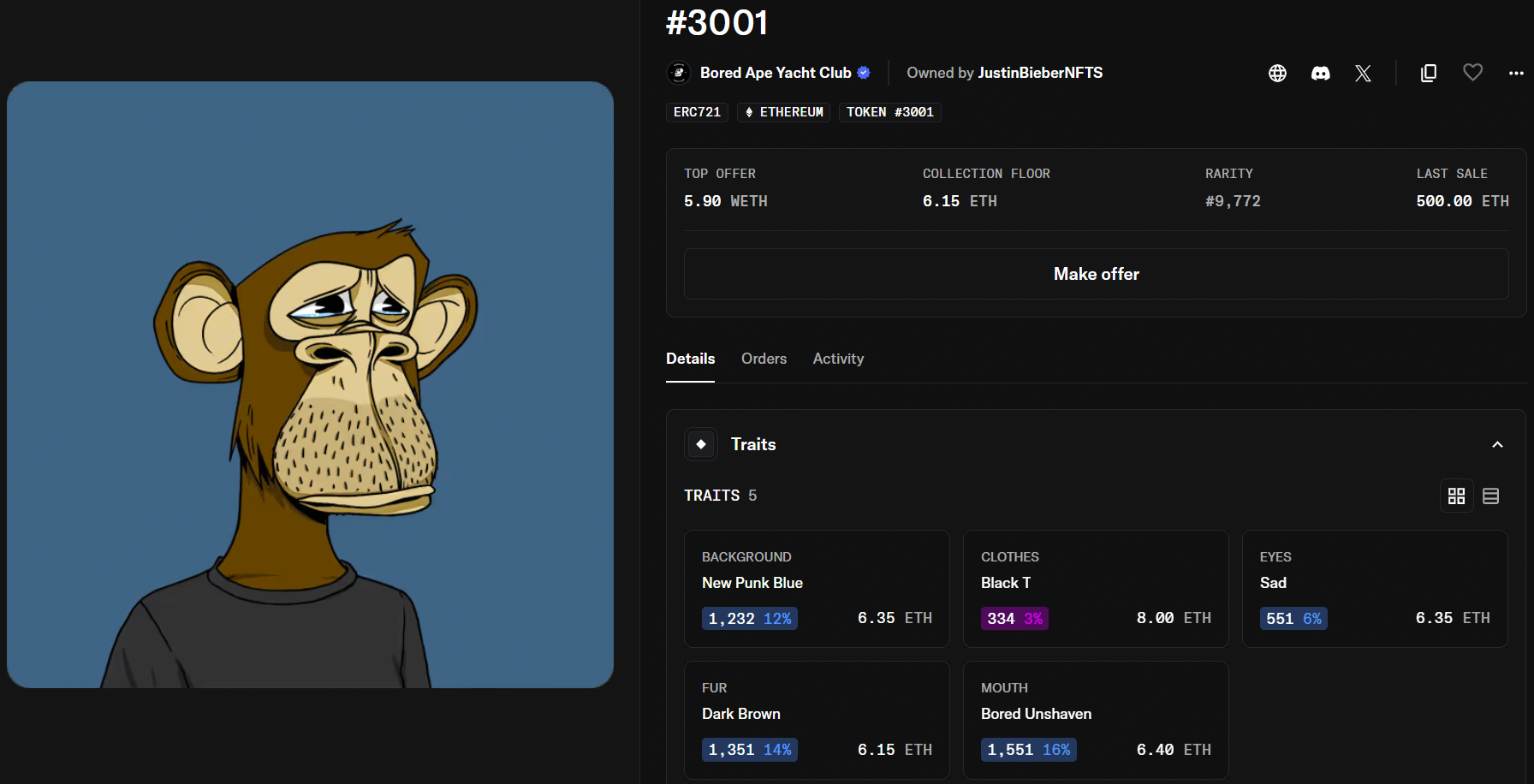
The meteoric rise and subsequent dramatic fall of digital assets have been starkly illustrated by the fortunes of Justin Bieber’s highly publicized Bored Ape Yacht Club (BAYC) NFT, Bored Ape #3001. Acquired in early 2022 for an eye-watering 500 Ether (ETH), a sum then equivalent to approximately $1.3 million USD, the digital collectible has experienced a precipitous decline in value. Current valuations place Bored Ape #3001 at a mere $12,000, representing a staggering loss of nearly 99% of its initial investment value. This dramatic depreciation underscores the volatility inherent in the non-fungible token (NFT) market and serves as a potent case study in the speculative fervor that characterized its peak.
Bieber, a global music icon with one of the most prominent celebrity NFT portfolios, made his acquisition at the zenith of enthusiasm for the sector. At that time, the NFT market was experiencing an unprecedented surge, driven by a confluence of factors including a broader cryptocurrency bull run, increased mainstream awareness, and the allure of digital ownership and exclusivity. Analysts observing the market in early 2022 noted that Bieber’s purchase of Bored Ape #3001 was significantly above the prevailing market rates. Comparable NFTs within the Bored Ape Yacht Club collection were trading in a range of $200,000 to $300,000 USD. This premium purchase price, while perhaps a testament to Bieber’s eagerness to be part of a cultural phenomenon, ultimately proved to be a costly decision in hindsight.
The current market for Bored Ape Yacht Club NFTs paints a grim picture for many investors who entered the market during the 2022 rally. The highest current bid for Bored Ape #3001 stands at a meager 5.9 ETH, and the collection’s "floor price" – the lowest price at which any NFT in the collection is being offered – hovers around 6.15 ETH. With the price of Ethereum currently trading at approximately $2,000 USD per ETH, investors who purchased during the peak of the 2022 boom are facing substantial dollar-denominated losses, far exceeding the percentage drop experienced by Bieber’s specific NFT. This situation highlights how even prominent figures can be caught in market downturns, especially when strategic timing and asset valuation are compromised by market exuberance.
The Rise and Fall of Bored Ape Yacht Club
The Bored Ape Yacht Club (BAYC) is a collection of 10,000 unique generative art pieces created by Yuga Labs, a company that has since become a dominant force in the metaverse and NFT space. The project first launched in April 2021 with a minting price of just 0.08 ETH per NFT. The collection sold out in a remarkably short period, within half a day, signaling immense early demand and interest.
The trajectory of BAYC’s floor price is a microcosm of the broader NFT market’s boom and bust cycle. By May 2022, the floor price for a Bored Ape NFT had surged to an astonishing range of 128 to 145 ETH. At the prevailing exchange rates of that period, this translated to a staggering value of approximately $350,000 to $420,000 USD per NFT. This meteoric rise transformed early adopters and speculative buyers into instant digital millionaires, fueling further hype and drawing in more capital.
Justin Bieber’s involvement with the Bored Ape Yacht Club extended beyond his purchase of #3001. Shortly after his initial acquisition, he also purchased another BAYC NFT, #3850, for an estimated $470,000 USD. This dual investment further amplified his presence within the NFT community and the broader cultural conversation surrounding digital collectibles. His high-profile engagement served as a significant endorsement, encouraging other celebrities and influencers to explore the NFT space.
The Speculative Bubble Bursts
The peak of the NFT market, often referred to as a speculative bubble, began to deflate in late 2022 and into 2023. Several factors contributed to this downturn, including a broader economic slowdown, rising interest rates, and increased regulatory scrutiny. The speculative fervor that had driven prices to unsustainable levels began to wane, leading to a sharp decline in trading volumes and floor prices across most NFT collections, including the highly coveted Bored Ape Yacht Club.
Following the bursting of the speculative bubble, the NFT sector did not disappear entirely. Instead, a significant shift in focus occurred. The narrative moved away from pure speculation and towards the development of tangible utility for NFTs. Projects that offered real-world benefits, such as access to exclusive communities, in-game assets, digital identity solutions, and tokenized representations of physical assets, began to gain prominence. This evolution signifies a maturation of the NFT market, moving towards more sustainable use cases beyond mere digital collectibles.
Ethereum’s Dominance and Emerging Challengers
Ethereum has remained the dominant blockchain for high-value NFT transactions, owing to its established ecosystem, robust security, and widespread adoption by developers and collectors. The vast majority of prominent NFT projects, including the Bored Ape Yacht Club, are built on the Ethereum blockchain. However, the network’s historical challenges with high transaction fees (gas fees) and scalability have opened the door for competing blockchains.
Solana and Polygon have emerged as significant players in the NFT space, particularly for projects seeking lower transaction costs and improved scalability. Solana, with its high transaction throughput and low fees, has attracted a growing number of NFT marketplaces and gaming applications. Polygon, a layer-2 scaling solution for Ethereum, offers a more affordable and faster alternative for NFT minting and trading, making it an attractive option for a broader range of users and projects. This diversification of blockchain infrastructure reflects the ongoing development and competition within the broader Web3 ecosystem.
Data-Driven Perspective on the Decline
To contextualize the financial implications for investors like Justin Bieber, it’s crucial to examine the data surrounding the Bored Ape Yacht Club’s performance.
- Initial Investment (Bieber’s #3001): 500 ETH in early 2022. At an average ETH price of $2,600 in January 2022, this equates to approximately $1,300,000 USD.
- Current Valuation (Bieber’s #3001): Approximately 5.9 ETH. With ETH at $2,000, this is $11,800 USD.
- Loss: $1,288,200 USD or 99.1% of the initial investment.
This stark financial reality is mirrored across the broader NFT market. Data from various analytics platforms, such as NonFungible.com and CryptoSlam, consistently show significant declines in trading volume and average sale prices for most NFT collections since their 2022 peaks. For instance, overall NFT market volume, which reached billions of dollars monthly during the peak, has contracted considerably.
The floor price of the Bored Ape Yacht Club, a key indicator of the collection’s market health, illustrates this trend:
- Peak Floor Price (May 2022): Approximately 128-145 ETH. At an ETH price of $2,000, this represented roughly $256,000 to $290,000 USD.
- Current Floor Price (as of recent data): Around 6.15 ETH. At an ETH price of $2,000, this is approximately $12,300 USD.
This represents a floor price depreciation of over 95% from its peak, meaning even the cheapest Bored Ape NFTs have lost a substantial portion of their value.
Expert and Market Reactions (Inferred)
While direct public statements from Justin Bieber regarding the depreciation of his NFT holdings are scarce, the broader sentiment within the NFT and cryptocurrency communities is one of cautious observation. Many analysts and commentators have pointed to Bieber’s purchase as a prime example of celebrity involvement driving unsustainable valuations.
"The case of Justin Bieber’s Bored Ape is a classic illustration of how hype and celebrity endorsement can inflate asset prices beyond their intrinsic or sustainable market value," commented a prominent NFT market analyst who requested anonymity due to client confidentiality. "When high-profile individuals invest at the absolute peak, they become particularly vulnerable to the subsequent inevitable corrections. It serves as a cautionary tale for anyone looking to enter speculative markets based on celebrity influence rather than thorough due diligence."
Another observation from the Web3 space suggests that while high-profile losses are significant, they also serve a purpose in educating the wider public about the risks involved. "Celebrity NFT investments, while often creating buzz, can also inadvertently set unrealistic expectations. The current market reality, however harsh, brings a more grounded perspective. The focus is now shifting, and rightly so, towards projects with genuine utility and long-term vision, not just speculative value driven by FOMO (Fear Of Missing Out)."
The financial press has widely reported on the decline, framing it as a stark reminder of the volatility in digital asset markets. Headlines often highlight the immense sums lost, emphasizing the speculative nature of some high-profile NFT acquisitions.
Broader Impact and Implications
The substantial loss incurred by Justin Bieber on his Bored Ape NFT, while significant due to his celebrity status, is symptomatic of a larger trend that impacted numerous investors in the NFT market. The dramatic price depreciation has several broader implications:
-
Increased Skepticism and Regulatory Scrutiny: The high-profile losses and the speculative nature of the NFT boom have intensified scrutiny from regulators worldwide. Concerns about market manipulation, investor protection, and the potential for money laundering have led to calls for clearer regulatory frameworks. The volatility observed in the NFT market may influence how future digital asset regulations are formulated.
-
Shift Towards Utility and Sustainability: The bursting of the speculative bubble has accelerated the evolution of the NFT market towards practical applications. Projects that offer demonstrable value beyond mere collectibility or speculative trading are more likely to endure. This includes NFTs integrated into gaming ecosystems, providing access to exclusive content or services, or representing ownership of real-world assets.
-
Re-evaluation of Celebrity Endorsements: The financial outcomes of celebrity NFT investments are being closely watched. While celebrity endorsements can drive initial awareness and demand, the long-term value of these assets is now being judged more critically. Investors are likely to become more discerning, looking beyond celebrity association to fundamental project value and utility.
-
Technological Maturation: Despite the market downturn, the underlying blockchain technology and the concept of digital ownership via NFTs continue to evolve. The infrastructure for creating, trading, and managing NFTs is becoming more sophisticated. The current market correction, while painful for many, may be a necessary step in the maturation process, weeding out unsustainable projects and paving the way for more robust and valuable applications.
-
Investor Education and Risk Management: The significant losses experienced by many, including prominent figures, underscore the critical importance of investor education and robust risk management strategies. The NFT market, like any speculative investment, carries inherent risks, and understanding these risks is paramount before committing capital.
In conclusion, Justin Bieber’s Bored Ape #3001’s journey from a $1.3 million investment to a $12,000 digital asset is a compelling narrative within the broader story of the NFT market’s rise and fall. It highlights the extreme volatility, the influence of speculative fervor, and the ongoing evolution of digital assets towards more sustainable and utility-driven applications. As the market continues to mature, lessons learned from such high-profile instances will undoubtedly shape its future trajectory and the way digital collectibles are perceived and valued.