Foundry, a premier digital asset infrastructure company and the operator of the world’s largest Bitcoin mining pool by total computational power, has officially announced plans to introduce a specialized, institutional-grade Zcash (ZEC) mining pool. Slated for an April 2026 rollout, this strategic expansion marks a significant milestone for both the privacy-focused cryptocurrency and the broader institutional mining sector, aiming to bridge a persistent infrastructure gap for publicly traded companies and large-scale enterprise entities.
The announcement underscores a growing institutional appetite for robust, compliant, and highly secure mining solutions within specialized blockchain ecosystems. By leveraging its extensive technical expertise derived from managing Foundry USA—the dominant force in North American Bitcoin mining—the company intends to bring enterprise-level reliability, transparency, and operational efficiency to the Zcash network.
Addressing the Institutional Infrastructure Gap in Privacy Coins
For years, institutional participation in privacy-centric cryptographic networks has faced unique hurdles, ranging from regulatory scrutiny to a lack of enterprise-grade tooling. Unlike transparent blockchains where transaction metadata is fully visible on a public ledger, Zcash utilizes advanced cryptographic protocols—specifically zk-SNARKs (Zero-Knowledge Succinct Non-Interactive Arguments of Knowledge)—to shield transaction details while preserving network consensus through decentralized verification.
Despite Zcash maturing into a prominent digital asset with a dedicated market following, the foundational mining infrastructure supporting it has historically lagged behind the sophisticated requirements of corporate entities and institutional miners. Foundry’s upcoming mining pool is designed to resolve this disparity. By offering US-based operations backed by enterprise security standards, compliance frameworks, and reliable payouts, Foundry aims to provide a trusted gateway for institutional capital and computational power to enter the Zcash ecosystem.

Mike Colyer, Chief Executive Officer of Foundry, emphasized the necessity of this development in the official press release, noting that while Zcash has successfully evolved into an institutional-grade asset over its decade-long existence, the underlying mining architecture has failed to keep pace with modern corporate demands.
The Technical Foundations and Tokenomics of Zcash
Launched in October 2016, Zcash was originally built upon the foundational codebase of Bitcoin. Consequently, its core tokenomics mirror those of the pioneering cryptocurrency. Zcash operates on a Proof-of-Work (PoW) consensus mechanism, meaning that new tokens are minted and introduced into circulation as rewards given to miners who successfully append new blocks to the blockchain.
Much like Bitcoin, Zcash features a strict supply cap of 21 million ZEC. To control inflation and steadily reduce the rate of new issuance, the network implements a halving schedule, cutting the block reward in half approximately every four years. This predictable monetary policy has historically appealed to long-term investors and institutional allocators seeking hard-asset characteristics in digital currencies.
Furthermore, Zcash distinguishes itself through its selective transparency features. Users can choose between transparent addresses (similar to Bitcoin) and shielded addresses protected by zero-knowledge proofs. This architecture allows the network to demonstrate how financial privacy and regulatory compliance can coexist, satisfying institutional demands for transaction confidentiality without entirely abandoning cryptographic verifiability.
A Surging Network Hashrate Signals Renewed Momentum
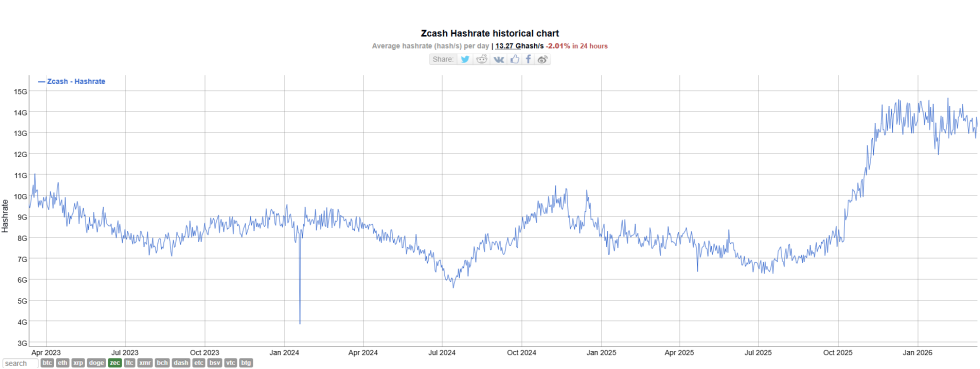
Foundry’s expansion into Zcash does not occur in a vacuum; it arrives amid a profound revitalization of the network’s fundamental metrics. Network hashrate—a measure of the total combined computational power being used to mine and secure a Proof-of-Work blockchain—has experienced a dramatic upward trajectory over recent months.

According to data compiled by BitInfoCharts, the computing power connected to the Zcash blockchain has surged significantly. In October of the previous year, the ZEC hashrate hovered below 8 Gigahashes per second (Ghash/s). In the months since, that figure has climbed steadily, stabilizing above 13 Ghash/s. This sharp increase indicates that miners and institutional stakeholders are increasingly dedicating expensive hardware resources to the network, driven by improving economic prospects, anticipated infrastructure upgrades, and a broader resurgence in alternative layer-1 and privacy-focused assets.
This robust growth in hashrate serves as the foundational justification for Foundry’s strategic pivot. As competition among miners intensifies and the network secures higher levels of decentralization and security, the demand for sophisticated, pooled mining services becomes paramount.
Industry Reactions and Official Endorsements
The announcement has garnered widespread support from key stakeholders across the cryptocurrency industry, particularly from organizations dedicated to the development and promotion of the Zcash protocol.
Zooko Wilcox, founder of Zcash and Chief Product Officer at Shielded Labs—an independent Swiss-based support organization for the ZEC ecosystem—welcomed the news with considerable enthusiasm. In official statements accompanying the launch, Wilcox praised Foundry’s market position and geographic footprint, highlighting the significance of North America’s largest Bitcoin mining operator extending its operational capabilities to the privacy coin sector.
"We at Shielded Labs are delighted that Foundry—the largest Bitcoin mining pool, and one based in North America—is launching an enterprise-grade Zcash mining pool," Wilcox remarked. The endorsement underscores the collaborative effort between core protocol advocates and enterprise infrastructure providers to foster a more mature, accessible, and secure environment for institutional participants.
Market Context and Price Action
While the macroeconomic outlook for Zcash mining infrastructure appears robust, the token’s spot market performance reflects the inherent volatility characteristic of the broader digital asset class. At the time of reporting, Zcash (ZEC) is trading around the $209 mark, registering a retracement of more than 11% over the preceding week.
Market analysts point out that this recent downward correction follows a broader period of recovery for the asset, during which ZEC capitalized on renewed interest in privacy narratives and macroeconomic hedging tools. While short-term price fluctuations remain common, long-term industry observers emphasize that foundational developments—such as Foundry’s upcoming institutional-grade mining pool—often carry far greater weight for the asset’s structural maturity than weekly price movements.
Broader Implications for the Digital Asset Ecosystem
Foundry’s entry into the Zcash mining ecosystem carries several critical implications for the cryptocurrency mining industry and the future of privacy coins:
- Legitimization of Privacy Assets: The involvement of a heavyweight infrastructure provider like Foundry lends significant regulatory and operational credibility to Zcash. It demonstrates that tier-one digital asset firms are willing to support privacy-enhancing technologies under compliant frameworks.
- Professionalization of Mining Operations: By introducing institutional-grade tooling, Foundry is expected to streamline operations for publicly listed mining companies and corporate treasuries looking to diversify their mining revenue streams beyond Bitcoin.
- Enhanced Network Security: The anticipated influx of institutional capital and state-of-the-art mining hardware ahead of the April 2026 launch will likely drive the Zcash network hashrate to historic highs, bolstering the blockchain’s overall resilience against potential 51% attacks and ensuring robust decentralization.
As the April 2026 launch date approaches, industry participants will closely monitor Foundry’s rollout, evaluating how corporate-backed infrastructure influences the distribution of hash power and the ongoing adoption of compliant privacy technology on a global scale.