Foundry, the preeminent operator of the world’s largest Bitcoin mining pool by total computational power, has officially announced its strategic expansion into the privacy-centric cryptocurrency sector. The company plans to launch a dedicated, institutional-grade Zcash (ZEC) mining pool in April 2026. This major infrastructure development is designed to address a persistent gap in the Zcash ecosystem, specifically catering to the rigorous compliance, operational security, and scale requirements of institutional entities, publicly traded corporations, and enterprise-level miners.
The announcement marks a significant milestone not only for Foundry—widely recognized as the driving force behind Foundry USA—but also for the broader privacy coin market. By bringing institutional-grade reliability to the Zcash network, Foundry aims to bridge the divide between traditional financial compliance expectations and cutting-edge decentralized privacy technology.
Bridging the Institutional Gap in Zcash Infrastructure
Mining pools are foundational components of proof-of-work (PoW) blockchain networks. By allowing independent miners across the globe to pool their computational power—or hashrate—these collaborative networks significantly increase their statistical probability of successfully mining a block and earning the associated block rewards. While robust mining infrastructure has long existed for major assets like Bitcoin and Ethereum (prior to its transition to proof-of-stake), privacy-focused networks have historically lacked the enterprise-focused support structures required by large-scale institutional participants.
Mike Colyer, Chief Executive Officer of Foundry, emphasized this structural deficiency when announcing the new initiative. "Zcash has matured into an institutional-grade asset, but the mining infrastructure supporting it hasn’t kept pace," Colyer stated. By establishing a robust, US-based mining pool tailored to corporate standards, Foundry seeks to provide the security, transparency, and operational predictability that institutional balance sheets demand.

Understanding Zcash: Technology, Tokenomics, and Compliance
Launched in October 2016, Zcash was developed as a privacy-focused alternative to Bitcoin. While foundational cryptocurrencies like Bitcoin and Ethereum are often labeled as "anonymous," their core ledgers are entirely public. Every transaction detail, including wallet addresses and transferred amounts, is permanently recorded on a transparent ledger accessible to anyone.
Zcash revolutionized this dynamic by implementing advanced zero-knowledge cryptographic proofs (specifically zk-SNARKs). This technology allows transactions to be verified on the blockchain without revealing the sender, receiver, or transaction amount, offering genuine financial privacy by default.
Despite its advanced privacy architecture, Zcash shares deep technical roots with Bitcoin. The protocol was originally built upon Bitcoin’s foundational codebase, resulting in nearly identical tokenomics:
- Supply Cap: Like Bitcoin, Zcash has a strict maximum supply limit of 21 million ZEC.
- Issuance Model: New tokens are minted and introduced into circulation as block rewards paid out to miners who successfully secure the network.
- Halving Schedule: The rate of new token issuance is systematically reduced by half approximately every four years through programmed halving events, ensuring long-term scarcity.
Proponents argue that Zcash represents a vital synthesis between individual financial privacy and regulatory compliance. As outlined in Foundry’s official press release, "By combining strong, cutting-edge privacy technology with transparent blockchain verification, Zcash demonstrates how financial privacy and compliant digital infrastructure can coexist."
Chronology and Industry Reception
The path toward Foundry’s April 2026 launch has been marked by steady developments within both the company’s operational focus and the broader Zcash network.

Over recent years, Foundry established market dominance through Foundry USA, cementing its position as the premier Bitcoin mining pool operating out of North America. However, shifting macroeconomic conditions, energy market fluctuations, and evolving regulatory frameworks prompted leading infrastructure providers to diversify their operational footprints.
Concurrently, the Zcash network has experienced a notable resurgence in computational engagement. Network telemetry from BitInfoCharts illustrates a substantial upward trajectory in Zcash hashrate over the preceding months. In October, the total computing power dedicated to securing the Zcash blockchain hovered below 8 Gigahashes per second (Ghash/s). By early 2026, that figure expanded significantly, stabilizing at over 13 Ghash/s. This surge in network hashrate signaled a growing appetite among miners, setting the stage for Foundry’s enterprise-level intervention.
The initiative has drawn enthusiastic support from key stakeholders within the Zcash ecosystem. Zooko Wilcox, founder of Zcash and Chief Product Officer at Shielded Labs—an independent Swiss-based support organization dedicated to the growth and resilience of ZEC—welcomed the news with strong endorsement.
"We at Shielded Labs are delighted that Foundry—the largest Bitcoin mining pool, and one based in North America—is launching an enterprise-grade Zcash mining pool," Wilcox remarked. The endorsement underscores the cooperative momentum building between established North American blockchain infrastructure providers and privacy-centric development foundations.
Market Context and Price Performance of ZEC
Foundry’s expansion announcement arrives during a period of notable market volatility for the underlying asset. At the time of reporting, Zcash (ZEC) is changing hands at approximately $209, reflecting a retracement of more than 11% over the trailing seven-day period.
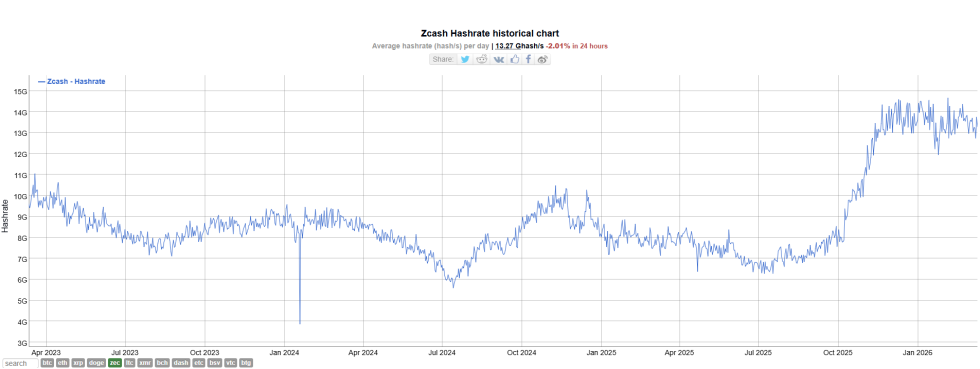
Despite short-term price fluctuations—which are characteristic of the wider digital asset market—industry analysts point out that enterprise investments in network infrastructure are typically driven by long-term fundamental metrics rather than weekly price action. The steady climb in network hashrate, combined with institutional-grade backing from firms like Foundry, suggests sustained confidence in the underlying utility and long-term viability of the protocol.
Broader Implications and Industry Impact
The introduction of an institutional-grade Zcash mining pool by an industry heavyweight like Foundry carries several critical implications for the digital asset landscape:
- Legitimization of Privacy Assets: Institutional participation in privacy-focused protocols helps dispel regulatory stigma. By demonstrating that privacy technology can operate within structured, compliant frameworks, Foundry’s initiative could pave the way for broader institutional adoption of zero-knowledge technologies.
- Geographical Concentration and Security: Operating out of the United States, Foundry’s ZEC pool will offer North American institutional miners a localized, highly reliable avenue for participation. This geographic distribution enhances the decentralization and resilience of the global Zcash hash rate.
- Template for Future Mining Expansion: As public companies and institutional funds seek diversified exposure beyond Bitcoin and Ethereum, the successful integration of enterprise mining infrastructure for alternative Layer-1 and privacy networks could serve as a blueprint for future industry expansions.
As the April 2026 launch date approaches, industry observers will closely monitor how Foundry integrates institutional compliance standards with the complex cryptographic requirements of zero-knowledge privacy coins.