
Foundry, a premier digital asset infrastructure company and the operator of the world’s largest Bitcoin mining pool by total hashrate, has officially announced its strategic expansion into the privacy-centric cryptocurrency sector. Scheduled for an April 2026 rollout, the firm will launch a dedicated, institutional-grade Zcash (ZEC) mining pool. This development aims to bridge a critical infrastructure deficit for public companies and institutional entities looking to participate in advanced proof-of-work privacy networks.
The initiative marks a significant milestone not only for Foundry’s portfolio diversification but also for the broader maturation of privacy-preserving digital assets within institutional finance. By leveraging its established operational expertise in North America, Foundry seeks to provide a compliant, highly secure, and reliable mining environment tailored specifically to meet the stringent operational demands of enterprise-level participants.
Main Facts and Operational Structure
The upcoming Zcash mining pool will operate primarily out of the United States, replicating the geographic and regulatory focus that propelled the Foundry USA Bitcoin mining pool to industry dominance. A mining pool functions as a collaborative network where independent miners spread across the globe combine their computational power—known as hashrate—to solve cryptographic puzzles more efficiently. By aggregating these resources, participants significantly smooth out the variance in finding blocks, ensuring a more predictable and steady stream of block rewards relative to their individual contributions.
For Zcash, the introduction of an institutional-grade pool addresses long-standing vulnerabilities associated with fragmented or smaller-scale mining infrastructure. Historically, institutional entities have faced hurdles regarding compliance, reporting transparency, and enterprise-grade security when attempting to allocate capital toward proof-of-work privacy coins. Foundry’s entry into the ecosystem is expected to professionalize ZEC mining operations, bringing institutional accountability and robust technical frameworks to a network traditionally driven by decentralized, smaller-scale hobbyists and independent operators.

Background Context: The Evolution of Zcash and Privacy Technology
Launched in October 2016, Zcash was created as a decentralized, open-source cryptocurrency rooted in Bitcoin’s foundational codebase. While major cryptocurrencies like Bitcoin and Ethereum offer pseudonymity—meaning transactions are recorded on a public ledger tied to public addresses rather than legal identities—they lack native financial confidentiality. Every transaction amount, sender, and recipient address remains completely transparent and traceable by anyone analyzing the blockchain.
Zcash introduced groundbreaking cryptographic architecture, specifically Zero-Knowledge Succinct Non-Interactive Arguments of Knowledge (zk-SNARKs), allowing users to execute fully shielded transactions. This technology enables the network to verify the validity of transactions without revealing sensitive metadata such as the sender, recipient, or transaction value.
Despite its technological sophistication, Zcash shares foundational economic mechanics with Bitcoin. It operates on a proof-of-work consensus mechanism, enforces a hard supply cap of 21 million coins, and incorporates a halving schedule that reduces block rewards roughly every four years. These similarities have made Zcash an attractive asset for portfolio managers seeking Bitcoin-like scarcity combined with advanced financial privacy. However, the ecosystem has frequently struggled to attract institutional capital due to a perceived lack of institutional-grade infrastructure, compliance tooling, and large-scale mining support.
Chronology of Events and Network Growth
The decision by Foundry to expand into Zcash does not occur in a vacuum; it follows a notable resurgence in the network’s fundamental metrics over recent quarters.
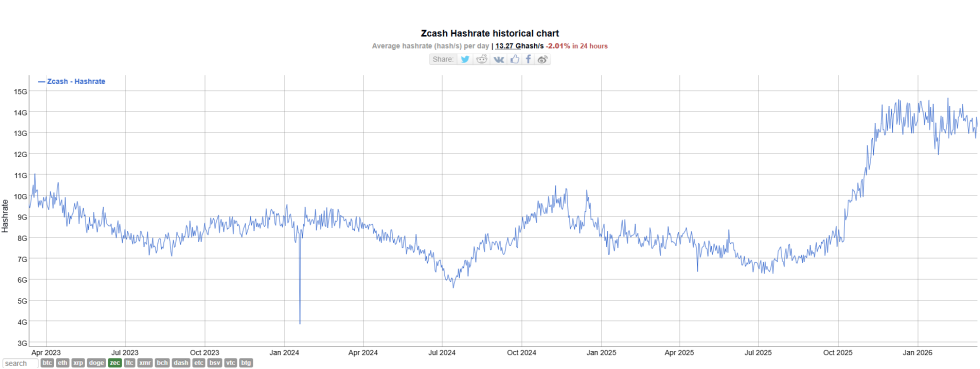
Over the past three years, the Zcash network has experienced shifting dynamics in computational security and market participation. However, recent months have marked a definitive turning point for the blockchain’s underlying security. Data from BitInfoCharts illustrates a substantial upward trajectory in network hashrate. In October of the preceding year, the aggregate computing power securing the Zcash blockchain hovered below 8 Ghash/s. In the months leading up to Foundry’s announcement, that figure climbed aggressively, stabilizing at over 13 Ghash/s.

This dramatic increase in hashrate signals renewed miner confidence, improved hardware efficiency, and heightened interest in the asset’s long-term viability. Foundry’s announcement to launch an enterprise-grade pool in April 2026 capitalizes directly on this organic growth momentum, positioning the company to capture newly energized institutional demand just as network participation scales upward.
Official Responses and Industry Reactions
The announcement has garnered enthusiastic endorsement from key stakeholders within the Zcash ecosystem, particularly organizations dedicated to the protocol’s development and long-term sustainability.
Mike Colyer, Chief Executive Officer of Foundry, emphasized the strategic necessity of the expansion, pointing directly to the structural disconnect between Zcash’s market maturity and its supporting infrastructure. "Zcash has matured into an institutional-grade asset, but the mining infrastructure supporting it hasn’t kept pace," Colyer stated in the official press release. By deploying institutional-grade resources, Foundry intends to rectify this imbalance, providing the necessary operational backbone for corporate miners.
Zooko Wilcox, founder of Zcash and current Chief Product Officer at Shielded Labs—an independent support organization for ZEC based in Switzerland—welcomed the news with strong affirmation. "We at Shielded Labs are delighted that Foundry—the largest Bitcoin mining pool, and one based in North America—is launching an enterprise-grade Zcash mining pool," Wilcox remarked. The endorsement from a core architect of the protocol underscores the perceived legitimacy and strategic value that a North American industry leader brings to a privacy-focused network.
Broader Impact, Market Implications, and Financial Context
The macroeconomic and regulatory implications of Foundry’s upcoming ZEC mining pool extend far beyond simple hashrate aggregation. For years, regulatory scrutiny surrounding privacy coins has created friction for institutional adoption. Cryptocurrencies featuring advanced privacy controls have occasionally faced delistings or restrictive measures from centralized exchanges operating under stringent anti-money laundering (AML) and know-your-customer (KYC) frameworks.
However, Zcash represents a unique intersection within the digital asset landscape: it offers strong privacy technology while maintaining transparent, auditable blockchain verification metrics. The network demonstrates that robust financial privacy and compliant digital infrastructure can successfully coexist. By housing its ZEC operations within a structured, US-based institutional framework, Foundry is signaling to regulators and corporate entities that privacy-preserving mining can be conducted transparently, securely, and within established compliance boundaries.
At the time of this report, market conditions for the underlying asset reflect standard crypto market volatility. Zcash (ZEC) has been trading around the $209 threshold, experiencing a downward correction of over 11% over the preceding week as broader digital asset markets retrace portions of their prior recovery phases. Despite short-term price fluctuations, infrastructure investments of this magnitude are historically viewed by long-term analysts as foundational indicators of structural maturation.
As the April 2026 launch date approaches, industry observers will closely monitor how Foundry’s institutional-grade pool influences miner distribution, network security, and corporate participation in the privacy coin sector. By bridging the gap between traditional enterprise requirements and cutting-edge cryptographic privacy, Foundry’s upcoming venture could serve as a blueprint for how privacy-centric blockchain networks integrate into the mainstream institutional economy.