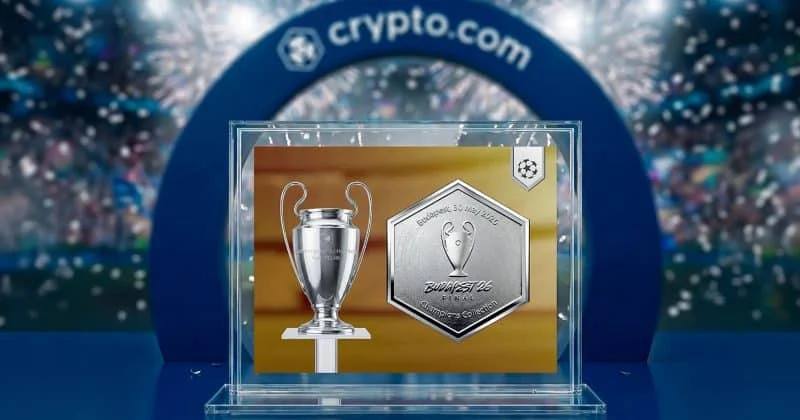
In a groundbreaking convergence of traditional sports memorabilia and decentralized ledger technology, Crypto.com, the Singapore-based digital asset exchange and exclusive global partner of the UEFA Champions League, has announced a first-of-its-kind activation for the 2026 UEFA Champions League Final in Budapest. The initiative, executed in partnership with Fanatics Collectibles—the parent company of the iconic Topps brand—seeks to bridge the gap between physical sports history and the digital economy by tokenizing the official match coin used in the opening ceremony of Europe’s most prestigious club football competition.
This collaboration represents a significant evolution in fan engagement, transforming a fleeting, ritualistic moment of the game into a permanent, tradeable, and verifiable asset. By embedding the physical coin used during the referee’s opening toss into a one-of-one premium Topps Now "Relic" trading card, the organizers are creating a hybrid collectible that bridges the interests of physical trading card hobbyists and the burgeoning digital asset market.
The Mechanics of the Activation
The core of this activation centers on the official coin used at the Puskás Aréna in Budapest to decide possession and side for the 2026 UEFA Champions League Final. Prior to the match, the coin was delivered to the pitch in a high-tech display, flown into the stadium via drone and unveiled by UEFA ambassador and former English international Ashley Cole. Following the ceremonial toss by the match referee, the coin was secured for its transformation into a collector’s item.
The physical coin will be encased within a bespoke Topps Now "Relic" card, a premium format that traditionally features pieces of match-worn jerseys or other game-used artifacts. For this specific release, the card will be authenticated and tracked on the Cronos blockchain. The distribution process is designed to gamify the experience: fans who purchase the corresponding base Topps Now trading card through the company’s official website in the immediate aftermath of the final will be entered into a drawing. One lucky collector, selected at random from the pool of purchasers, will be awarded the unique one-of-one Relic card containing the historic match coin.
Chronology of the 2026 Final Integration
The integration of this asset into the blockchain ecosystem involves several distinct phases:
- Pre-Match Preparation: The official Match Coin is minted and prepared for the Budapest final, with its digital twin established on the Cronos blockchain to ensure transparent provenance.
- The Delivery: Utilizing drone technology, the coin makes its high-profile entrance into the Puskás Aréna, underscored by the presence of football legend Ashley Cole.
- The Ceremonial Toss: The coin serves its traditional purpose in the heart of the Champions League Final, marking the official start of the match.
- Post-Match Processing: Following the final whistle, the coin is recovered, verified, and encapsulated within the one-of-one Topps Now Relic card.
- Distribution Phase: Topps releases the standard base cards on its platform. Fans who purchase these cards are entered into a sweepstakes to determine the final owner of the unique Relic.
- Digital Rights Activation: The eventual owner of the card gains access to a suite of digital rights and exclusive experiences for the upcoming 2026/27 football season.
Bridging Two Worlds: The Strategy Behind the Partnership
Nicholas Christ, Global Head of Sponsorships at Crypto.com, emphasized that the collaboration is not merely a marketing gimmick but a strategic attempt to unify disparate fan bases. "By tokenizing the physical coin, we are uniting two groups of sports fans—those who collect NFTs and those who collect physical trading cards," Christ stated. "We are proving how this real-world tokenization use case can ultimately become an investment asset on the blockchain, providing long-term utility that goes beyond the static nature of traditional memorabilia."
This initiative reflects a broader trend in the sports industry: the transition from passive consumption to active ownership. By layering digital access onto a physical asset, Crypto.com and Fanatics are attempting to move beyond the "speculative" label often associated with early-stage NFTs, pivoting instead toward "utility-backed" assets.
Unlocking Exclusive Fan Experiences
Beyond the value of the card as a physical collectible, the tokenization on the Cronos blockchain provides the owner with tangible, real-world utility throughout the 2026/27 season. The ownership rights attached to the asset include:
- UEFA Super Cup Access: The owner receives tickets to the UEFA Super Cup Final, one of the most exclusive events in the European football calendar.
- League Phase Pass: A comprehensive pass allowing the owner to attend a selected club’s matches during the league phase of the Champions League.
- Ceremonial Participation: A unique opportunity for the owner to participate in the pre-match delivery of the Match Coin before the selected club’s opening fixture of the season.
These perks are designed to ensure that the asset maintains a high level of engagement and value for the owner, far beyond the initial excitement of the final match itself.
Supporting Data and Market Context
The sports memorabilia market has undergone a significant transformation over the past five years. According to industry data, the global sports trading card market is projected to reach several billion dollars in valuation by the end of the decade, bolstered by a resurgence in interest from millennial and Gen Z investors. Simultaneously, the integration of blockchain technology into this market has sought to solve the perennial problems of provenance and authentication.
Cronos, the blockchain utilized for this activation, serves as an Ethereum-compatible sidechain that focuses on scaling and speed. By anchoring the Match Coin to this chain, the organizers ensure that the card’s history is immutable, preventing the forgery that often plagues the physical secondary market.
Fact-Based Analysis of Broader Implications
The collaboration between a major digital asset exchange and a powerhouse like Fanatics Collectibles signals a maturing of the "Web3" sports sector. Following the peak of the NFT hype cycle in 2021, many sports-based digital projects faced criticism for lacking long-term utility. This activation demonstrates a shift toward "phygital" (physical plus digital) assets, where the value is anchored in a verifiable physical object while the logistics of ownership are handled by the blockchain.
1. Increased Institutional Trust: By partnering with an established brand like Topps, Crypto.com is signaling a move toward legitimacy. Integrating with a company that has existed since 1938 helps normalize the use of blockchain technology for the average football fan, who may be skeptical of purely digital assets.
2. Provenance and Security: The use of blockchain to track the Match Coin mitigates the risk of "card doctoring" or counterfeit relics. Because the coin’s movement is recorded on the Cronos ledger from the moment it is used in the stadium, the buyer has a transparent, indisputable chain of custody.
3. The Gamification of Loyalty: The sweepstakes model used to distribute the card incentivizes broader participation. By requiring fans to purchase a base card to enter the draw, the companies are creating a multi-tiered fan experience: those who simply want a collectible card get the base product, while those seeking the high-value, utility-heavy relic participate in a digital lottery.
Future Outlook
The success of this activation will likely serve as a blueprint for future sports-tech partnerships. As clubs and leagues look for ways to deepen relationships with global fan bases that may never attend a match in person, the ability to offer digital ownership of real-world stadium artifacts becomes a powerful tool.
The 2026 UEFA Champions League Final in Budapest will be remembered not only for the tactical masterclasses on the pitch but also as the moment when the physical coin toss became a programmable, blockchain-tracked asset. Whether this model can be scaled remains to be seen, but the clear alignment between the physical legacy of Topps and the digital infrastructure of Crypto.com provides a compelling look at the future of sports fandom. As the industry continues to integrate, the distinction between a "physical collector" and a "digital asset holder" is likely to fade, replaced by a new class of fan who values both the history of the game and the transparency of the technology that records it.