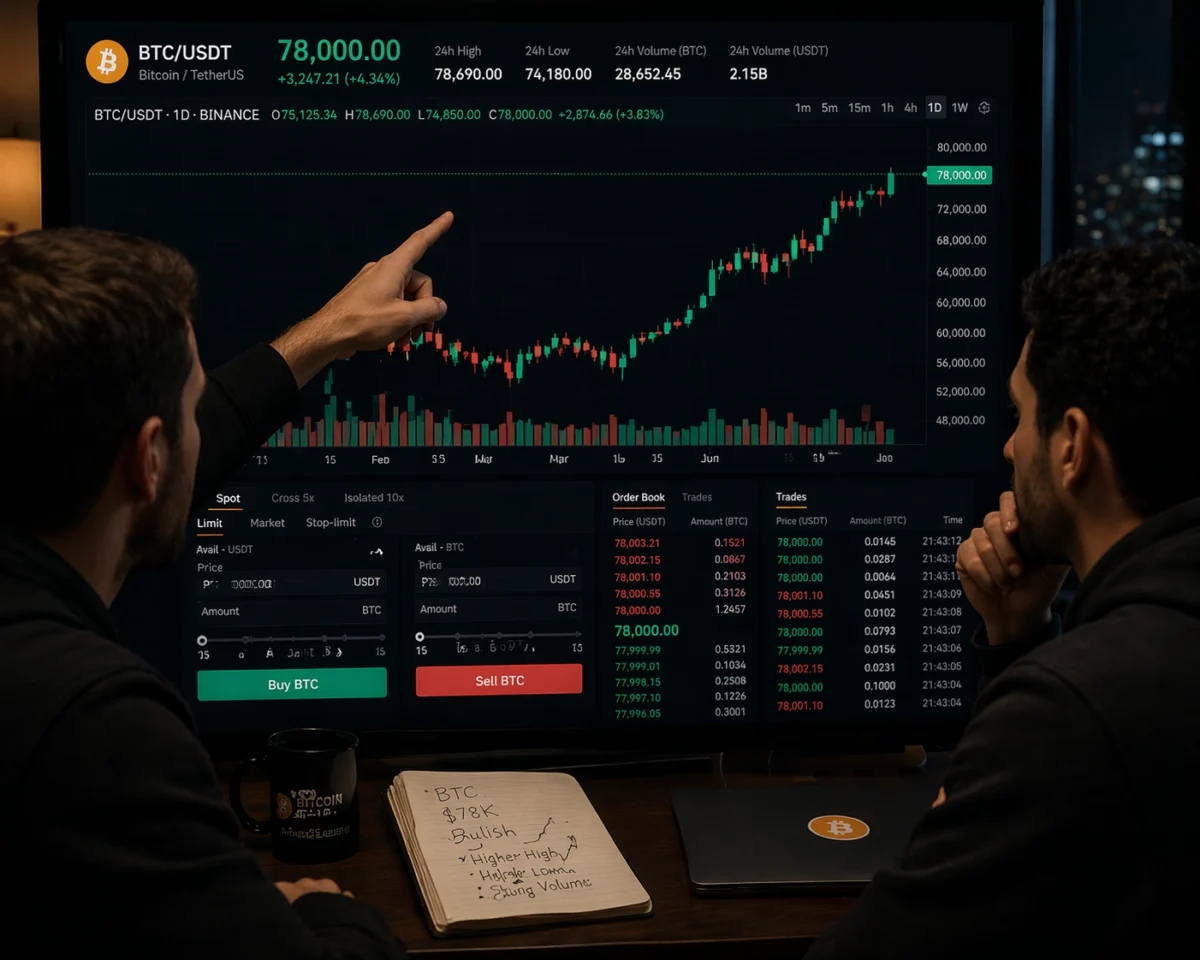
Bitcoin (BTC) continued its upward trajectory on Wednesday, surging past the $78,000 threshold following a week of high-intensity market activity that saw the world’s largest cryptocurrency gain 6% in value. As of mid-day trading, the asset reached a peak of $78,452, marking its highest price point since early February. This bullish momentum is being attributed to a confluence of geopolitical stability in the Middle East and a significant shift in U.S. fiscal policy, specifically a massive debt buyback program initiated by the U.S. Treasury. While institutional demand via spot Exchange Traded Funds (ETFs) showed a temporary cooling period on Tuesday, the broader market remains optimistic that a combination of increased global liquidity and de-escalating international tensions will provide the necessary foundation for Bitcoin to challenge the psychological $80,000 barrier.
Geopolitical De-escalation: The Trump-Pakistan-Iran Factor
The primary catalyst for the mid-week rally was an unexpected diplomatic breakthrough involving the United States, Pakistan, and Iran. Late Tuesday, U.S. President Donald Trump announced an extension of the existing two-week ceasefire, which had originally been slated to expire on April 22, 2026. The extension came at the direct request of the Pakistani government, which has been acting as a primary intermediary between Washington and Tehran.
The extension is intended to provide a diplomatic window for the United States to receive and review a unified proposal from the Iranian leadership regarding regional security and nuclear protocols. Although President Trump maintained a firm stance, clarifying that the U.S. naval blockade of Iranian seaports would remain in effect until a permanent agreement is reached, the market reacted to the "absence of escalation" with a broad risk-on rally.
For Bitcoin, which has increasingly become a barometer for global geopolitical risk, the extension signaled a move away from immediate kinetic conflict. Investors who had previously hedged into stablecoins or moved to the sidelines returned to the market, driving BTC to its highest levels in over two months. The news triggered a wave of liquidations for short-sellers, further accelerating the price climb as the $78,000 resistance level was breached with significant volume.
US Treasury Buybacks and the Liquidity Influx
Parallel to the geopolitical developments, the U.S. Treasury Department has introduced a fiscal maneuver that is providing a secondary tailwind for digital assets. The Treasury is poised to execute a $15 billion buyback of its own debt this week, a move that matches the largest buyback in the nation’s history.
Debt buybacks are a strategic tool used by the Treasury to improve market liquidity and manage the maturity profile of outstanding government debt. By purchasing older, less liquid bonds from the private sector, the Treasury injects cash directly into the financial system. This influx of capital often finds its way into "risk assets," including equities and cryptocurrencies.
Market analysts note that Bitcoin is a highly liquidity-sensitive asset. Historically, periods of expanding central bank balance sheets or aggressive Treasury buybacks have correlated with significant price appreciation for BTC. As the $15 billion enters the ecosystem, it reduces the "liquidity premium" on cash, encouraging investors to seek higher returns in alternative stores of value. This specific buyback is seen as a crucial support mechanism that could prevent a deep correction even if geopolitical tensions resurface.
Analyzing the Institutional Shift: ETF Inflow Discrepancy
Despite the positive price action, data from the institutional sector provided a more nuanced picture. On Tuesday, Bitcoin spot ETFs recorded a modest net inflow of $11.84 million. While this remains positive, it represents a sharp decline from the $238.37 million in inflows recorded just 24 hours prior.

This deceleration suggests that while retail and algorithmic traders are aggressively buying the ceasefire news, institutional fund managers are adopting a "wait-and-see" approach. The discrepancy highlights a lingering caution among large-scale investors regarding the long-term viability of the current peace talks. If the unified proposal from Tehran fails to meet Washington’s expectations, the market could see a rapid reversal of the current risk-on sentiment.
However, the fact that inflows remained positive despite the price nearing all-time highs suggests a "buy-the-dip" mentality is still prevalent among institutional clients. If ETF demand scales back up to the $200 million-plus range in the coming days, analysts believe the momentum could be sufficient to push Bitcoin toward the $82,000 range.
Technical Outlook: Support and Resistance Levels
From a technical perspective, Bitcoin’s 4-hour chart displays a strongly bullish configuration. The asset is currently trading well above its key moving averages, which often serve as dynamic support during uptrends.
- Moving Averages: Bitcoin is holding above the 50-day Exponential Moving Average (EMA) at $72,345 and the 100-day EMA at $75,368. The widening gap between these averages and the current price indicates strong trend strength.
- Momentum Indicators: Both the Relative Strength Index (RSI) and the Moving Average Convergence Divergence (MACD) are in constructive territory. The RSI is trending upward but has not yet reached the "overbought" threshold of 70, suggesting there is still room for growth before a technical exhaustion occurs.
- Resistance: The immediate hurdle for bulls is the 50% Fibonacci retracement level located near $78,962. Beyond that lies the major psychological resistance of $80,000. If Bitcoin can clear $80,000 with high volume, the next major target is the 200-day EMA at $82,769.
- Support: In the event of a pullback, the first line of defense is the prior channel top at $75,680. Deeper support is found at the 100-day EMA ($75,368) and the 38.2% Fibonacci level at $74,487. A catastrophic break below $70,000 would be required to shift the mid-term outlook to bearish, with the lower channel boundary currently sitting near $62,950.
Chronology of the Weekly Rally
The current rally is the result of a sequence of events that began over the weekend:
- Sunday, April 19: Bitcoin trades sideways near $73,000 as markets await news on the expiring ceasefire.
- Monday, April 20: Institutional inflows surge to $238 million on rumors of a Treasury buyback plan, pushing BTC to $75,000.
- Tuesday, April 21: The U.S. Treasury confirms the $15 billion buyback. Late in the evening, President Trump announces the ceasefire extension at Pakistan’s behest. BTC breaks $77,000.
- Wednesday, April 22: Bitcoin hits a multi-month high of $78,452 as Asian and European markets react to the news of continued diplomatic talks.
Broader Implications and Market Sentiment
The current price action of Bitcoin is increasingly reflective of its maturing role within the global financial architecture. No longer viewed solely as a speculative asset, BTC is being integrated into broader macro-economic strategies. The correlation between Bitcoin and Treasury liquidity suggests that investors are viewing the digital asset as a hedge against the potential devaluation of fiat currency resulting from massive government debt management.
Furthermore, the diplomatic role played by Pakistan highlights the changing nature of international relations and its impact on digital markets. As non-Western powers take a more active role in mediating conflicts involving the U.S., the volatility of "geopolitical risk" is being re-priced. For Bitcoin holders, the move toward a multi-polar diplomatic effort generally provides a more stable environment for asset growth compared to unilateral military posturing.
As the week progresses, the market’s focus will remain on two key areas: the specific details of the Iranian proposal and the actual implementation of the Treasury’s $15 billion liquidity injection. If the proposal is viewed as a legitimate step toward peace, and the liquidity flows seamlessly into the banking sector, the "bullish bias" for Bitcoin is likely to persist. Traders are now looking toward the end of the month, with many speculating that April 2026 could be the month Bitcoin finally establishes a permanent foothold above the $80,000 mark, fundamentally shifting the price floor for the remainder of the year.
While the "US blockade" remains a significant point of friction, the market’s current preference for "peaceful uncertainty" over "certain conflict" is the engine driving this rally. As long as the lines of communication remain open between Washington and Tehran, and the U.S. Treasury continues to support market liquidity, the path of least resistance for Bitcoin appears to be upward.